

“The world sees you through your eyes only.”
This is the realization Sudha Chandani Khatri arrived at as a teenager, staring at her very first portrait, the moment everything about how she saw herself changed.
It sounds like a throwaway line until you sit with it. Most of us wait for someone else to confirm we look good before we believe it. Sudha didn’t wait, she photographed her way into believing it herself, and then spent the next two decades building a business that hands that same belief to other women, one sitting at a time.
At Decoding Draupadi, we aim to push forward more female voices and share stories of SUPER women who are rewriting their stories.
Sudha Chandani Khatri is the founder of Portraits by Sudha, a portrait photography studio built around what she calls an outcome-based model, where clients pay only for the photographs they actually choose to keep. A former Six Sigma black belt engineer who started her career at Satyam, she spent close to a decade running the wedding photography studio Pixel Story with her husband, and the two were counted among the top ten wedding photographers in Bangalore. She eventually left weddings entirely to shoot vogue-style portraits of everyday women, from women in their twenties to women in their nineties, across every complexion and body type. Portraits by Sudha now runs on the same principles that built her wedding business, and her stated goal is to help 100 women start their own photography studios. We sat down to talk about the Six Sigma thinking behind her outcome-based pricing model, why she believes AI will never replace what she does, and what it actually takes to get a woman who has never faced a camera to fully let go in front of one.
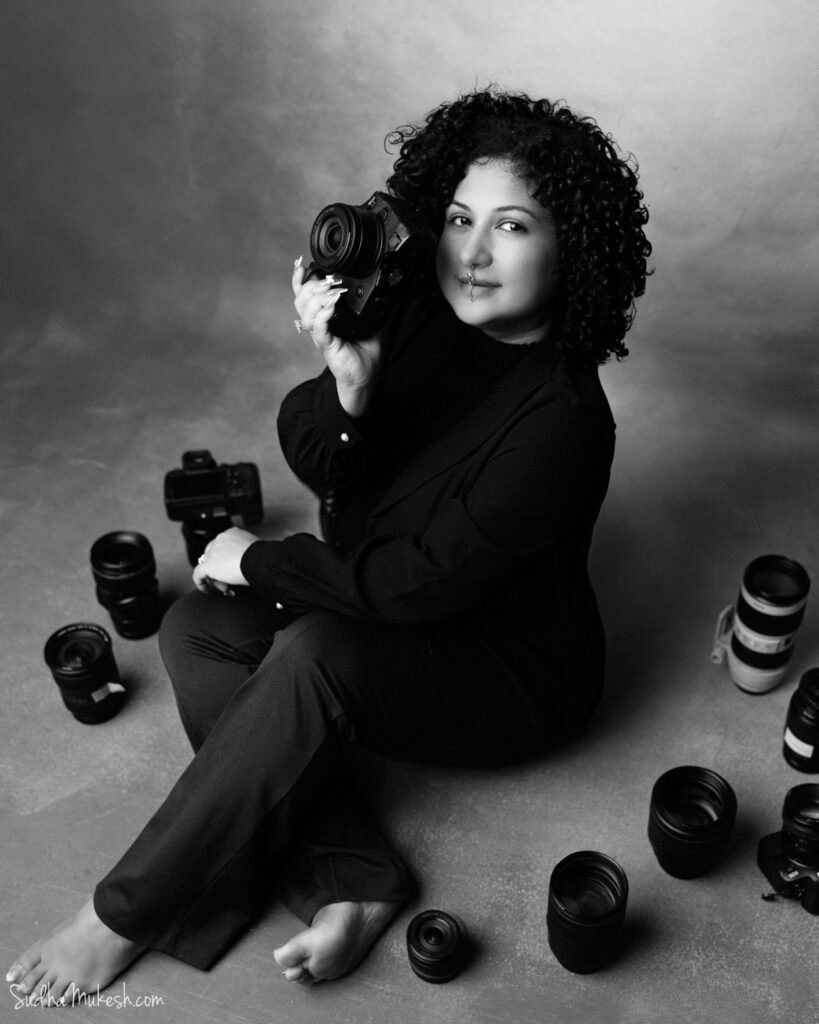
Here are our key takeaways from our chat:
One photograph can hand a woman back a version of herself she didn’t know existed.
At sixteen, Sudha told her mother she wasn’t pretty. Her mother didn’t argue. She simply booked her a portrait shoot with the best photographer in town. Sudha lied to the photographer about why she wanted it, claiming she needed a modelling portfolio, because admitting she just wanted to feel beautiful felt too exposed to say out loud. When the photographs came back, she went into shock, then smiled, then laughed, then cried loudly in the studio.
That reaction wasn’t vanity, it was recognition. She was seeing proof of something she had always suspected about herself but had never been shown. A photograph, in that sense, isn’t decoration, it’s evidence. And evidence is a far more durable foundation for self-worth than a compliment ever is, because nobody can talk you out of something you’ve already seen with your own eyes.
Confidence behaves less like a fixed trait and more like a habit you repeat until it becomes true.
For years, portraits sat everywhere, on a bedroom wall, on a work laptop as a slideshow, on a phone’s memory card that kept filling up. Waking up to them and saying “hello gorgeous” wasn’t performance, it was a daily rehearsal. That rehearsal is what set the tone for the rest of the day, over and over, until it stopped being an affirmation and started being a fact.
The habit was tested hardest after childbirth, when a changed body brought back old doubts about being pretty enough. The way out wasn’t a pep talk, it was logic: every woman who had ever sat for a portrait, at every age, weight, and complexion, had been found beautiful through the same lens. If that was true for all of them, it had to be true on the other side of the camera too. Research on self-image backs this instinct up, self-perception shapes both mental health and how confidently a person shows up in the world, which is a fairly precise description of what happened in that studio, twice.
Every woman who walks in unsure of the camera walks out having renegotiated how she sees herself.
The first forty-five minutes of any shoot are spent doing nothing that looks like photography at all. Clients are told plainly that there is no pressure on them to perform, because they aren’t professional models, the responsibility to make them look good belongs entirely to the person behind the camera. Every woman who walks into the studio is treated as though she were Priyanka Chopra, styled, directed, and photographed like it’s a given that she’ll look extraordinary, because it is.
Decoding Draupadi has heard some version of this before from other women we’ve spoken to, but what stands out here is how concretely it plays out. Clients have walked out of that studio and started businesses they’d only ever considered privately. Others became influencers with followings in the millions. A seventy-year-old client walked in wanting a portfolio to try acting, and has since booked advertisements and a film role. The photograph is rarely the end point, it’s the permission slip.
A business built only on what you enjoy doing tends to outlast one built only on what earns money.
Before any of this, Sudha was a Six Sigma black belt, the kind of consultant whose entire discipline is built on removing waste and centering the customer. When it came time to design her portrait business, she applied the same rigor to her own career: she sorted a decade of wedding photography into what she loved and what she tolerated, then deliberately built her new studio around the first list and stripped out the second. Tight deadlines, anxious clients hunting for one missing photo among thousands, requests to alter how someone looked, all of it was designed out from the start.
What replaced it was an outcome-based model: clients only pay for the specific photographs they choose after the shoot, not for a fixed package that leaves them stuck with images they never wanted. It removes the awkwardness of asking for changes, because nobody has to justify a rejection, they simply don’t select that frame. It’s a pricing structure built on statistics and customer behavior rather than instinct alone, and it happens to be the reason neither she nor her clients end a shoot feeling shortchanged.
Consistency, not perfection, is what actually turns a hobby into a body of work.
The advice for any woman thinking about starting a portrait studio is blunt: be fearless, be shameless, stop judging yourself, and pick up the camera. Self-diagnosed procrastination was managed not through willpower but through public accountability, a Facebook post promising twenty portrait sessions in twenty days, posted before there was any plan for how to deliver on it. Within half an hour, the post had a hundred responses.
Those fifteen days were genuinely stressful, stressful enough to cause fevers before certain shoots. But they worked, because the commitment had already been made publicly and there was no version of backing out. The hundredth photograph in that process looked nothing like the first, not because talent arrived overnight, but because showing up did. Anyone waiting to feel ready before starting is optimizing for the wrong thing entirely.
AI can shorten a workflow, but it cannot manufacture the feeling of being genuinely seen by another person.
AI has made editing and post-production dramatically faster, work that once took hours now takes minutes, and there’s no resistance to that shift. But roughly five percent of what happens in a portrait studio is the photography itself. The other ninety-five percent is how a woman feels walking out, and that isn’t something software can currently replicate. A recent trend where thousands of women generated near-identical AI portraits of themselves in the same saree made the point unintentionally: the images were pretty, but nobody cried looking at them, because nobody had actually been seen.
Decoding Draupadi hears this anxiety constantly from creative women worried that AI is coming for their work, and the more useful framing is one the wider industry is already landing on: photography rooted in human connection and emotional intelligence is proving far more resilient than the routine, generic kind. AI is an assistant that clears the boring parts out of the way. It was never going to be the one making a client feel like the most beautiful version of herself, because that was never the technical part of the job.
What comes through across this conversation isn’t really about photography at all, it’s about the gap between how a woman actually looks and how she believes she looks, and how much of her life gets shaped by that gap without her ever noticing it. Sudha has spent two decades closing it, one studio session at a time, and she’s not close to done.
Until next time
Team Decoding Draupadi