
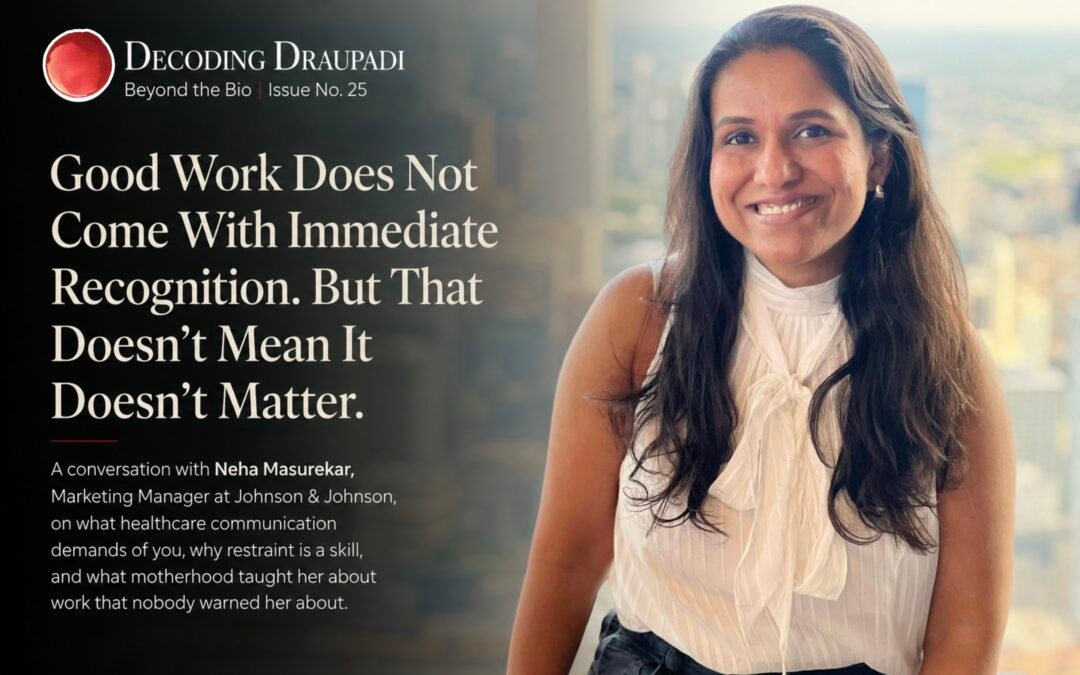
A conversation with Neha Masurekar, Marketing Manager at Johnson & Johnson, on what healthcare communication demands of you, why restraint is a skill, and what motherhood taught her about work that nobody warned her about.
Neha Masurekar works in surgical sutures. On paper, that sounds technical and distant. But spend five minutes with how she thinks about her work, and you realise it is one of the most human jobs in marketing: she is part of the chain of decisions that ends with a patient she will never meet.
She has eleven years in healthcare marketing, is three months back from maternity leave, and is one of the most honest people we have had in this series about what it actually costs to show up well, and what it looks like when you stop needing someone else to tell you that you did.
Layered. And Slightly Sleep-Deprived.
Who is Neha right now, across the different lives she is living?
Right now, Neha is layered. And slightly sleep-deprived on most days.
At work, I’m quite structured. I like things to make sense, I like clarity, and I probably spend more time than necessary trying to get a message exactly right. A lot of my job is translating: science into something usable, technical into something human.
At home, I’m a new mom, which has been the fastest way to unlearn control. You can have a perfect plan for the day and then one missed nap rewrites everything. Recently, my nanny was on leave for a month, which basically meant my calendar and my baby were in a quiet power struggle. The baby won. Which I’m fast realising is becoming the norm.
Somewhere in between those two versions, I’m still figuring out how to be just myself again. Not only in the roles I play, but outside of them too. I do enjoy being by myself, but pockets of alone time are rare these days.
“I’m still figuring out how to be just myself again. Not only in the roles I play, but outside of them too.”
I laughed out loud at the calendar-versus-baby power struggle. But there is something genuinely useful in how she frames it: that becoming a mother has been the fastest way to unlearn control. That is not a small thing to happen to someone who describes herself as structured, precise, someone who spends more time than necessary getting a message exactly right. It rewires you. And she is still in the middle of it.

Somewhere at the End of That Chain Is a Patient You’ll Never Meet
What does it mean to communicate something that people may actually rely on in their real lives?
Working in healthcare changes your relationship with communication very quickly.
I started my career in pharmaceutical marketing, and now I work in the medtech space, specifically in wound closure and surgical sutures. On paper, sutures can sound like a very technical, almost invisible part of surgery. But when you spend enough time around surgeons and operating room conversations, you realise how much trust sits in those tiny decisions.
That changes how you think as a marketer. You stop seeing communication as just visibility or persuasion. You start seeing it as something that people may actually carry into a real clinical setting. A surgeon may rely on the information you’ve shared while making decisions in the middle of a procedure. And somewhere at the end of that chain is a patient you’ll never meet.
I underwent a C-section last year, and those tiny decisions made by my gynaecologist will continue to have a long-lasting impact on my life. That awareness has stayed with me.
This is why healthcare marketing is very different from other industries. Nuance matters. You can’t oversimplify something just because it sounds catchy. Claims must fully hold up in practice. And healthcare practitioners can tell very quickly when something is superficial or overly polished. So you learn to respect the intelligence of your audience instead of trying to out-market them.
“Somewhere at the end of that chain is a patient you’ll never meet.”
The C-section detail is the one that reframes everything. She is not just describing an abstract responsibility. She has been on the other end of it. She has been the patient whose surgeon made tiny decisions in a procedure, and those decisions continue to matter to her body. That is not a case study. That is lived understanding. It changes the weight of the work completely.
Restraint Is a Skill
What has working in healthcare taught you about what marketing should be careful about?
That not everything needs to be amplified.
In most industries, you’re encouraged to sharpen the message, make it stronger, more memorable. In healthcare, if you push too far, you risk crossing into overstatement. I’ve become a lot more aware of that line.
It’s a lot more regulated, so you naturally learn to pay attention to specifics and details. And honestly, it’s made me more comfortable with restraint. Over time I’ve come to appreciate honest, quiet communication, even when it’s not flashy.
“Over time I’ve come to appreciate honest, quiet communication. Even when it’s not flashy.”
Restraint as a skill is something this series keeps returning to in different forms. Divyankshi said knowing what a brand won’t do is as important as knowing what it will. Ajita talked about resonance over reach. Neha is making the same argument from inside a regulated industry where the line is enforced externally, but she has internalised it. The discipline is the same. The stakes are just higher here.

This Work Doesn’t End at the Campaign
How do you stay connected to the meaning of your work when the results are not immediately visible?
You have to zoom out intentionally.
Day-to-day work can feel very operational: timelines, reviews, revisions. Especially when you’ve just come back from a break and you’re finding your rhythm again. I restarted work about three months ago, so there are still days where I’m toggling between strategy decks and baby schedules and wondering which one is more unpredictable. Some days are hard, when you’re surviving on next to no sleep and a cranky infant.
But then I remind myself: this work doesn’t end at the campaign. It ends in a real setting, with real people, impacting lives. That connection isn’t always visible, but it’s there.
And becoming a parent makes that harder to ignore. You start seeing healthcare less as an industry and more as something you might depend on at any point. I’m highly conscious and intentional with every small decision I make for my baby, right from which body wash to use to which fabric detergent is safest. So the realisation that patients depend on our products for life-saving surgeries has only deepened post motherhood.
“This work doesn’t end at the campaign. It ends in a real setting, with real people, impacting lives.”
Toggling between strategy decks and baby schedules while wondering which one is more unpredictable: I felt that. And the thing she is doing here, the intentional zoom out, is a muscle most people do not know they need until the day-to-day starts to feel purely operational. She has found her anchor. It is not a metric. It is a patient she will never meet, and a baby she is figuring out every day.
Did I Think This Through Properly? That’s Usually Enough.
When there is no external validation, how do you know you are doing good work?
I’ve lowered the need for constant feedback. Which, at the risk of sounding repetitive, motherhood has taught me. Good work does not come with immediate recognition. But just because it’s not appreciated does not mean it doesn’t matter.
I’ve realised the same principle now applies to my work. So I check differently now. Did I think this through properly? Did I avoid taking shortcuts? Did I do what felt right, not just what was quick? Am I satisfied with what I’ve put out there? That’s usually enough.
I’ve also realised that consistency matters more than occasional highs. Showing up, doing the work properly even when it’s not particularly exciting, adds up.
With eleven years of experience in healthcare marketing, external validation feels superfluous when I see the impact our products drive in patients’ lives.
“Did I think this through properly? Did I avoid taking shortcuts? Did I do what felt right, not just what was quick? That’s usually enough.”
That internal checklist is one of the most practical things anyone has shared in this series. No metric, no manager, no praise. Just four questions she asks herself. And the fact that she arrived at it through motherhood, through months of doing invisible, essential work that no one applauds, makes it land differently than if it were just career advice. She earned this framework in the hardest possible school.

Still Asking Basic Questions. Still Okay With Being Alone.
As you grow, what is something you hope never changes about you?
First and foremost, my curiosity. I hope I never get to a point where I feel like I’ve figured things out. That usually feels like the beginning of becoming a bit rigid.
I have always liked asking questions, even basic ones. I like understanding why something works the way it does, whether it’s a campaign, a system, or why my baby suddenly refuses sleep for no apparent reason. ChatGPT is my paediatrician disguised as a sounding board, though please don’t tell my actual paediatrician that.
And secondly, my ability to be comfortable with my own company. Life has gotten chaotic lately and I feel constantly needed, at home for my son and at work. So I hope I keep making space for small things that make me feel like myself: reading (I’m a fantasy nerd), doing something creative like paint by numbers kits, or just being alone for a bit without needing to be productive.
“I hope I never get to a point where I feel like I’ve figured things out. That usually feels like the beginning of becoming a bit rigid.”
The paint by numbers detail made me smile. It is such a specific, unpretentious thing to protect. Not a grand creative practice, just a kit, some colours, some quiet. And the line about being comfortable with her own company, especially from someone whose alone time is now genuinely rare, is not a small thing to name. It tells you what she knows she needs, and that she is paying attention to it even in the middle of the chaos.
Careers Make More Sense in Hindsight Than in the Moment
What would you want someone just beginning their journey to worry less about?
Two things.
First: getting everything right, all the time. I was someone who wanted to always make the perfect move. But careers don’t really work like that. They are built through a series of decisions that always make more sense in hindsight than in the moment. And you don’t have to prove yourself in every single room.
Second: comparing yourself to your peers. It’s human nature to evaluate where you are career-wise against your batchmates, but it gets exhausting very quickly. Everyone’s career moves at a pace dictated by their own proclivities and skill sets. Just because a friend got promoted before you doesn’t mean you are lagging behind. It simply could mean your path is different. And that’s okay.
Take your time. Learn properly. Pay attention. And most importantly, keep believing in yourself.
“Careers are built through a series of decisions that always make more sense in hindsight than in the moment.”
You don’t have to prove yourself in every single room: I needed to hear that. And the comparison point, the batchmate benchmark, is so specifically true for people who went through structured programmes where everyone entered at the same time and then diverged. She is not saying stop caring. She is saying stop using someone else’s timeline as evidence about your own. Those are very different instructions.

A Note From Decoding Draupadi
What stayed with us from this conversation is that internal checklist. Did I think this through properly? Did I avoid taking shortcuts? Did I do what felt right, not just what was quick? Am I satisfied with what I’ve put out there?
Neha arrived at those four questions through eleven years of healthcare marketing and a few months of new motherhood. Both taught her the same thing: good work doesn’t always come with applause, and applause doesn’t always mean good work. The two are less connected than we are trained to believe.
We think that is worth writing down and keeping somewhere close.
If this felt like someone you know, share it with her.
Neha Masurekar is Marketing Manager at Johnson & Johnson, working in the medtech space across wound closure and surgical sutures. This interview was conducted as part of the Decoding Draupadi Brand Manager Series.
You don’t have to prove yourself in every single room. For everyone who needed that reminder today, find us at @decodingdraupadi.