

“You have to persist against the naysayers, against reality, against maybe even your closed ones, to hold that intention that yeah, you are much more gifted than the reality is presenting itself and then somehow the reality bends to your thinking.”
Vinita Surana said this while describing the mindset shifts that took her from a shy, whimsical child to the entrepreneur and investor she is today.

It’s a strange thing to hear from someone who spends her working life running due diligence and reading spreadsheets for a living, that conviction comes first and evidence follows. But that is the throughline of this conversation. Not confidence as a mood, but confidence as something manufactured, on purpose, through the hardest available option, again and again, until belief stopped needing anyone else’s sign-off.
At Decoding Draupadi, we aim to push forward more female voices and share stories of SUPER women who are rewriting their stories.
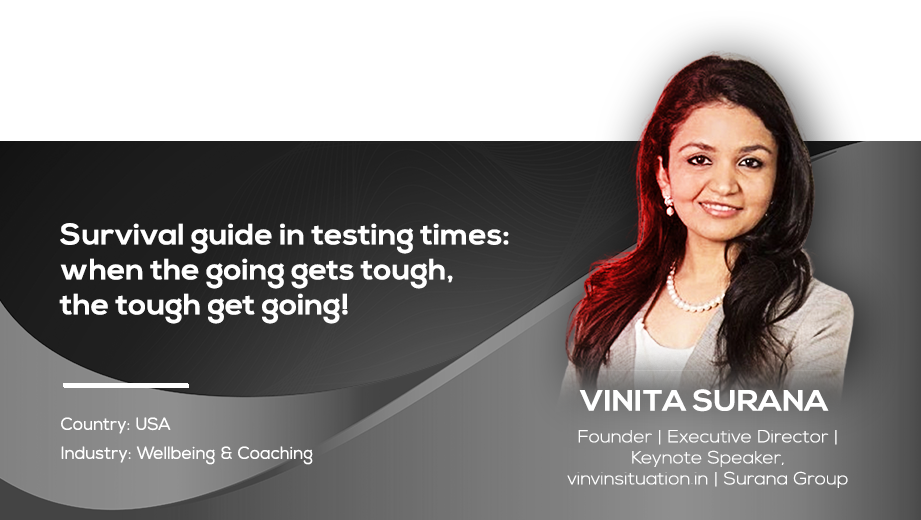
Vinita Surana is a serial entrepreneur, investor, and keynote speaker who holds a Wharton MBA. She serves as Executive Director of Surana Group, her family’s business, and is the Founding Partner of Vinvinsituation, her investment fund, which she has run for five years and this year expanded into advisory and brand-activation partnerships with founders who are still finding their footing. She grew up inside a family business where, by her own account, no woman before her had gone into the boardroom, and had to earn her seat one closed deal and one client presentation at a time. She has also chaired FICCI YFLO and JITO, appeared on Lion’s Den, trained for years as a classical Kathak dancer, and holds a second master’s in international business from the University of Manchester. We sat down with Vinita to talk about the difference between betting on a founder and betting on yourself, why she designs her entire day the night before it starts, and what it actually took to stop needing anyone’s approval before trusting her own decisions.
Here are our key takeaways from our chat:
1. Confidence is not a feeling you wait for. It is proof you collect, one hard thing at a time.
You don’t need to sit through a ten-day silent Vipassana course with no phone, no talking, and no proper shower to feel like your life is going fine. Vinita signed up for one anyway, at a point when everything in her life was going well and that was exactly the problem. Comfort had started to feel like a ceiling, and the only way past it was to choose something hard on purpose, then find out what was actually on the other side of it.
The same instinct pushed her to apply to twelve MBA programs, Wharton among them, instead of the usual six, sleeping on a cousin’s couch through the interview rounds without ever treating it as a hardship worth complaining about. None of this was performed for an audience. It was a private experiment in what she was capable of, and the answer, once she had it, wasn’t something anyone could later talk her out of.
2. Real empowerment looks less like an achievement and more like not needing anyone’s permission to trust it.
For years, every big call, professional or personal, got run past a man first. A father before a business decision, a husband after marriage, sometimes a brother. It wasn’t a lack of clarity or intelligence, it was conditioning so ordinary it barely registered as a habit, and it meant that even wins built entirely on her own thinking got quietly filed away as someone else’s approval rather than her own competence.
A mentor eventually pointed out the pattern: the ideas were always hers, the execution was always hers, the outcomes kept working out, and still none of it built real confidence, because the credit kept getting rerouted elsewhere. It’s a dynamic The Confidence Code documents in women across industries, achievement and self-belief rarely arrive together on their own. This is exactly the kind of quiet erosion Decoding Draupadi exists to interrupt, the gap between a woman succeeding and a woman actually believing she is the reason for it. Real empowerment doesn’t announce itself. It just stops asking.
3. A good pitch and a good founder are not always the same person, and telling them apart is the actual job.
Financials, decks, and mindset tend to travel together. The strongest founders stay just as composed under six months of due diligence as they were in the pitch room, and they invite the tough questions instead of resenting them. Weak mindsets complain that diligence is taking too long. Strong ones ask investors to go straight to the customer and check the numbers on the ground for themselves.
The harder lesson came later: some of the most confident founders were the ones quietly cooking their books. One revenue-share partner was found, a full year in, to be pocketing fifty percent more than what had been reported. It tracks with recent research showing venture-backed startups are more likely to commit fraud when growth pressure outruns oversight. Early losses taught what pattern recognition alone never could, that conviction and character are not the same signal, and the second one only shows up under real pressure.
4. Earning a seat in a family business is an entirely different job than inheriting one.
Closing a sales deal or delivering a client presentation nobody else in the room could pull off should count as a win in any office. In this one, the response to that kind of news was disappointment rather than celebration, because Vinita was still unmarried, and success outside of that particular milestone barely registered as success at all.
A grandmother once said, half-joking, not to become so competent that no one would find her a match. A grandfather suggested arts over engineering because it would suit a future wife better than a future engineer. Every one of those comments came from a place of protection, not malice, but protection built on a smaller idea of what she was allowed to become. She simply kept making the case for a bigger one, one closed deal at a time, the same instinct that would later put her in the chairperson’s seat at FICCI YFLO.
5. Decision fatigue is not a personality flaw. It is a design problem, and it has a design solution.
The night before matters more than the morning. Outfits, workouts, meals, meetings, even the order of phone calls in the car, all get planned a day in advance, because a mind left to decide everything in real time runs out of energy for the decisions that actually deserve it. This isn’t rigidity for its own sake. There’s room built in for spontaneity too, just not for chaos.
Some of this borrows directly from Getting Things Done, the productivity framework built around externalizing every task so it stops occupying headspace. The payoff isn’t a fuller calendar, it’s arriving at rest time actually satisfied with the day instead of replaying what should have gotten done. Knowing your own energy, evenings over mornings in this case, and building the design around it, is the entire trick.

6. Effort without attachment to the result is not detachment from caring. It is the only way to keep caring for very long.
The philosophy comes from the Yoga Sutras and shows up, in one form or another, across the Gita, Christianity, and Islam too. The Gita calls it Nishkama Karma: give a hundred percent to the action, and let go of the outcome entirely. In practice that means showing up to a speaking engagement through illness or crisis, doing the work of the day regardless of what the day hands back in return.
Visibility, followers, deals, all of it becomes a byproduct rather than the target, in the same way losing weight followed picking up a sport she genuinely loved, not the other way around. It’s a philosophy Decoding Draupadi keeps running into in different words across different women’s lives. The ones who last are rarely chasing the outcome directly, they’re just unusually loyal to their own craft.
What stays with you after this conversation isn’t the Wharton acceptance or the fund she eventually built, it’s how deliberately she built the person who could do either. Somewhere between a ten-day silent retreat and a phone call she stopped making to men before trusting her own decisions, the confidence stopped being borrowed.
Until next time
Team Decoding Draupadi