
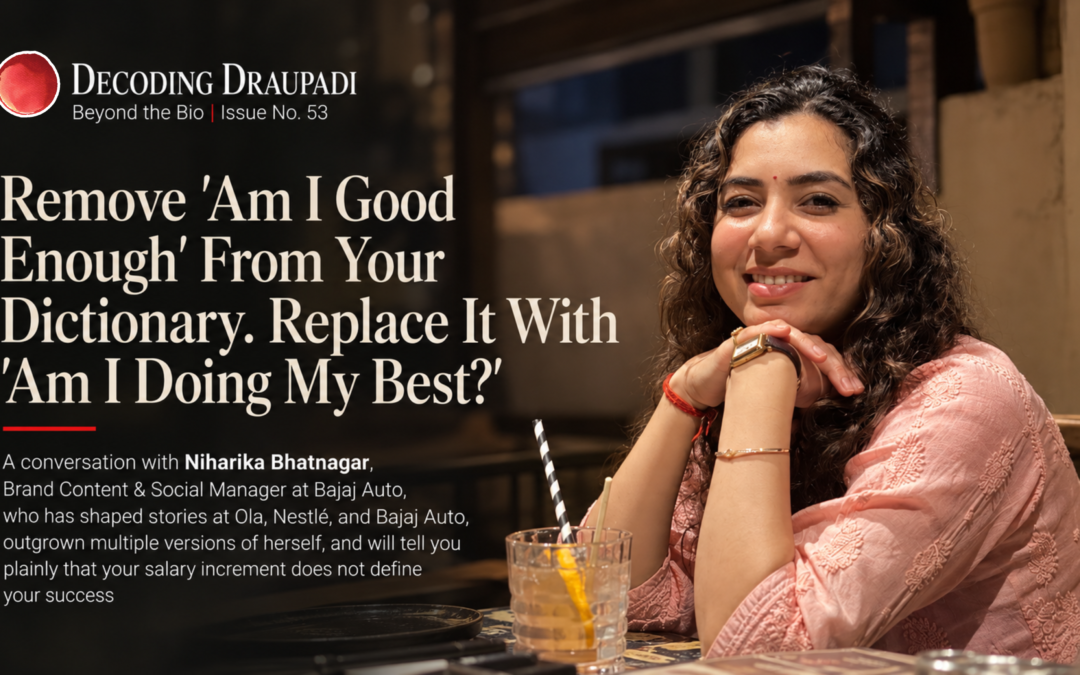
Niharika Bhatnagar has built her career at the intersection of brand reputation and public perception: at Ola when it was tumultuous, at Nestlé when it was complicated, and at Bajaj Auto, where she led PR, media, and events before her recent promotion to Brand Content & Social Manager. She knows what it costs to shape a story at scale, what you can change with consistent storytelling, and what you cannot.
She is also someone who has done the internal work. She has outgrown her own anger, her need for external validation, and the question that haunts most overachievers. This conversation is about all of that.
A Well-Oiled Machine, Built on Privilege She Acknowledges
Who is Niharika right now, across the different lives you are living?
She has asked herself this question many times, because she knows she is a different person in different rooms. At the office, with her in-laws, with herself. What she has arrived at, deep down, is someone who does not want to waste a single moment of life.
A healthy kitchen garden and healthy plants, a clean house and a thriving career: she wants all of it. Being genuinely good at each one matters to her, not just being present for it. She likes having an operating system of life that is a well-oiled machine, so that when external disturbances come, because they always do, she is physically, mentally, and emotionally prepared to deal with them.
She is quick to name the conditions that make this possible. Political stability in her city. A stable job. A supportive husband. Families on both sides who care only about her being happy, not about what she does. You can only reach this place of achieving your ambitions inside and outside the home, she says, if you have a good support system. She is not pretending otherwise.
“I want an operating system of life that is like a well-oiled machine, so that any external disturbance that comes, I am well prepared to deal with it.”
The machine metaphor is precise. She is not describing calm. She is describing preparedness. The goal is not a life without disruption. It is a life where disruption meets someone who has already done the maintenance work.
You Can Modify Memory Towards a Brand, But You Cannot Cheat the Public
You have worked across sales, content marketing, and PR, media, and corporate reputation. Looking back, was there a particular moment where you realised your strength was not just building brands, but shaping the stories people believe about them?
She has worked for brands that are remembered positively, and brands that have disappeared from public memory in a negative way. What she has learned across all of them is that you can only modify someone’s memory of a brand to a certain extent, and only if the storytelling is genuinely consistent over years.
Attention spans are short and content moves fast. If you want to influence somebody’s decision toward a brand, it has to be a sustained effort with significant financial and thought investment maintained across years. Throwing money at a problem does not work. You cannot cheat the public into thinking something. Honesty is the only route, along with understanding the emotion behind the purchase.
Even a 10-rupee chocolate involves a thought. That thought is what needs to be resonated with. Flashy boards, online visibility, in-store presence: all of that changes brand awareness, but it does not always influence purchase decisions or build the consistent thought you want in someone’s head over time. That takes a lot of work, and management needs to understand the long timeline and financial commitment that requires.
“You can’t cheat the public into thinking something. You need to be honest with them and understand the emotion behind every purchase, even a 10-rupee chocolate.”
She names something that gets lost in most brand conversations: the difference between visibility and trust. Visibility is fast and measurable. Trust is slow and requires consistency. The two are not the same thing, and confusing them is one of the most expensive mistakes a brand can make.
You Want the Person in Front of You to Carry the Message
In communication, you are often responsible for saying the right thing at the right time. Outside of work, when do you find it hardest to find the right words?
When she knows someone is extremely incorrect in what they are doing or how they are behaving, but they are incredibly confident about it. The hesitation is not about how she will be perceived. It is about whether the person in front of her will actually receive what she is trying to say.
She gives an example: a leadership figure whose speech, due to be broadcast across the country, had multiple grammatical errors and words used entirely incorrectly. She had to guide him through corrections step by step, while navigating the reality that men often find it difficult to take criticism from women. She had to shift between being encouraging, being deferential, and being precise, all to ensure the message landed rather than triggering defensiveness.
For corridor conversations and small professional moments, she has learned to let things go. Earlier she would go out of her way to correct people. Over time she realised her energy is better invested elsewhere, especially when the person in front of you does not actually want to be helped. If the person is not open, whatever you say has gone to waste.
“What makes you hesitate in communicating is not worrying about being perceived as rude. It’s wanting the person in front of you to actually carry the message you’re giving them.”
This is one of the more mature things said about communication in this series. Most people frame the difficulty of feedback as a question of courage. She frames it as a question of effectiveness. The courage part she has sorted. The question is always whether the investment of effort will produce any actual result.
Three Versions, Outgrown in Order
Have you ever outgrown a version of yourself that once felt like your biggest achievement?
Many times. She describes three levels, each one a level up from the last.
The first was during her MBA: she was holding other people to her own standards. She had grown up with good role models and a clear moral compass, and she had assumed everyone else shared the same framework. Over time she realised that was ridiculous, and possibly hypocritical. Different people have different compasses and different ambitions. That version of herself went.
The second was early in her career: she had significant anger issues and was subjecting people around her to those emotions when they had not instigated them. Consciously, she learned to switch it off. Her methods were her own: restricting communication to email when someone triggered her, walking away, keeping topics narrow. She built her way around it.
The current level up, which she noticed only in the past couple of months: she no longer needs external words or actions to change her mood. She has learned to ignore a large volume of voices and thoughts that are simply not productive. Instagram gets limited time. A few seconds of something on a screen no longer alters the rest of her day. The goal she is working toward is being the kind of person nothing external fazes, because being fazed is not productive and does not help anyone around her.
“How can a few words said by somebody else, on my screen or in front of me for a few seconds, change my mood for the rest of the day? That’s just not done.”
She describes the three versions with no nostalgia and no drama. Each one was a real version of herself, and each one was genuinely limiting. The current version is, by her own assessment, the most advanced. The fact that she says this without arrogance is what makes it credible.
You Cannot Control What People Say. Give Up Trying.
Working in PR means you are constantly thinking about perspective. Has there ever been a time when you had to stop worrying about how you were perceived and simply do what felt right?
She does not really worry about how she is perceived. She gave it up early, during her engineering years, when she realised how toxic the thought of “what are people thinking about me” can become. Her MBA showed her people’s true personalities in competitive environments. That was the last time external opinion seriously affected her.
You can do everything right and there will still be people who say something. You can support a good cause and someone will find a way to make it negative. So she just lives her life. In PR specifically, where every other function tends to think they have marketing opinions because marketing looks easy from the outside, you have to put your foot down regularly in rooms with people two levels above you. You cannot be doing that while simultaneously worrying about what those people think of you.
Her advice is specific: have one support system, whether a partner, a friend, a parent, a mentor, or anyone else. Depend on them for positivity and friendship. Depend on yourself for a positive opinion of who you are. Shut the rest out.
“You need to have a positive opinion of yourself. Depend on your support system for friendship, and on yourself for how you see yourself. Don’t depend on anyone else for that.”
She gives this advice from a field where managing perception is literally the job. The fact that she has separated the professional task of shaping how others see a brand from the personal question of how she sees herself is not a small thing. Many people in PR quietly blur that line. She has not.
Remove ‘Am I Good Enough’ From Your Dictionary
We often celebrate confidence but rarely talk about doubt. What is a doubt you have learned to live with instead of trying to eliminate?
“Am I good enough?” That is the one.
She was an overachiever from the beginning. Best at sports, best at debating, best at quizzes, best at studies. She was used to being the best. That habit followed her into adulthood and into her home, where she would give advice as though she knew everything. Then she met the full range of people in the working world, people with less formal education doing exceptional work, people years younger performing brilliantly, and she had to come to terms with the fact that she is not the best at everything.
Her conclusion: remove “am I good enough” from the question entirely. Replace it with “am I doing my best?” She gives a specific example. A terrible day at work, a crisis, a headache, period pain, everything going wrong at once. You go to the bathroom, you cry if you need to, you take a painkiller, you eat something, you go back and do your job. Did you do your best in that situation? Yes. Does that mean you also have to do the laundry tonight? No. That is just called me-time.
Nobody in her exact circumstances, with her exact personality, could probably do better than she is doing, because she is striving to be better every day. That is what good enough actually means.
“Am I good enough needs to be removed from everybody’s dictionary and replaced with: am I doing my best? And am I doing the best I can in these circumstances?”
She arrives at something more precise than the usual “stop comparing yourself to others” advice. The issue is not comparison. The issue is that “am I good enough” is the wrong question. It is comparative, vague, and unanswerable. “Am I doing my best” is specific, contextual, and honest. She has replaced the question, not suppressed it.

Your Salary Increment Does Not Define You
What is one belief about success you held early in your career but no longer believe?
The television version of success: working in the US, wearing power suits, going to meetings, speaking in an authoritative tone. She says she understood quite early that this was not actually success. Her mother was in the workforce from the beginning, so she had seen what work really looked like. The glamour version was just what the culture around her was selling.
Her current definition: can she use the money she has judiciously and plan well for her future? Can she maintain her current standard of living and prepare responsibly for the decades ahead? That is success to her now.
She is also very direct about career progression. Promotions and salary increments in most organisations are not purely a function of individual performance. They depend on the financial health of the company, on departmental budgets, on factors entirely outside your control. So she does not equate a big hike with success, or a smaller one with failure. If the company does not value you, you move on. But the number does not define you.
Success needs a definition that can change with time, adapt with age and life stage, and remain positive and progressive throughout.
“Your promotions every year are not really dependent on you most of the time. You cannot equate your success with this year’s salary hike. That doesn’t define you.”
She gives the most practical definition of success in this series: can I plan well for my future? Not a title, not a revenue number, not a public achievement. The capacity to be financially intentional and forward-looking. That is a definition that holds across decades and does not depend on what anyone else is doing.
A Note From Decoding Draupadi
What stayed with us is the operating system image. She wants her life to be a well-oiled machine, not so that nothing goes wrong, but so that when things go wrong she is already prepared. That is a fundamentally different relationship with stability than most people have. Stability, for her, is not the absence of disruption. It is the presence of readiness.
The “am I good enough” answer stayed with us too, specifically the replacement question. Am I doing my best? It is a simpler question, but it is harder to answer honestly, because it forces you to be specific about your actual circumstances rather than comparing yourself to a vague imagined standard. She has done that work. The answer, in her circumstances on that particular day, is almost always yes.
If this felt like someone you know, share it with her.
You can’t cheat the public into thinking something. You need to be honest and understand the emotion behind every purchase. A decade in brand reputation and this is still her core belief. Full interview at @decodingdraupadi.
Niharika Bhatnagar is Brand Content & Social Manager at Bajaj Auto, where she previously served as PR, Media & Events Manager. This interview was conducted as part of the Decoding Draupadi Brand Manager Series.