DECODING DRAUPADI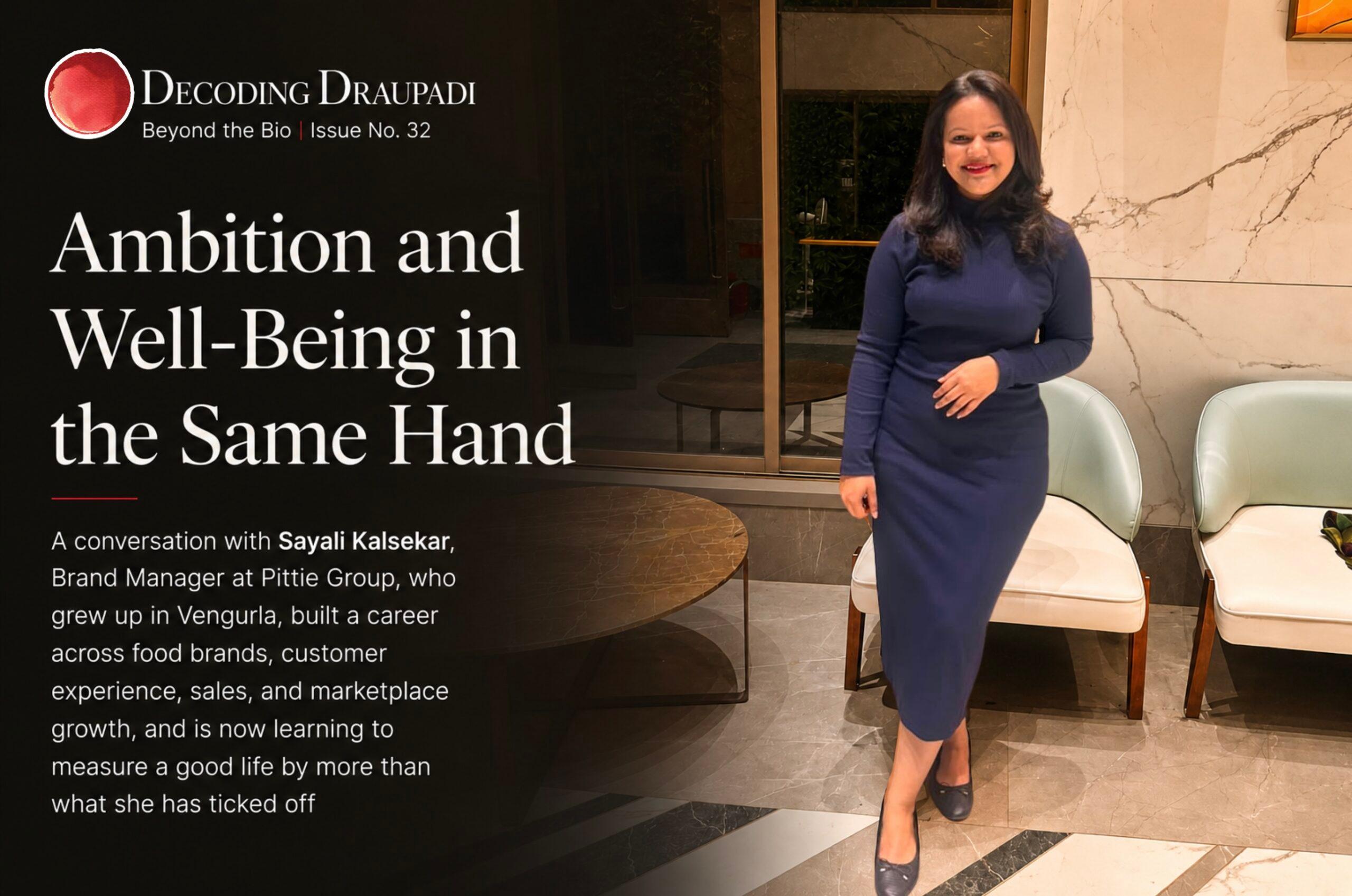
A conversation with Sayali Kalsekar, Brand Manager at Pittie Group, who grew up in Vengurla, built a career across food brands, customer experience, sales, and marketplace growth, and is now learning to measure a good life by more than what she has ticked off
Sayali Kalsekar grew up in Vengurla, a small town in coastal Maharashtra, in a business family where she watched consumers and trade up close long before she had a job title. She moved to Mumbai, built a corporate career across multiple industries, and has spent years understanding people from every angle a brand can offer.
What makes this conversation worth reading is not the trajectory. It is the honesty sitting inside it. She is someone who poured most of herself into professional growth for a long time, and is now, mid-career, quietly renegotiating the terms. Not stepping back. Just expanding what counts.
Holding Ambition and Well-Being in the Same Hand
Who is Sayali right now, across the different lives you are living?
Right now, she is someone trying to hold ambition and personal well-being in the same hand.
At work, she is a marketer, and she loves the craft of it: understanding consumers, building brands, turning an idea into something you can hold. But she also deeply values the people she does it with. Some of her closest friendships started as workplace ones, colleagues who quietly became friends along the way.
At home, family is still a huge part of who she is. Coming from Vengurla, she grew up in a culture where family is the centre of everything, and that sense of belonging keeps her grounded no matter how busy life gets.
Privately, she is learning that life is more than career milestones. For a long time, she poured almost everything into professional growth. These days, she is making room for her health, her peace of mind, and being kinder to herself in uncertain phases instead of expecting to have it all figured out.
Who is Sayali right now? She is someone ambitious and curious, but also learning to slow down, hold her people a little closer, and enjoy the journey a bit more.
“She is someone trying to hold ambition and personal well-being in the same hand.”
That opening line is the whole piece in one sentence. Not work versus life. Not ambition versus rest. Both, in the same hand, at the same time. Most people eventually arrive at this negotiation. What is less common is being able to name it this clearly while it is still in progress.

What the Dashboard Cannot Tell You
Having seen consumers so closely from so many different angles, what is one thing you have learned about people that no business dashboard or report can ever capture?
That people rarely decide with their heads alone.
Whether it is food, a product, or a brand, emotion is doing far more of the work than the data ever shows. A dashboard can tell you what someone bought. It cannot explain the memory, the habit, the trust, or the feeling sitting behind that choice.
That is something she has only really understood by talking to consumers and watching how they actually behave, not how a report says they should.
“A dashboard can tell you what someone bought. It cannot explain the memory, the habit, the trust, or the feeling sitting behind that choice.”
This is the thing that gets lost in the shift toward data-first marketing. The data is accurate. It describes what happened. It does not explain why, and the why is where the real work lives. Sayali has worked on both sides of that gap, in sales, in customer experience, in brand, and this is still the thing she comes back to.
The Instinct No Textbook Could Give Her
Was there ever a phase where you felt pressure to become a more acceptable or conventional version of yourself professionally?
Yes, definitely. She comes from Vengurla, Maharashtra, a small town, and a business family. Moving to Mumbai and building a corporate career dropped her into a completely different world. In the beginning, she felt this constant pull to fit in: to speak a certain way, carry herself a certain way, become a more acceptable version of herself.
It took time. But she slowly realised her background was never something she needed to hide or fix. Growing up around a family business, seeing consumers and retailers, watching how trade actually works up close, gave her an instinct that no textbook could. Today, she sees that whole part of her journey as one of her biggest strengths, not something she had to overcome.
“Growing up around a family business gave me an instinct that no textbook could. Today, I see that as one of my biggest strengths.”
There is a particular kind of pressure that comes with entering corporate life from outside the usual pipeline. The accent, the references, the way certain rooms assume a shared context. Sayali walked into all of it. And what she found on the other side is that the very thing that made her feel like an outsider was the thing that made her better at the job.

What a Sorted Career Does Not Tell You
What is something you are still figuring out privately, even though externally your career may look very sorted?
For a long time, she measured success mostly through work: new roles, new chances, ticking off goals. Those still matter to her. But she is slowly learning that good health, peace of mind, the people she loves, and feeling happy in normal life matter just as much.
She will not pretend she has figured it all out. It is still a work in progress. And she is okay with not having all the answers yet.
“I won’t pretend I’ve figured it all out. It’s still a work in progress, and I’m okay with not having all the answers yet.”
That last sentence is doing more work than it looks like. Being okay with not having all the answers is not a passive position. It requires actively choosing not to perform certainty you do not have. For someone whose career looks sorted from the outside, that is a quiet kind of courage.
From Comparing to Building
Do you think ambition becomes healthier or more exhausting as people grow older?
She thinks it can become healthier, but only if you learn to define it on your own terms.
When you are younger, ambition is so tied up with titles, promotions, and proving yourself to everyone watching. As you get older, you start to understand what actually matters to you, and ambition quietly shifts. From comparing to building. Building a life you are genuinely happy in.
At least, she says, that is how she is starting to see it.
“Ambition quietly shifts from comparing to building, building a life you are genuinely happy in.”
The word ‘comparing’ is precise. Early-career ambition is almost always relational: am I ahead, am I behind, what does this look like to other people. The shift she is describing is the moment when that external reference point stops being the primary one. Not everyone gets there. And the ones who do usually cannot tell you exactly when it happened.

The Part That Still Excites Her
What kind of work gives you the deepest sense of meaning, the kind that reminds you why you entered this field in the first place?
Building something from the ground up. Understanding who the consumer really is, shaping a brand’s story, and then watching that idea come alive as a product, a pack, a campaign.
There is something deeply satisfying about taking a real consumer insight, tying it to a business goal, and creating something people genuinely choose and connect with.
She also loves that this work keeps her learning something new every day. Taking on new roles across different industries has pushed her out of her comfort zone again and again, and each one has taught her something she could not have learned any other way. That mix of constant learning and building is what pulled her into marketing in the first place, and it is still the thing that keeps her excited about it.
“Taking a real consumer insight, tying it to a business goal, and creating something people genuinely choose and connect with. That is the thing.”
She has worked across food brands, customer experience, sales, marketplace growth, and now brand management. Most people who move that much do it out of restlessness. Sayali’s answer suggests something different: she moved because each new angle taught her something the last one could not. That is not restlessness. That is a very deliberate kind of curiosity.
Do What Makes You Happy, Not What Looks Good on Paper
If someone younger feels anxious because their career path looks non-linear or unconventional, what would you want to tell them?
Whenever her younger siblings come to her for advice, she tells them the same thing: do what genuinely makes you happy, not what looks good on paper or what everyone else seems to be doing. Careers do not have to run in a straight line. Hers certainly did not.
Every experience teaches you something, even when it makes no sense in the moment. So trust yourself, stay curious, and do not be scared of taking a different road. Sometimes the unconventional route is exactly the one that teaches you the most.
“Careers don’t have to run in a straight line. Mine certainly didn’t. Every experience teaches you something, even when it makes no sense in the moment.”
She gives this advice to her younger siblings. That detail matters. It is not something she rehearsed for a stage or polished for a LinkedIn post. It is what she actually says to the people she loves when they are scared. That is the test of whether you mean something. And she means this.
A Note From Decoding Draupadi
What stayed with us is the image of Vengurla. Not as a backstory, not as a detail to make the Mumbai-corporate-career arc more dramatic, but as an actual foundation. She watched trade happen in real life before she ever learned a framework for it. She understood consumers before she had a job title that required her to. And then she walked into a world that asked her to pretend that experience did not count, and she had to slowly, over time, decide it did.
That is a more common story than most career narratives admit. The people who fit the expected profile rarely have to do that work. The ones who do not fit have to spend years learning to trust what they already knew.
If this felt like someone you know, share it with her.
A dashboard can tell you what someone bought. It cannot explain the memory, the habit, the trust, or the feeling sitting behind that choice. She has spent years on both sides of that gap. Read the full conversation at @decodingdraupadi.
Sayali Kalsekar is Brand Manager at Pittie Group. This interview was conducted as part of the Decoding Draupadi Brand Manager Series.