
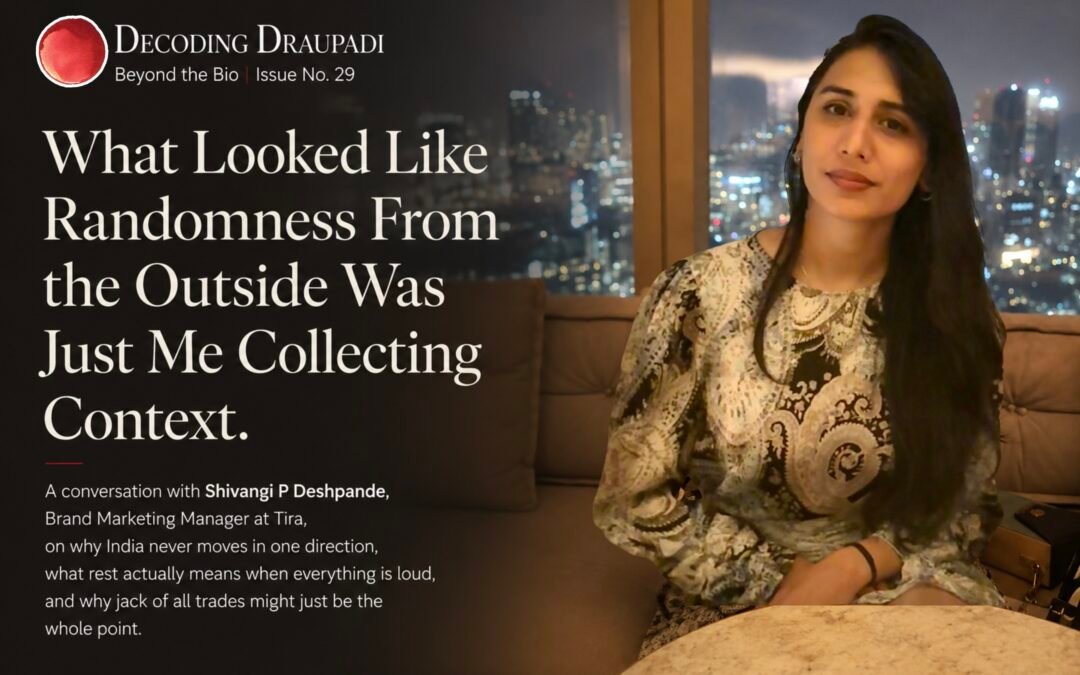
A conversation with Shivangi P Deshpande, Brand Marketing Manager at Tira, on why India never moves in one direction, what rest actually means when everything is loud, and why jack of all trades might just be the whole point.
Shivangi P Deshpande is a 29-year-old in Mumbai trying to make sense of adulthood, ambition and everything in between. She has worked across celebrity events, Hamleys, Tira and global brand launches, and she would be the first to tell you that it does not look linear on paper. It was not meant to.
She is also someone who thinks carefully about India, about consumers, about what the word modern actually means when 1.4 billion people are living very different realities at once. This conversation has that kind of sharpness throughout, delivered in a voice that is direct, a little dry, and very much her own.
Less Drama. More Discipline. Mastering Just Peace.
Who is Shivangi right now, across the different lives she is living?
Since we live in a world of labels, identities and carefully curated versions of ourselves, here’s my bit. I’m just a 29-year-old woman in Mumbai trying to make sense of adulthood, ambition and everything in between.
My parents, for example, may currently describe me as marketing professional, decent girl, marriageable age.
Work-wise, I’m ambitious, practical and still figuring things out. Seven years across events, lifestyle and brand launches have made me comfortable with fast-moving environments, last-minute pivots and organised chaos. Calm? Not always. But definitely getting better at handling the madness.
Hamleys shaped me a lot. When your audience ranges from a one-year-old to a seventy-year-old, you realise quickly that people are layered. Different age groups, emotions, expectations and sometimes egos. It taught me more about people than any textbook or marketing framework could.
Outside work, I’m in my less drama, more discipline era. Gym consistency, eating better and trying to build habits that last instead of overnight fixes. Faith, podcasts and chai help me reset.
Socially, I still enjoy people and good energy, but I’ve become more selective with time and energy. Quality over quantity suddenly stopped sounding boring and started sounding sensible.
“Quality over quantity suddenly stopped sounding boring and started sounding sensible.”
The parents line made me laugh, and I think that was the point. She is describing herself with real warmth and a light touch, and that combination is rare. The less drama, more discipline era is something I think a lot of women in their late twenties are quietly living right now, even if most of us would not put it quite so cleanly.

Marketing Decks Are Beautiful. Consumers Are Humbling.
What has your journey taught you about how people actually experience a brand beyond what we say about it?
Marketing decks are beautiful. Consumers are humbling. That’s probably the biggest lesson.
Hamleys taught me this early. When your audience ranges from a one-year-old child to a seventy-year-old grandparent, you realise quickly that people don’t experience brands the same way. A child looks for wonder, parents look for value and convenience, and grandparents often buy emotionally. Same store, completely different expectations.
And honestly, working across launches teaches you humility. There will always be trials, errors and unpredictability. No launch, campaign or brand journey is ever perfectly linear.
What feels different today is that people have become far less forgiving of mistakes. Thanks to social media, things can get amplified quickly. At the same time, I understand why sensitivity exists. Culture, identity and emotions matter deeply to people now, maybe more visibly than before.
So I’ve learned that every move needs to be thoughtful and well-intentioned. Not fear-driven, but considered.
And somewhere along the way, I also learned something bigger. Timing and context matter. You can prepare, plan and execute with sincerity, but not every variable sits within your control. Do the work honestly, learn from the outcome and stay detached enough to keep moving. Because brands may start with campaigns, but people remember experiences.
“Brands may start with campaigns. But people remember experiences.”
The detachment line is the one I keep returning to. She is not saying do not care. She is saying care fully and then let go of the outcome you cannot control. That is a very specific and hard-won relationship with work, and it shows up because she talks about faith in the same breath. The two are connected for her.
India Doesn’t Move in One Direction
What does the phrase ‘the modern Indian consumer’ get wrong?
Honestly, I think the definition gets one thing fundamentally wrong. It assumes there’s one version of the Indian consumer and one shared idea of what modern means.
India rarely works in singular narratives.
Yes, consumers today are more exposed, aspirational and digitally aware. But I’m cautious of terms like digitally native or modern becoming catch-all labels, because exposure itself is uneven. Step outside metros and you realise many Tier 3 and Tier 4 consumers are still experiencing very different realities. For some, convenience and premiumisation are everyday expectations. For others, even access, awareness or affordability shape choices first.
And maybe that’s the contradiction we often miss. We speak about sustainability, climate consciousness and organic living, and while those conversations matter, they can sometimes feel disconnected from the reality we live in. High AQI, tree cutting, construction and rapidly changing cities sit alongside those ideals.
India feels beautifully dichotomous. Traditional and modern. Emotional and rational. Premium-seeking and value-conscious. Multiple realities coexisting at once. To me, the phrase doesn’t get consumers wrong. It gets complexity wrong.
“The phrase doesn’t get consumers wrong. It gets complexity wrong.”
That last line is the kind of thing that sounds obvious once someone says it and is not obvious at all before they do. Most marketing language flattens India into a trend or a demographic. Shivangi is making a structural argument: the problem is not the data, it is the frame. And she makes it without being preachy, which is the harder thing to do.

Stepping Out of the Need to Label Everything
What does rest actually look like for you right now?
I used to think rest meant doing nothing. Full stop. But that just made me more restless and slightly guilty for being unproductive.
Now it feels more like detachment.
Especially working across so many inputs: social media, PR, advertising, marketing. You realise how loud everything is. Constant inputs, constant opinions, constant this is what people want. The more you sit in it, the more you realise how much it over-simplifies people.
So rest for me is just stepping out of the need to label everything, including myself.
Gym helps. So do slower evenings, better eating, and not being constantly plugged into noise. Not in a rigid wellness way, more like keeping my system a little less overloaded.
There’s also this grey-area philosophy I’ve started liking. Not everything needs to be defined or resolved immediately. You can just exist in between things. That, for me, is rest right now.
“Rest for me is just stepping out of the need to label everything. Including myself.”
The grey-area philosophy is something I had not heard framed quite this way before. Most rest conversations are about doing less or being more present. Shivangi is talking about something more cognitive: the relief of not needing to categorise, resolve or define. For someone who spends her days thinking about how brands position and label things, that makes complete sense as an antidote.
Jack of All Trades. Mastering Just Peace.
What was one career decision that looked wrong from the outside but turned out to be exactly right?
Probably not choosing a linear path and instead just following curiosity.
On paper, it probably looks scattered: celebrity events, Hamleys, Tira, global brand launches. Not the neatest career graph.
But I’ve always believed one simple thing: better to know than assume. So I kept moving across different functions and channels, just to understand how different parts of the system actually work. Events taught me confidence, networking and ownership. Retail taught me real consumer behaviour, not deck versions of it. And the rest came from the mixed emotional wins and failures in between.
What looked like randomness from the outside was just me collecting context.
Or honestly: jack of all trades, mastering just peace.
“What looked like randomness from the outside was just me collecting context.”
Jack of all trades, mastering just peace is the line I want on a poster. She is doing something clever here: taking a phrase that is usually used as criticism and turning it into a philosophy. The randomness was the point. The context was the currency. And the peace is what you get when you stop trying to make your career graph look neat for other people.

Time Teaches You What Rushing Usually Messes Up
Which relationship in your life has changed the most since you started working?
Probably my relationship with time, myself and everything around me.
Whatever I am today is very influenced by the experiences I’ve had, meeting so many people along the way, a few constants and a lot of passing ones. That mix teaches you a lot about people, and also about yourself in the process.
Earlier, I thought being present meant being available all the time. Now it feels more like balance. Showing up, but not losing yourself in it. Kindness still matters, but so do priorities.
And honestly, a lot of it comes back to what my dad always said: family over everything. That’s become a real anchor for me now. At the same time, I’ve become more conscious about the kind of people and companies I choose to work with. Similar mindset matters. Alignment matters more than just opportunity.
Time teaches you what rushing usually messes up. My mom says you can’t have it all at once, and the older I get, the more it makes sense. So now it’s less about optimising everything at the same time, and more about choosing your battles wisely.
“Time teaches you what rushing usually messes up.”
Both parents get a line in this answer, and I noticed that. Her dad for the family anchor, her mom for the you can’t have it all at once. Two different kinds of wisdom, offered at different moments, both landing. Shivangi has clearly been paying attention to the people around her for a long time, and it shows in how she talks about relationships.
Boring Consistency. Hopefully Compounding.
Outside of your job title and company, what are you building?
Outside of work, I’m focused on building good, consistent habits. Gym, eating better, being more disciplined with time, and just showing up for myself in small ways that actually compound over time. Nothing dramatic, just boring consistency.
I’m also getting more intentional about money: SIPs, mutual funds, basically making my money work a little instead of just existing in my account and disappearing with inflation like it has other plans. With how expensive things are getting, it honestly feels less like a finance thing and more like staying alert and staying ahead.
I see side hustles everywhere now, but for me it’s more about financial awareness and security than chasing trends. Not putting everything in one basket just feels like common sense in today’s world.
So yeah, outside of everything else, I’m just building habits and financial discipline that will hopefully keep future-me a bit more stable, and a lot less stressed.
“Nothing dramatic. Just boring consistency.”
Making my money work instead of just existing in my account and disappearing with inflation like it has other plans: that sentence made me genuinely laugh. But the point underneath it is serious, and I think it will resonate with a lot of women in their late twenties who are figuring out that financial awareness is not optional anymore. Shivangi says it without making it feel heavy, which is exactly the right register.

A Note From Decoding Draupadi
What stayed with us from this conversation is the grey-area philosophy. Not everything needs to be defined or resolved immediately. You can just exist in between things.
Shivangi works in an industry that is obsessed with positioning, with labels, with telling consumers exactly what a brand is and why it matters. And her rest is the opposite of that: releasing the need to define, categorise, resolve. That is not laziness. That is a very conscious act of self-preservation from someone who knows what the alternative costs.
We think a lot of women need permission to exist in the grey area. Shivangi seems to have found it for herself, and she handed it over pretty freely here.
If this felt like someone you know, share it with her.
Shivangi P Deshpande is Brand Marketing Manager at Tira, working on KIKO Milano. This interview was conducted as part of the Decoding Draupadi Brand Manager Series.
The phrase ‘modern Indian consumer’ doesn’t get consumers wrong. It gets complexity wrong. On what marketing keeps missing about India, at @decodingdraupadi.