DECODING DRAUPADI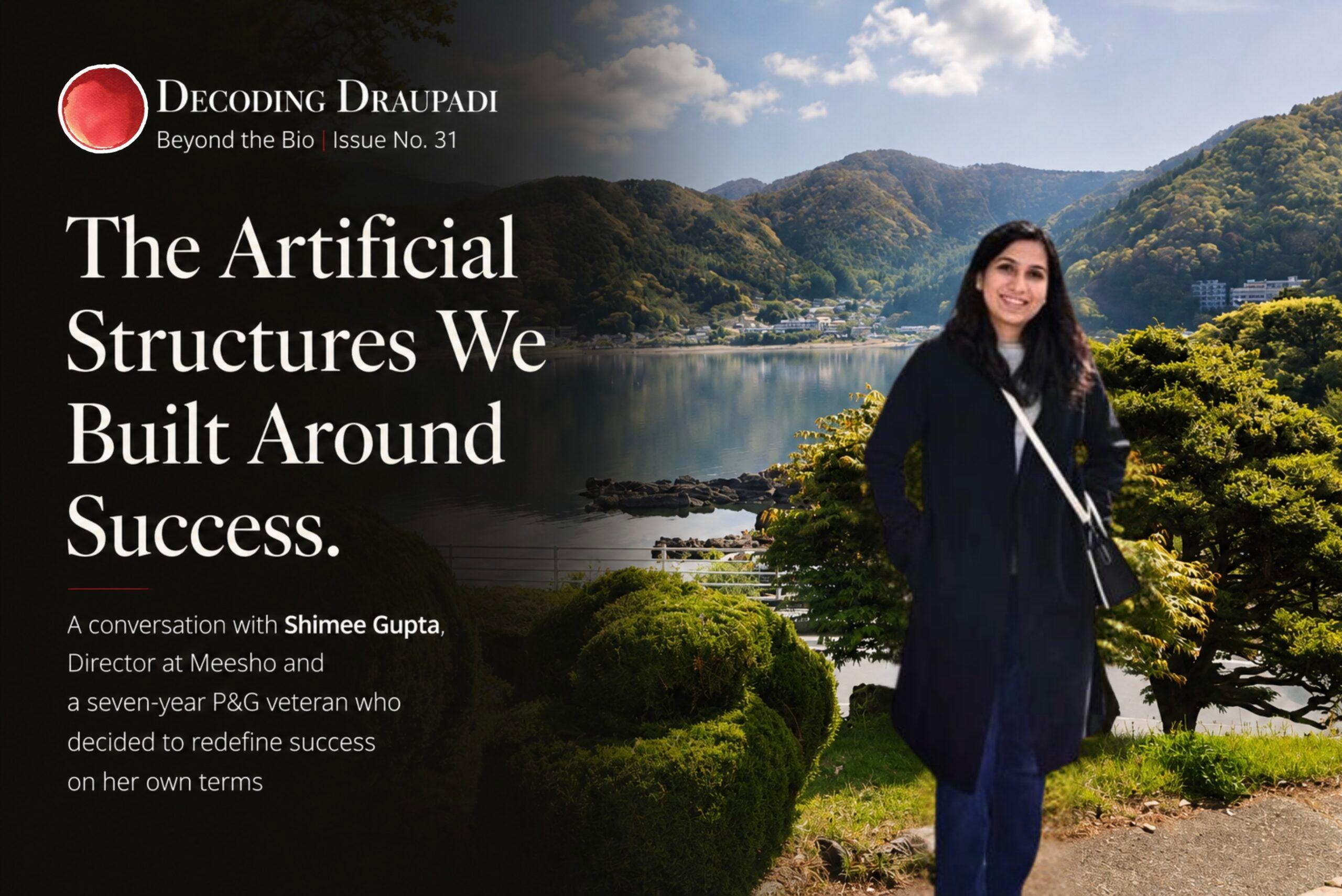
A conversation with Shimee Gupta, Director at Meesho and a seven-year P&G veteran who decided to redefine success on her own terms
Shimee Gupta has spent her career at the intersection of legacy brand building and hyper-growth consumer internet, moving from seven years at P&G to leading categories at Meesho. What runs through every answer she gave is a quiet but deliberate rebellion against the version of ambition she was sold early in her career.
She kept arriving at the destinations she had aimed for, and then had to decide what to do with the gap between arriving and feeling okay. This piece is about that gap.
YOLO as a Philosophy, Not a Hashtag
Who is Shimee right now, across the different lives you are living?
If I were to define Shimee today, she is someone who lives by the YOLO philosophy, and that lens shapes every decision she makes, both personally and professionally. At her core, she is a business leader and marketer, but more than that, she is someone who craves learning, growth, and the constant pursuit of becoming a better version of herself.
In her private hours, Shimee deeply values solitude. She reconnects with herself through mandala art and dance, two creative outlets that bring her a sense of calm and peace that is otherwise hard to find. These are not hobbies; they are anchors.
She carries the responsibilities of being a daughter, a wife, a sister and a friend, and she holds each of those roles with care. But she is equally deliberate about carving out time just for herself, because she knows that growth requires both connection and quiet.
“These are not hobbies; they are anchors.”
Most people describe their creative practices as things they do when they have time. Shimee describes hers as things that make the rest of her life possible. That reframe matters, especially in an industry that quietly devalues everything that does not show up on a performance review.

The Bar Is Higher Now, and Rightly So
Do consumers today still build emotional loyalty with brands, or are people becoming more transactional than attached?
I don’t believe consumers are becoming less emotionally attached to brands, but the types of brands they attach to have changed fundamentally. Today, people seek out brands that are genuinely meaningful, that solve real problems, and that are transparent about what they are and what they aren’t.
Consumers today are more informed and more discerning than at any previous point in history. They make conscious, research-backed decisions. They see through performative marketing quickly. But when a brand earns their trust, when it truly delivers on its promise, the loyalty that follows is deep and durable.
I have seen firsthand how powerful brand love can be for brands that get this right. The bar is simply higher now, and rightly so.
“When a brand earns their trust, the loyalty that follows is deep and durable.”
She is describing something the industry often gets backwards: the assumption that lower loyalty is a consumer problem. Shimee’s read is that it is a brand problem. Consumers are not less capable of loyalty. Brands are simply less worthy of it, until they are not.
Redefining From the Inside
Was there ever a point where you realised success doesn’t automatically create clarity or peace?
Yes, and this realisation has hit me harder in recent years than I expected. Reaching a leadership position, building a team, driving real impact, these were things I had always aspired to. And arriving there does carry a genuine sense of pride and accomplishment.
But the trade-offs are real. Health, peace of mind, time for yourself, I had been quietly trading all of these away without fully acknowledging it. At some point, I had to stop and redefine what success actually meant to me. Today, I actively prioritise sleep, physical health, and moments of stillness. These aren’t luxuries anymore; they are non-negotiables.
I think the world has constructed a very narrow definition of success, one that is almost entirely tied to professional titles and financial rewards. But neither of those things, in isolation, brings a human being to a state of genuine peace or fulfilment. We were not designed for that.
I often remind myself: we were given one life, and a beautiful world to inhabit. The artificial structures we have built around success can obscure that. When I spend time in nature, or in stillness, something resets. That calm, I believe, is where real clarity lives, and from clarity comes a much more personal and honest definition of what success looks like.
“The artificial structures we have built around success can obscure that.”
The phrase ‘quietly trading away’ is the one to sit with. It is not dramatic. There is no single moment of burnout or breakdown. Just a slow accumulation of small surrenders that nobody notices, including you, until you stop and look at the ledger.

The Weight That Never Gets Lighter
What became more emotionally difficult once you stepped into bigger leadership roles?
Leadership brings a set of responsibilities that no one truly prepares you for. Most of our training focuses on how to execute, how to deliver outcomes, hit targets, manage projects. But the hardest part of leadership is something entirely different: developing people.
Growing the next generation of leaders, identifying someone’s potential, giving them honest and sometimes difficult feedback, these are skills that are rarely taught formally, and they carry a real emotional weight. The most challenging moments in my career have been the ones involving people: making tough calls, having hard conversations, and knowing that the words you say can genuinely shape someone’s trajectory.
That responsibility never gets lighter. I think the best leaders are the ones who carry it with care rather than trying to set it aside.
“The words you say can genuinely shape someone’s trajectory.”
There is a particular kind of loneliness in leadership that rarely gets named: you are trained to optimise, but the actual job is to hold people. Shimee does not dress this up. She says the hardest moments have been about people, not strategy or pressure or performance. That honesty is itself a form of leadership.
Proof of Concept, at a Cost
Are high-achieving women today allowed to be uncertain publicly, or do we still expect them to constantly have it together?
Honestly, the expectation to always have it together is still very present, and I think it falls more heavily on women who have reached senior positions in environments where those opportunities were not always equally available to them.
There is a quiet but persistent pressure: if you have broken through, you must now serve as proof that it was possible. You become a reference point for others. And that is a meaningful responsibility, but it can also mean that showing doubt, fatigue, or uncertainty feels like it costs more for us than it might for others.
I think we need to change this narrative. Vulnerability and honesty about uncertainty are not signs of weakness, they are signs of self-awareness. And frankly, they make leadership more human and more trustworthy.
“You become a reference point for others. And that is a meaningful responsibility, but it can also mean that showing doubt feels like it costs more.”
She names something that rarely gets articulated this clearly: the representational burden. When you are one of few, your uncertainty is read as a verdict on whether this was ever possible. That is not a small thing to carry. And it is a structural problem, not a personal failing.

Perfection Was the First Thing to Go
What’s one thing you value far less now than you did earlier in your career?
Perfection. Early in my career, I genuinely believed that whatever I delivered had to be flawless, near-perfect in execution, polished in presentation. I placed enormous internal pressure on myself because of that belief.
Over time, I came to understand that most work environments do not actually reward perfection. They reward speed, iteration, and the willingness to learn from mistakes. The person who tries something, fails, adjusts, and moves forward grows far faster than the one who waits until everything is exactly right.
To anyone early in their career: do your best, but give yourself permission to be imperfect. Try new things. Embrace the mistakes. They are not setbacks. They are the curriculum.
“They are not setbacks. They are the curriculum.”
The shift from perfection to iteration is one of the more underrated moves a career can make. It sounds simple. In practice, it requires dismantling a belief that was probably praised and rewarded for years before it started working against you.
Impact and Learning, in That Order
What kind of work still gives you genuine excitement, the kind that reminds you why you entered this space?
Building something from the ground up and then watching it make a real difference in people’s lives, that is what keeps me going. When a product or a campaign genuinely improves someone’s day, solves a real problem, or makes something easier for them, that impact is deeply motivating.
The second thing is learning. I genuinely crave it. Every day I do not learn something new feels like a day not fully used, and time is the most valuable asset I have. The combination of creating impact and continuously growing is, for me, what meaningful work looks like.
“Every day I do not learn something new feels like a day not fully used.”
Impact first, then learning. That ordering is deliberate and worth noticing. A lot of people in high-growth environments say the reverse. Shimee’s answer suggests that what sustains her is not the intellectual thrill in isolation, but the sense that the work is landing somewhere real.

You Are Not Behind. You Are Building.
What would you genuinely want to tell someone who feels behind because everyone online seems more accomplished?
First: what you see online is a curated highlight reel, not a complete picture. Everyone is navigating uncertainty. They just do not always show it.
My honest advice is to focus relentlessly on building skills. Whatever field you choose, invest in understanding it deeply. Seek out mentors who can tell you which capabilities will matter in the long run, not just what is trending right now. As your career develops, pay attention to what genuinely excites you, and move deliberately in that direction.
I also believe that AI is a genuine opportunity for this generation. It can dramatically reduce the time it takes to learn new skills and accelerate growth. Use it as a tool to become sharper and more capable, not as a comparison point that makes you feel behind.
You are not behind. You are building.
“You are not behind. You are building.”
She ends on the cleanest line in the entire piece, and she earns it. Everything she said before, about iterating over perfecting, about finding clarity in stillness, about carrying leadership with care, is the long version of this. You do not arrive. You build.
A Note From Decoding Draupadi
What stayed with us is the detail about mandala art and dance as anchors, not hobbies. It is a small distinction, but it says everything about how Shimee thinks. Anchors hold you in place when everything else is moving. Hobbies are things you do when there is time left over. The fact that she makes that distinction tells you she has thought hard about what actually keeps her functional.
We meet a lot of women in this series who have quietly been recalibrating the same thing: what they were told success looked like versus what it actually feels like from the inside. Shimee names it plainly. The artificial structures we built around success, she says, can obscure a beautiful world. That line deserves to be read slowly.
If this felt like someone you know, share it with her.
Shimee Gupta is a Director at Meesho. This interview was conducted as part of the Decoding Draupadi Brand Manager Series.
One life. A beautiful world. And a lot of artificial structures getting in the way. More of these conversations at @decodingdraupadi.