
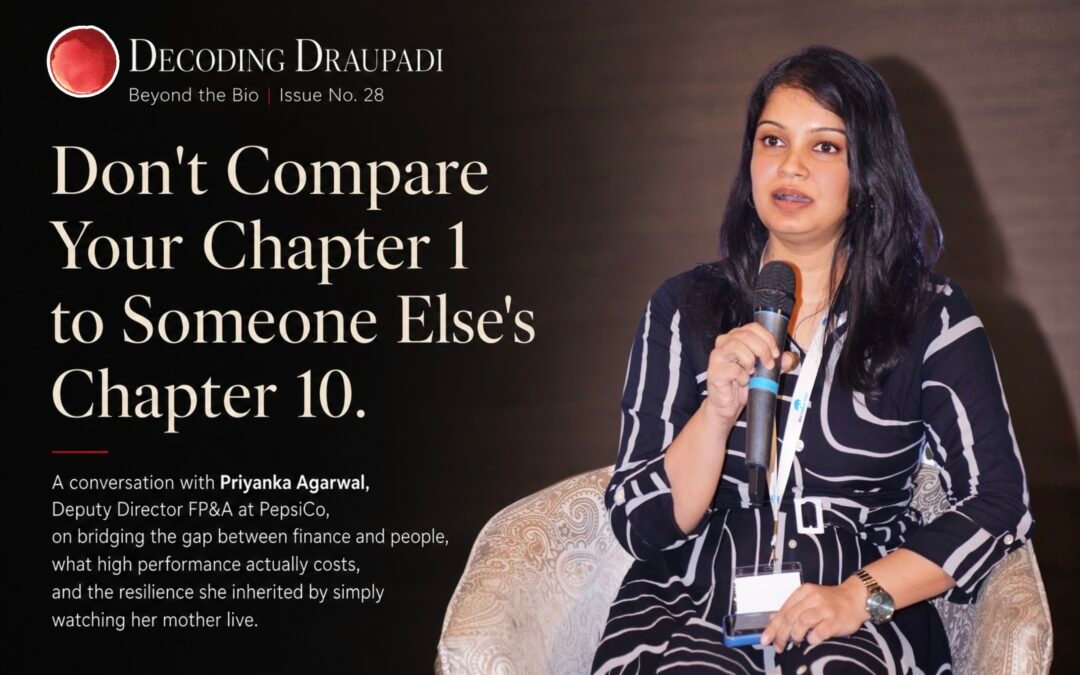
A conversation with Priyanka Agarwal, Deputy Director FP&A at PepsiCo, on bridging the gap between finance and people, what high performance actually costs, and the resilience she inherited by simply watching her mother live.
Priyanka Agarwal is a gold medallist CA who has skydived, fallen out of a river tube, shared stories with strangers, and hiked through silence in forests she did not know. She also leads financial planning and analysis for PepsiCo South Africa. She is the kind of person who brings the same quality of attention to a stakeholder negotiation and a solo trip to a country where she does not speak the language.
This conversation is one of the longest and most honest we have had in this series. She gives everything. It is worth reading slowly.
A Daughter Shaped by Resilience. A Traveller Who Needs to Feel Terrified and Alive.
Who is Priyanka right now, across the different lives she is living?
There’s no single version of me that exists anymore, and I think I’ve stopped trying to force myself into being just one person.
If someone had met me years ago, they would have seen a very driven CA student trying to survive exams, responsibilities, expectations and uncertainty. I carried a fear that I might not make it. Looking back, that fear became fuel. It led me to achieve more than I had imagined, not just qualifying but earning a gold medal along the way. But somewhere parallel to that life, another version of me was quietly growing: someone deeply curious about the world, who wanted to experience life beyond routines and checklists.
That version started travelling five or six years into working. For me, travel was never about seeing places as a tourist. It was about collecting experiences that made me feel alive. I have gotten lost in jungles, missed buses and trains in countries where I did not know the language, shared meals and stories with strangers, hiked through silence. Along the way I have tried skydiving, river rafting, and even fell out of a river tube and was safely rescued. These experiences made me realise not only how big the world is, but how kind people can be underneath all our differences.
During COVID, I threw myself into learning things purely because they fascinated me: jazz, contemporary, hip-hop, Bollywood, bachata, flexibility training, yoga, tried pole fitness, aerial hoops, indoor rock climbing. I loved understanding techniques, improvisation, rhythm, posture, the feeling of becoming comfortable in my own body instead of constantly criticising it. My bucket list keeps growing. I want to learn skiing, complete a paragliding course, learn guitar, learn swimming and eventually surfing. A part of me is always chasing experiences that make me feel both terrified and alive at the same time. Though over the last two years, most of these hobbies quietly took a backseat because I became deeply career-focused. But now, I’m slowly finding my way back to those parts of me again.
But while all these versions were evolving outside, home remained my emotional anchor. My mother raised us as a single parent after we were abandoned by my father during my childhood. There was a phase where stability felt very far away, yet she made sure my brother and I never stopped dreaming bigger. If resilience is one of my defining traits today, it is because I watched her practice it every single day. The ability to keep going despite uncertainty, adapt to situations, quietly carry responsibilities and still move forward with dignity: I learned that by simply watching her live and still do.
She supported every version of me, the CA student, the corporate professional, the girl who wanted to travel alone, the daughter who did not want to rush into marriage. During my CA days she would accompany me for institute visits, paperwork, internship searches. Looking back, I think she grew alongside me too.
My brother, in his own way, became another safe space. He has this habit of making me feel protected no matter how independent I become. If I randomly mention wanting something at 2 AM, he will still get up and make the effort even when I tell him not to. I think a huge part of my ambition came from wanting to make them proud.
Female friendships changed me too. I did not fully understand their value earlier, but now I think they have become one of the purest forms of support in my life. The kind where someone celebrates your wins, sits through your breakdowns and reminds you who you are when you forget. I naturally become a support system for people I care about, whether it is helping a friend prepare for an interview or simply being the person who shows up. If a friend is travelling somewhere, I’ll probably curate an entire itinerary for them along with safety instructions, backup plans and things to avoid. I find a lot of fulfilment in seeing the people I love become more confident in themselves.
At work, I evolved from someone timid on stage to someone who now sits on panels, speaks at events and contributes to conversations I once felt too intimidated to enter. Over the last few years, I stretched myself beyond what was expected, out of equal parts passion and self-doubt, and it paid off. People noticed. Opportunities came I grew
Right now, Priyanka is someone balancing many worlds at once: ambitious yet deeply emotional, independent yet extremely attached to the people she loves, adventurous yet introspective. Someone who can sit in corporate meeting rooms one day and disappear into forests or unknown streets another. She spent years chasing achievements and is now learning to make equal space for experiences, friendships and joy. Most importantly, she is still evolving. And that is her favourite version of herself.
“If resilience is one of my defining traits today, it is because I watched my mother practice it every single day.”
That line about watching her mother live is the kind of thing that stays with you. Not a lesson taught, not a value instilled in a conversation. Just a woman living through hard things with dignity, and a daughter paying attention. Priyanka has carried that into everything: the CA exams, the solo trips, the stakeholder negotiations, the team of seven. The source is visible in all of it.
Finance Versus Business Is the Wrong Frame
How do you make decisions when the financially correct answer and the human answer don’t fully align?
I’ve learned that these situations are rarely about choosing between the financial answer and the human answer. More often, they are about finding a solution that delivers the business objective while bringing people along in the journey.
I remember a situation where there was a gap between what leadership wanted to achieve and what the business believed was practically possible. My role was to bridge that gap by identifying fact-based opportunities and helping both sides align on realistic, data-backed assumptions. The first step was simply listening: understanding stakeholders’ constraints and why they felt certain targets were difficult. That shifted the conversation from Finance versus Business to how do we solve this together.
People are far more receptive when they feel understood rather than judged. By taking the time to understand their challenges, I was able to position myself as a partner working with them, not someone imposing targets on them. We worked together to identify opportunities, evaluate them through a financial and operational lens, challenge assumptions and build credible scenarios. Ultimately, both sides came onto common ground because the conversation was driven by facts, transparency and collaboration rather than positions or opinions.
That experience reinforced something I now believe completely: sustainable results come from building relationships, credibility and alignment. When people trust your intent and feel they have a voice in the process, the financially sound decision often becomes the human decision as well.
“When people trust your intent and feel they have a voice in the process, the financially sound decision often becomes the human decision as well.”
She is describing influence without authority, and doing it in a finance context where that is genuinely hard. The people she was working with did not report to her. She had to earn the right to shape their thinking. The way she did it, through listening first and building a shared fact base, is not a soft skill. It is a precise strategy. And it works because she had thought carefully about what actually moves people.
Nobody Is Coming With a Perfect Roadmap for You
What did adulthood or corporate life teach you that nobody really prepares you for?
That nobody is coming with a perfect roadmap for you. You have to become a go-getter and carve your own path.
Nobody really prepares you for how often things won’t go according to plan. Careers take unexpected turns, opportunities don’t always arrive when you expect them, and sometimes despite giving your best, you still fall short. You learn how to survive uncertainty, trust yourself even when there is conflicting advice around you, and keep moving forward despite setbacks. Corporate life especially teaches you that opportunities don’t always arrive neatly packaged; sometimes you have to create them yourself by taking initiative, speaking up, learning continuously and staying adaptable.
A book that changed how I think is Man’s Search for Meaning. One line has stayed with me for years:
“Everything can be taken from a man but one thing — the last of the human freedoms, to choose one’s attitude in any given set of circumstances.”
Whenever I struggle or fail, I try not to focus on blame or circumstances. I ask: what can I do differently? What can I learn? What will help me win the next time? Growth usually begins when you focus on what is within your control.
Over time I also realised that growth is not just about persistence. It is about judgment and self-awareness. Not every feeling needs to become an action. Sometimes maturity is knowing where to draw the line, respecting boundaries and choosing what aligns with your values even when emotions suggest otherwise.
“Not every feeling needs to become an action. Sometimes maturity is knowing where to draw the line.”
The Viktor Frankl line is one of the most cited in self-development, but Priyanka has made it operational rather than decorative. She has a three-question framework she actually runs when things go wrong. That is the difference between inspiration and practice. And the maturity line at the end — not every feeling needs to become an action — is one of the most useful things in this conversation, and she says it without fanfare.
Fulfilled or Just Better at Functioning Under Pressure?
Do you think high-performing professionals today are actually becoming more fulfilled, or just better at functioning under pressure?
I think it depends on what is driving the individual and what success means to them at that stage of life.
For some, high performance comes from genuine passion, curiosity and a desire to create impact. They are willing to go above and beyond because they are aligned with a purpose that excites them. In those cases, performance can be deeply fulfilling.
For others, the motivation may be stability, financial security or specific career goals. They become better at functioning under pressure, managing stress and balancing competing priorities. There is fulfilment in that too, even if it looks different.
The same person can experience both at different points in life. Priorities evolve with changing life phases and responsibilities. There are times when we push aggressively for growth and times when maintaining balance becomes equally important. Fulfilment comes less from the pressure itself and more from whether our efforts are aligned with what matters most to us in that particular phase. The zeal and purpose behind the work determine whether high performance feels energising or simply exhausting.
“Fulfilment comes less from the pressure itself and more from whether our efforts are aligned with what matters most to us in that particular phase of life.”
She refuses the binary, and she is right to. The question implies that high performance and fulfilment are in tension. Priyanka is saying: sometimes they are, sometimes they are not, and the variable is alignment, not the intensity of the work. That is a more honest answer than most people give, because it requires admitting that the same person can be in very different places at different points.
Waiting for Opportunities Is Not a Growth Strategy
What is one belief about career growth or success that you have had to unlearn?
Early in my career, I believed that doing assigned work accurately and on time was enough for growth. For a few years, I focused on delivering consistently while maintaining a balanced approach.
Over time I became more ambitious and realised that growth does not always come from waiting for opportunities to be handed to you. Sometimes you have to create them yourself: by taking initiative, volunteering for challenging work, building new skills and making your aspirations visible.
I also had to unlearn the limits I had unconsciously placed on myself. Challenging assignments are not obstacles to avoid. They are often the experiences that teach you the most. The projects that stretch you, make you uncomfortable and push you into unfamiliar territory are usually the ones that accelerate your growth the most. Taking risks has been another important lesson. It’s natural to gravitate toward what’s familiar and comfortable, but real growth often happens when you’re willing to step into uncertainty.
Another belief I had to unlearn was the need to chase perfection. Early on, I thought every piece of work had to be flawless before it could move forward. Over time, I realised that perfection often creates unnecessary anxiety and delays action. Progress, learning and adaptability matter more.
I also redefined what success means. Not just promotions or titles, but doing higher-quality work, earning a seat at the decision-making table, influencing meaningful outcomes and continuously expanding my impact. For me, success is as much about growth and contribution as it is about career progression.
“Growth does not always come from waiting for opportunities to be handed to you. Sometimes you have to create them yourself.”
The unlearning of perfectionism is something almost everyone in this series has mentioned in some form, but Priyanka frames it practically: perfectionism delays action. That is the actual cost of it, not that the work is worse, but that it does not move. And the redefinition of success away from titles toward influence and impact is a maturation that most people go through slowly. She has named it explicitly, which means she has made it conscious.
Numbers Bring Clarity. They Don’t Always Tell the Full Story.
Do you think numbers make people more objective or more anxious?
Both, depending on the situation.
In performance-driven environments, numbers bring clarity, accountability and a more objective basis for evaluation. Most people generally have a fair sense of how they are performing and what to expect.
That said, numbers do not always tell the complete story. Sometimes strong individual efforts are overshadowed by external factors: market conditions, economic challenges, things beyond anyone’s control. In those situations, appreciation and recognition become important. Acknowledging effort and ownership can go a long way in sustaining motivation when outcomes are not fully within someone’s control.
Anxiety usually arises in two situations: when people compare themselves to high performers without understanding the additional effort and sacrifice behind those results, and when the evaluation process feels unfair or inconsistent. Any lack of transparency in performance assessment can naturally lead to anxiety and disengagement. Numbers are valuable because they create objectivity, but they need to be complemented with context, recognition and fair judgment.
“Numbers are valuable because they create objectivity. But they need to be complemented with context, recognition and fair judgment.”
She works in FP&A, so this is not abstract. She lives inside the numbers. And the fact that she is the one arguing for context and recognition alongside the data says something about how she has developed as a leader. The most dangerous thing in a performance culture is not the metrics themselves. It is the assumption that the metrics are the whole picture. Priyanka knows the difference.

When an Idea Evolves Into Action and Contributes to a Real Outcome
What kind of work gives you the deepest sense of satisfaction beyond titles or financial outcomes?
Influencing meaningful business decisions and seeing ideas translate into tangible impact. There is something deeply fulfilling about spotting an opportunity, helping shape the thinking around it and ultimately seeing it come to life within the business.
I am naturally curious about how businesses grow and evolve. I explore perspectives from investor calls, town halls, industry discussions, macroeconomic trends and podcasts, and I enjoy connecting those insights back to the business. What excites me most is identifying opportunities, discussing them with leaders, learning from teams that have implemented similar initiatives and understanding how they can be adapted to our context.
The most rewarding moments are when an idea evolves into action and contributes to a business outcome. Knowing that I helped shape a strategy, brought stakeholders together and influenced the execution gives me a strong sense of purpose.
I find myself increasingly drawn to the idea of sustainability and creating positive impact at scale — the possibility of combining business value with broader social and environmental outcomes. It is something I have not yet tapped into, but it is a direction that genuinely excites me.
“The most rewarding moments are when an idea evolves into action and contributes to a real outcome. Knowing that I helped shape the thinking, brought people together and influenced the execution.”
The word influenced is doing important work here. She is not saying she executed it, or that she owned it. She is saying she shaped the thinking and brought people together. That is a specific kind of contribution that is very easy to undervalue in performance reviews but very hard to replace in practice. It is also, I think, where Priyanka is most naturally herself.
Don’t Compare Your Chapter 1 to Someone Else’s Chapter 10
If someone early in their career feels intimidated by everyone else seeming more successful or ahead, what would you genuinely tell them?
Don’t compare your Chapter 1 to someone else’s Chapter 10.
It is very easy to walk into a workplace, look around and feel like everyone else is smarter, more confident or more successful. What we often see is the final outcome, not the years of learning, mistakes, setbacks and uncomfortable growth that came before it. The people you admire today were once navigating the same uncertainties you are facing right now. They simply stayed in the game long enough to learn from those experiences.
Your career is not a race against other people. It is a journey of becoming a better version of yourself. Lean into what you do well, because your strengths are often where your unique value lies. At the same time, be intentional about working on your areas for growth. Over the years, many of the things that once felt like weaknesses can become strengths if you consistently invest in them.
The goal is not to be ahead of everyone else. The goal is to keep moving forward, keep learning and keep growing. And one day, someone else at the beginning of their journey may look at you and wonder how you became so confident, without realising the chapters it took to get there.
“Don’t compare your Chapter 1 to someone else’s Chapter 10.”
She closes with the line that opened this piece, and it earns its place at both ends. The reason it works is not because it is original — many people have said some version of it. It works because Priyanka has lived it. The CA student who feared she might not make it, the woman who earned a gold medal and then kept going, the professional who was once too intimidated to enter certain rooms and now sits on panels: she is the Chapter 10. She was also the Chapter 1. She remembers both.

A Note From Decoding Draupadi
What stayed with us from this conversation is the mother. Again.
This is the second time in recent issues that the most important sentence in the whole piece is about a woman who raised her daughter alone, under difficult circumstances, without a roadmap, and gave her something no classroom could: the sight of resilience practiced daily, with dignity.
Priyanka did not describe her mother as a lesson or a role model. She described watching her live. That is a different thing. You do not teach someone that way. You just show them what is possible. Even today, Priyanka continues to draw inspiration from watching her mother’s resilience in action everyday.
We think that is worth carrying forward.
If this felt like someone you know, share it with her.
Priyanka Agarwal is Deputy Director, FP&A Category Lead South Africa at PepsiCo. This interview was conducted as part of the Decoding Draupadi Brand Manager Series.
When people trust your intent and feel they have a voice, the financially sound decision often becomes the human one too. On bridging the gap, at @decodingdraupadi.