
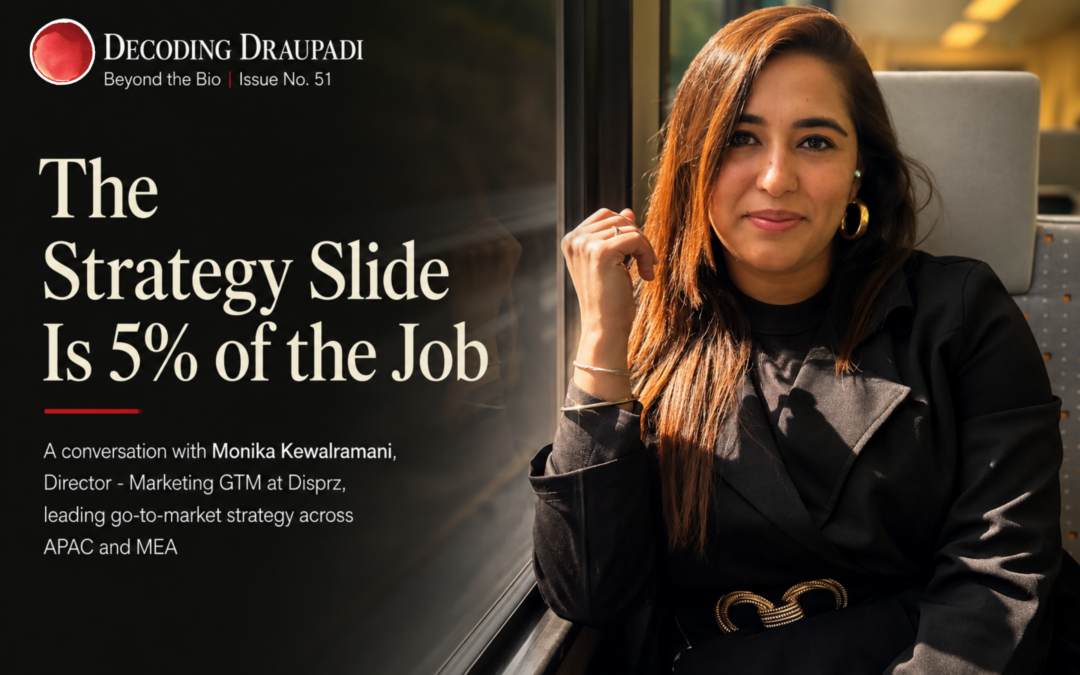
A conversation with Monika Kewalramani, Director – Marketing GTM at Disprz, leading go-to-market strategy across APAC and MEA
Monika runs go-to-market strategy across markets that don’t share a language, a time zone, or a playbook, while raising a two-year-old who wants the same toy shown to her for the fifteenth time like it’s brand new. The thread running through everything she said is unglamorous, deliberate maintenance work. The kind nobody puts on a highlight reel, but the kind that actually holds a career, a marriage, and a toddler’s world together.
There’s No Dashboard For That Job
Who is Monika right now, across the different lives you’re living?
Wow now this answer has to be a long one. At work, I’m someone who holds a lot of moving parts at once, campaigns running across the APAC region, an event booth set-up one week and a vendor dispute the next. That version of me is decisive, fairly unbothered by chaos, because the job has trained her to be.
At home, I’m someone else entirely, mother to a two-year-old who is fiercely, wonderfully attached to me, in the way toddlers are when they’ve decided you’re their whole world. That version of me doesn’t get to be “strategic.” She gets pulled into the present moment whether she likes it or not, a tantrum, a request to be picked up, a small person who wants to show me the same toy for the fifteenth time like it’s brand new. There’s no dashboard for that job, no framework, just showing up.
With Ankit (my husband), I think I’m the version that’s trying to hold both of the above without dropping either, some days managing that better than others.
With friends, I’m probably the most unfiltered version, the one who still shows up for an evening even on the days it feels indulgent to leave the house.
And then there’s the quiet version in my own head, the one negotiating, mostly privately, with the guilt that comes standard with being a working mother. Wondering if the hours at work are hours she’s borrowing from her son, and if the hours with him are hours the career is quietly noting as a gap. I don’t think that version ever fully resolves. She just gets a little more practiced at carrying the question without it stopping her.
“She just gets a little more practiced at carrying the question without it stopping her.”
This is the answer we ask this question hoping to get, and almost never do. Most brand managers reach for the job title. Monika reached for the guilt, the toddler, the version of herself that only exists at 11pm in her own head, and named all of it without flinching.
Kindness Is the One Thing That Hasn’t Needed Translating
What has working across such different kinds of marketing taught you about people that no framework or playbook ever could?
That kindness and empathy travels further than any strategy does.
Working across different countries in APAC, I’ve worked with people who speak different languages, sit in different time zones, and operate under completely different market pressures. No playbook holds up evenly across all of that. But empathy does. Checking in on a colleague or a vendor because they’re having a hard week, not because a deal needs them. Remembering something personal and following up on it later. Being genuinely warm with someone even when there’s nothing transactional riding on it. That’s not in any GTM deck, and it’s usually the actual reason a relationship survives a tough quarter and another one doesn’t.
Every framework I’ve used has been market-specific. In the end what works in Manila doesn’t automatically work in Jakarta. Kindness is the one thing that hasn’t needed translating, not once, anywhere I’ve worked. That’s the real lesson: treat the person before you treat the stakeholder, everywhere, always, and the rest tends to follow.
“Kindness is the one thing that hasn’t needed translating, not once, anywhere I’ve worked.”
Every market Monika operates in has its own definition of professional. What she’s noticed is that none of them have a different definition of decent. That distinction is worth sitting with if you’ve ever been told to localize everything, including how much you care.
Keeping the Instinct, Building the Numbers Case Around It
Has there ever been a phase where you felt pressure to become a more “acceptable” or conventional version of yourself professionally?
Yes. I think it showed up most clearly in the move from being a Brand Manager to owning GTM strategy across a whole region. Brand work lets you be instinctive, a little creative, a little “vibes-based” in the best sense. The moment you’re sitting across from revenue, pipeline, and multiple country stakeholders, there’s real pressure to sound more buttoned-up, to lead with numbers before instinct, to sound “strategic” in the way that gets nodded at in a leadership meeting, even when your first read on a situation was the right one. I had to learn to keep the instinct and just build the numbers case around it, instead of leading with the numbers and hoping the instinct still fit somewhere.
“I had to learn to keep the instinct and just build the numbers case around it, instead of leading with the numbers and hoping the instinct still fit somewhere.”
So many brand people quietly abandon the instinct once the meetings get bigger. Monika didn’t abandon it, she just learned to translate it. Small distinction, completely different outcome.

Doing More Is Not the Same As Doing the Right Things
What is a belief about success that you held in your twenties that you no longer believe today?
I think I believed success meant being visible everywhere saying yes to every campaign, every event, every extra task, because turning something down felt like admitting you couldn’t handle it. Running GTM across multiple markets in parallel cured me of that fairly quickly. I don’t believe anymore that doing more things is the same as doing the right things. Some of the best strategic calls I’ve made have been the ones where I said no early, not the ones where I said yes to everything and stayed late.
“I don’t believe anymore that doing more things is the same as doing the right things.”
A toddler and a multi-market GTM calendar will teach anyone this lesson faster than a leadership course ever could. There simply isn’t enough of Monika to go around, and she’s stopped pretending otherwise.
Nobody Notices Which Side Got the Tired Version
What is something you’re still figuring out privately, even though externally your career may look very sorted?
From the outside, it probably looks like I’ve got all of it figured out, a toddler, a husband who’s often away at sea, and a career spanning multiple markets, all somehow running in parallel without visibly falling apart. It reads as “she’s sorted.”
Privately, I haven’t figured it out at all. A lot of the days are solo, solo parenting a toddler through tantrums and playschool runs, while also solo-managing a team and a set of markets that don’t pause because home got hard that week. The part I’m still working out is how to actually lead a team well, give people real attention, catch the things that need catching, not just triage on the days when I’ve already spent my sharpest hours on a toddler who needed me more than the inbox did. I don’t think I’ve solved that split. I’ve just gotten reasonably good at making sure nobody, at home or at work, notices which side got the tired version of me that day.
What I’m still figuring out is whether “sorted” is even the right word for any of this, or whether it’s just that none of the plates have dropped yet and I’m quietly aware that’s not the same thing as having it figured out.
“I’ve just gotten reasonably good at making sure nobody, at home or at work, notices which side got the tired version of me that day.”
This is the line that stayed with us longest. Not the toddler, not the GTM markets, but the husband away at sea and the quiet math Monika is running alone, most days, without an audience for either the parenting or the leading.

Ambition With Better Filters
Do you think ambition becomes healthier or more exhausting as people grow older?
I think it becomes more selective, and that selectivity is what people mistake for becoming “healthier.” In your twenties ambition is often just volume, say yes to everything, be visible everywhere, take on the event, the campaign, the extra scope. Somewhere in a role like mine, spanning multiple markets and functions, you physically cannot keep operating that way. You start choosing which fires actually matter and which ones will resolve themselves. That’s not less ambitious, it’s ambition with better filters. Whether that’s “healthier” depends on whether you’re doing the filtering on purpose or just because you’re too tired to chase everything anymore. Those look identical from the outside but feel completely different from the inside.
“That’s not less ambitious, it’s ambition with better filters.”
The distinction Monika draws here, between choosing on purpose and choosing from exhaustion, is one worth asking yourself honestly. They look the same in a calendar. They don’t feel the same at 11pm.
The Unglamorous Plumbing Behind Every Highlight Reel
What is something people rarely talk about when discussing long careers and sustained growth?
How much of it is unglamorous coordination work that never shows up in a highlight reel. Nobody writes a LinkedIn post about chasing a vendor for three months over an undelivered database despite full payment, or sorting out which team gets attribution credit for a deal, or the fifteen Slack threads it takes to hand a lead from marketing to BDR to sales without it falling through a crack. But that invisible plumbing, the follow-ups, the internal alignment, the patience with ambiguity is most of what “growth” actually is day to day. The strategy slide is 5% of the job. The other 95% is making sure the unglamorous parts don’t quietly sabotage the 5%.
“The strategy slide is 5% of the job. The other 95% is making sure the unglamorous parts don’t quietly sabotage the 5%.”
We hear a version of this in nearly every interview in this series, and it never stops being worth repeating. The highlight reel is real, but it is never the whole job, and Monika is one of the few people willing to name the ratio out loud.
A Note From Decoding Draupadi
The detail we keep returning to is the husband away at sea, and the days that leaves Monika running a toddler and a multi-market team entirely on her own, with no one clocking which one got shortchanged. That is not a detail she offered for sympathy. She offered it as fact, in the middle of an answer about leadership, because for her the two are not separate stories. This is exactly why we started this series, to put on record the parts of a career that never make it into a bio line. If this felt like someone you know, share it with her.
Know a brand manager whose real story deserves this kind of space? Send them our way.
Monika Kewalramani is a Director – Marketing GTM at Disprz. This interview was conducted as part of the Decoding Draupadi Brand Manager Series.
Follow @decodingdraupadi for the next one.