
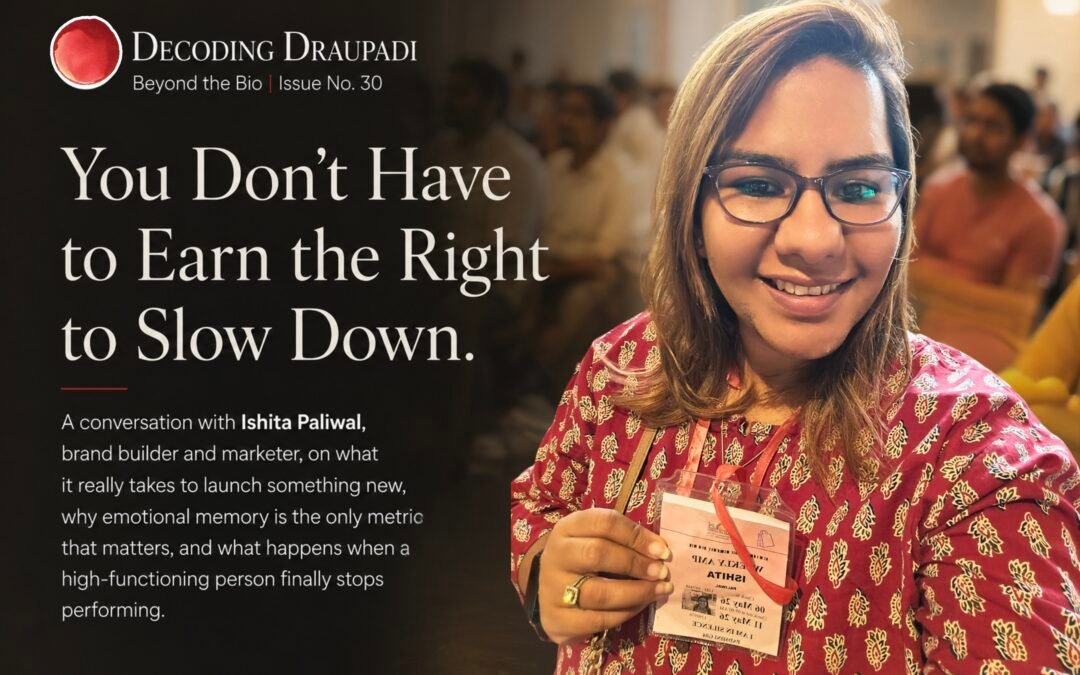
A conversation with Ishita Paliwal, brand builder and marketer, on what it really takes to launch something new, why emotional memory is the only metric that matters, and what happens when a high-functioning person finally stops performing.
Ishita Paliwal launched a 117-villa luxury resort in Udaipur, relaunched New Balance in India, and took ITC Hotels international with a campaign that generated over 100 million impressions. She has done the kind of work that looks effortless from the outside precisely because so much of the effort is invisible.
This conversation is about what that invisible work actually costs, and what Ishita has learned about sustaining yourself through it. She is honest in a way that high-performers rarely allow themselves to be, and it shows.
Holding Ambition and Softness at the Same Time
Who is Ishita right now, across the different lives she is living?
Right now, Ishita is someone who is learning how to hold ambition and softness at the same time.
Professionally, I’ve always been very driven. I genuinely enjoy building things: brands, experiences, ideas, teams. There’s a part of me that comes alive in high-energy environments where something meaningful is being created from scratch. That version of me is strategic, expressive, constantly thinking ahead.
But outside of work, I’ve been reconnecting with quieter parts of myself. Over the last few years I’ve realised that achievement alone doesn’t sustain you. That’s why I decided to intentionally slow down, take a short break from the corporate world, and travel solo for some time. To feel present, to protect my peace, and to understand myself beyond productivity. I’ve been on a spiritual healing journey, learning meditation, learning to draw healthy boundaries in personal and professional space.
I’m also someone who deeply values relationships: family, friendships, conversations, shared moments. The older I’ve grown, the more I’ve understood that success feels incomplete if you don’t have people and experiences that emotionally anchor you.
There are definitely multiple versions of me coexisting right now: the ambitious professional, the emotionally reflective person, the wife, the friend, the person trying to heal and grow in private while still showing up confidently in public. And honestly, I’m still figuring out how all those versions can exist together without one cancelling the other out.
During that time, I also started creating content for myself. I had spent years building content for brands, and somewhere in the middle of all that travel, I thought: why not try it for myself? It was the first time I was the brand.
“Achievement alone doesn’t sustain you.”
She said this so plainly, like it was obvious. But I don’t think it is obvious, not when you are in the middle of building impressive things and the momentum feels like enough. Ishita has clearly reached the point where she knows the difference between motion and meaning, and she is being very honest about what it took to get there.

The Question Was Never How to Get Attention
What have launching brands like Mementos and relaunching New Balance taught you about introducing something new into people’s lives?
People often assume launching something new is about visibility: bigger campaigns, louder messaging, more reach. But what I’ve learnt is that it is actually about creating emotional relevance.
Whether it was working on a luxury hospitality brand like Mementos or being part of the New Balance relaunch in India, the challenge was never just how do we get attention? It was: why should people care enough to emotionally invest in this?
People don’t remember brands because they saw an ad. They remember how a brand made them feel about themselves, their aspirations, or the kind of life they want to live. That’s what makes brand-building exciting to me. It sits at the intersection of culture, psychology, storytelling and experience. You’re not just selling a product or a property. You’re creating meaning around it.
And honestly, launching something new also requires patience. Not every idea lands instantly. Sometimes the real work is consistency: showing up repeatedly until trust is built.
“You’re not just selling a product or a property. You’re creating meaning around it.”
The patience point is the one I think gets skipped most often in conversations about launches. The campaign, the activation, the press coverage: all of that is visible and measurable. But Ishita is pointing at something slower and harder to justify in a debrief: the compounding effect of showing up consistently until people start to believe you. That is not exciting. It is essential.
The Categories Change. Human Emotion Doesn’t.
How has working across luxury hospitality, sportswear, and retail shaped what you believe stays constant in brand building?
The categories may change, but human emotions don’t.
Luxury hospitality, sportswear, retail: on the surface they are very different industries. But at the core, people are still looking for identity, aspiration, belonging, comfort, confidence, or escape. That’s the constant.
What changes is the language, the pace, and the way you deliver the experience. Luxury hospitality is deeply sensory and immersive. It’s slower, more emotional, more detail-oriented. Sportswear and retail move much faster and are tied to culture, momentum and community.
Working across these spaces taught me that strong brands are not built by copying trends blindly. They’re built by deeply understanding human behaviour within a specific context. The strategy changes. The platforms change. Consumer expectations change. But authenticity, consistency and emotional connection: those things remain timeless.
“The categories change. Human emotions don’t.”
This is the kind of insight that sounds simple and takes years to actually earn. Most marketers know their category. Ishita has moved across three very different ones and found the common ground underneath all of them. That is not just pattern recognition. It is a way of thinking about people that travels with you wherever the work takes you.

I Think About Emotional Memory
How do you approach building something that people don’t just see, but actually feel and remember?
Memorable brands are built through experiences that feel intentional. People may forget a campaign line, but they remember how something made them feel in a moment: the energy of a launch, the atmosphere of a space, the emotion attached to an interaction, even the smallest details.
So whenever I work on a brand or experience, I try to think beyond just communication. I think about emotional memory. What should someone feel when they enter this space? What should stay with them after they leave? What story are they subconsciously telling themselves while engaging with this brand?
Consistency matters enormously too. A brand becomes memorable when every touchpoint feels aligned: visually, emotionally and culturally.
And I’ve realised that audiences today are extremely intuitive. They can sense when something is manufactured versus when it genuinely has thought and soul behind it. That honesty makes a difference.
“I try to think beyond just communication. I think about emotional memory.”
Emotional memory as a design brief: that reframe changes how you approach every decision in a launch. Not what does this look like, but what will this feel like to someone standing in it six months from now? Ishita has clearly been using this as her filter for a long time, and you can see it in the scale of work she’s been trusted with.
Returning to Yourself, Slowly and Honestly
Has there been a phase where everything looked stable from the outside but felt overwhelming from the inside? What helped you find your footing?
Definitely. There have been phases where, externally, things looked stable: career progression, good opportunities, exciting projects. But internally I felt disconnected, exhausted, or unsure of myself.
High-functioning people often become very good at continuing to perform even when they’re emotionally overwhelmed. I was one of them.
What helped was learning to pause before reaching burnout. Therapy helped. Meditation helped. Silence helped. Even creating distance from noise and constantly being on helped.
I also started becoming more honest with myself about what success actually means to me personally, versus what simply looks impressive externally.
Finding your footing again is less about suddenly becoming fearless and more about returning to yourself slowly, honestly and consistently.
“Finding your footing again is less about suddenly becoming fearless and more about returning to yourself slowly, honestly and consistently.”
She named therapy directly, without hedging. In a series that talks a lot about ambition and performance, that matters. And the distinction she draws between what success means to her versus what looks impressive externally is one that I think a lot of people in high-visibility careers need to sit with. Those two things are not always the same, and it takes courage to admit that.

You Don’t Have to Earn the Right to Slow Down
What has been hardest for you to set boundaries around as your roles have evolved?
Probably the expectation that I should always be available, capable and composed.
When you’re someone people rely on professionally, it becomes very easy to tie your self-worth to being dependable all the time. Saying yes feels productive. Being needed feels validating.
But over time, I realised that constantly overextending yourself eventually disconnects you from your own needs.
The hardest boundary for me has been understanding that rest is not guilt, and that I don’t have to earn the right to slow down.
I’m still learning this, honestly. Boundaries become difficult when your identity is strongly tied to performance. But I’ve started understanding that protecting your energy is not selfish. It’s necessary if you want to sustain creativity, clarity and emotional well-being long term.
“Rest is not guilt. You don’t have to earn the right to slow down.”
This is the line that earned the title of this piece. And I think it will land hard for a lot of women reading it, because so many of us have been quietly operating on the opposite belief: that rest has to be justified, that slowing down has to be earned, that being needed is proof of worth. Ishita is dismantling all three of those at once. Slowly, she says. She is still learning it. That honesty is exactly why it lands.
What You Don’t See Is Most of the Work
What do people oversimplify or not fully see about the kind of work you do?
One thing people often oversimplify is how much of brand and launch work is actually emotional labour, not just strategic execution.
From the outside, people see the final campaign, the launch event, the visuals, the success metrics. What they don’t see is the uncertainty, the alignment work, the problem-solving and the emotional resilience that goes into making all of that come together.
In high-stakes launches, you are constantly balancing multiple realities at once: business expectations, creative vision, consumer behaviour, timelines, team dynamics, unforeseen setbacks. A lot of the work happens in invisible moments: difficult conversations, late pivots, managing pressure quietly, holding the energy of a team when things become chaotic.
People also underestimate how deeply observational this work is. Good brand-building is not just creativity for aesthetics. It is about understanding people: what they aspire to, what they’re afraid of, what makes them trust something, what makes them emotionally connect.
And there is a personal side to it too. When you spend months or years building something, a part of your identity gets attached to it. When something succeeds, it feels deeply rewarding. When something doesn’t land the way you hoped, you feel that too. It’s far more layered, human and emotionally demanding than it appears from the outside.
“A lot of the work happens in invisible moments: difficult conversations, late pivots, managing pressure quietly, holding the energy of a team when things become chaotic.”
Holding the energy of a team when things become chaotic. That one line contains a whole leadership philosophy. It is not about having the answers. It is about being the person in the room who does not let the panic become contagious. Ishita has clearly been that person on very large, very visible projects. The fact that nobody outside the room ever sees that work is exactly the point.

A Note From Decoding Draupadi
What stayed with us from this conversation is the image of a high-functioning person who has become very good at performing even when emotionally overwhelmed. Ishita said it about herself, directly, without softening it. And in doing so she named something that a lot of women in ambitious careers are living but rarely saying out loud.
The work she has done is extraordinary. The launches, the campaigns, the hundred million impressions. But the most interesting thing in this conversation is not any of that. It is the moment she decided to slow down before the burnout arrived. To travel alone. To go quiet. To stop earning the right to rest and just rest.
We think that is the harder launch. And we think she nailed it.
If this felt like someone you know, share it with her.
Ishita Paliwal is a brand builder and marketer, previously Deputy Brand Manager at ITC Hotels Limited, where she led the launch of Mementos by ITC Hotels and the relaunch of New Balance India. This interview was conducted as part of the Decoding Draupadi Brand Manager Series.
People don’t remember brands because they saw an ad. They remember how a brand made them feel. On building for emotional memory, at @decodingdraupadi.