
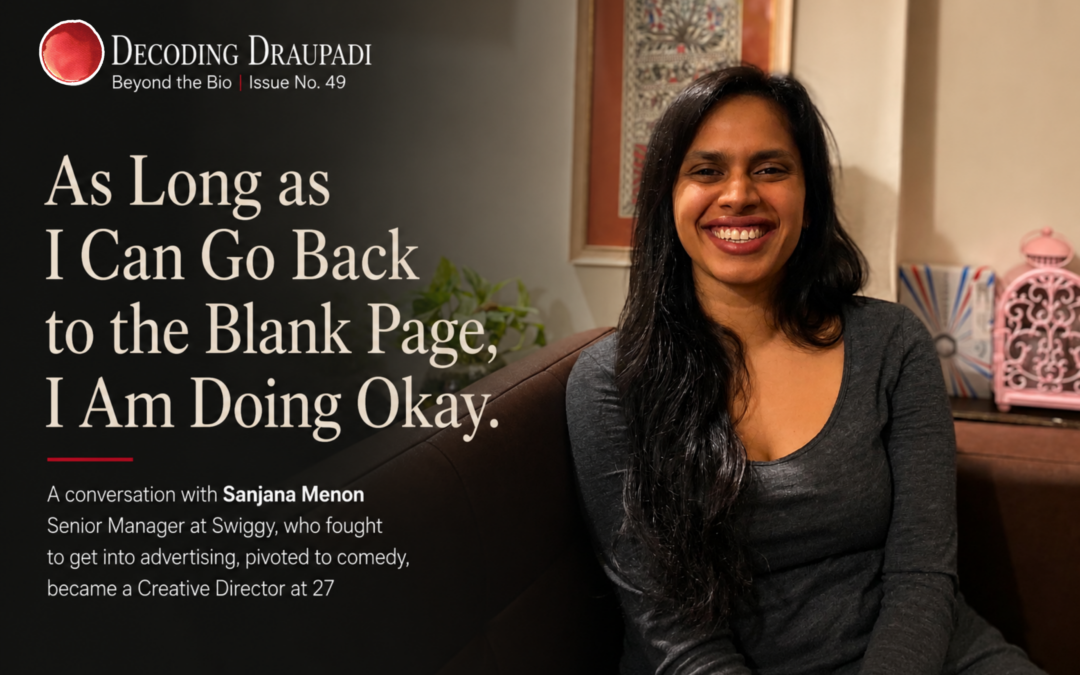
A conversation with Sanjana Menon, 29 (Y) Senior Manager (Brand Marketing) at Swiggy, who fought to get into advertising, pivoted to comedy writing for a YouTube channel and performed standup at open mics before anyone understood why, became a Creative Director at 27, had an existential crisis immediately after, and found out who she really was at a college interview she nearly did not apply for.
Sanjana Menon has been in advertising for eight years. She has written for ScoopWhoop, Netflix’s title marketing and 20+ brands. Some of her most viral pieces include Swiggy’s memeverse and its second rendition collectively reaching over 50 million people and most recently, an Instamart guerilla outdoor of a mango ambulance for India’s mango fever that took over everyone’s feed.
She has won awards at: Kyoorius Creative Awards, Good Ads Matter, Mad Over Marketing, Campaign India Digital Crest Awards and IAMAI. Her earliest exposure to comedy writing was when she added jokes in subtitles of comedy videos for ScoopWhoop and FilterCopy. Jokes for which she hilariously gets messages and even sometimes recognised in person till date.
She considers herself annoyingly enthusiastic about advertising and also, a complete homebody. Both are completely true. This conversation is about that gap between the two worlds, and what happened in the years between.
Hyperactive at Work. Biggest Homebody at Home.
Who is Sanjana right now, across the different lives you are living?
Her journey into this field wasn’t the easiest. Despite being an English Literature graduate from St. Xavier’s College, she always saw herself in the field of advertising thanks to her father belonging to said field. After noticing that no creative agencies were arriving at her college placement cell, for months she pestered the team and finally sat in on a junior copywriter placement which was actually for BMM students and ended up getting the job.
After all that, she is now the person in the room who says yes to every brief, who asks colleagues if there is something more she can help with, who finds energy in creative problems rather than being drained by them.
At home, she is the exact opposite. Complete homebody. Low energy. The hyperactive, hyper-organised person in her personal life is her husband. Her ideal weekend is watching The Office with her dog. She gave her dog a bath that morning before this conversation, and she considers that a very productive Saturday.
She wonders sometimes if that division is a creative thing: she puts so much of her brain into solving things all week that she genuinely wants to do nothing. She has found a lot of comfort in the mundane. She does not think it is mundane at all, actually.
“I get so immersed in my work, in a good way, that later I just want to watch The Office and switch off. I’ve found a lot of comfort in the mundane.”
The comfort in the mundane is the most interesting detail she offers. Not someone who burns out and retreats. Someone who loves the work so much that the reset has to be the opposite: completely undemanding, completely unstructured. The dog bath is the counterweight to all the awards.

Have the Courage to Go Back to the Blank Page
When your creativity becomes your profession and is constantly judged by views, engagement, awards, or virality, how do you protect the part of creativity that is still just yours?
Awards: do not get attached. That was the first thing her parents drilled into her, and it turned out to be the right thing. She has won some, and she is glad of them. She has also had years where nothing was entered and nothing was won, and that was fine too. Juries change. Teams change. Work of the year depends on so many things that attaching your identity to the outcome is a losing game.
What she values more than any award is a message from someone she respects in the industry, a supervisor, a colleague whose writing she admires, saying this was a banger. That has meant more to her than mainstream reach most of the time.
The algorithm and the content that the online audience enjoys is always evolving.
The memeverse idea showcasing a chaotic group of the most viral human memes to promote Swiggy’s group ordering blew up in not just likes and comments but also a million shares, truly unprecedented in the industry at the time.
While Instamart’s mango ambulance idea, just a physical manifestation of India’s urgent love for mangoes also broke records in the reach it received across platforms, without any creator whatsoever.
Today, a good idea isn’t enough. Understanding the platform is essential too. The aim is to give it your best shot and hope that in the endless scroll, the audience pauses for your work.
Her actual measure of a good career: can she still go back to the blank page? If she wakes up and approaches that page with dread or disappointment, no amount of awards makes it okay. If she can go back to it with the same excitement she had at the beginning, she is doing well.
“My biggest goal is that I should never go to the blank page with disappointment. As long as I can go back to it with the same excitement, I’m doing okay.”
She names something most creative people feel but rarely say this precisely: the awards and the virality are evidence, not the thing itself. The thing itself is the excitement at the blank page. Lose that and you have lost what matters most, regardless of what is on the shelf.
Became a Creative Director at 27. Had an Existential Crisis Immediately.
Have you ever outgrown a version of success you once wanted very badly?
On the agency side, she had one overriding goal: Creative Director, ideally before 30. She got there at 27, while leading Netflix India’s title marketing at an agency called EO2 EXP. And then she had no idea what was next. There was so much more of her career left, and the goal she had been chasing was gone.
When she moved to the client side at Swiggy, she went from being the most senior person in a room full of young writers to being the most junior person in a room full of ex-Ogilvy/McCann and other industry veterans. Her title changed. The ecosystem changed. She realised that the race she had constructed in her head was very small in the larger scheme of things, and that titles change depending on where you are.
Once she stopped chasing the next role and started focusing on good work instead, she started actually enjoying the jobs she was already in.
“When I stopped chasing that goal and just focused on doing good work, I started actually being grateful for how far I’d already come. And realised that I’m just getting started.”
The existential crisis after achieving a goal is something most people do not talk about. She names it directly: she got what she wanted, and then felt completely lost because she didn’t know what’s next. That is an uncomfortable thing to admit and a very useful thing to hear.

Left a Stable Ad Job to Write Jokes for a YouTube Channel. Everyone Was Against It.
What is the risk you have taken that looked questionable to others but made complete sense to you?
Six months into her first advertising job, she left to join ScoopWhoop. This was when YouTube comedy content was just beginning in India. She had no comedy writing experience and was just doing a few standup open mics every now and then. Her parents were not the happiest about this but still supported the call.
At ScoopWhoop she did everything: wrote topical jokes in a writers’ room, went on set as an extra to save budget, wrote subtitles with inside jokes too. And through standup she eventually wrote a show bible with a comedian she admired. This helped her realise that she enjoyed writing the jokes more than performing them.
She learned to be okay with jokes not landing, which turned out to be the most important skill she would ever develop as a creative. You cannot keep finding the funny if you cannot be okay with the unfunny. It’s what makes you keep trying.
The pivot also gave her something she could not have gotten in a conventional ad job: confidence. She was in an ecosystem where everyone was on the same level, all just comedy writers trying to do something funny, no hierarchy, no performing seniority. She learned to pitch ideas in a room without being afraid of them not working. That confidence moved with her into every ad job after.
“ScoopWhoop taught me to be okay with the unfunny. If you can be okay with the unfunny, you will keep striving to find the funny. That moved with me into every job after.”
She describes the pivot as the thing that made her okay with herself as a writer, which is more fundamental than any career move. She had been writing in professional environments where the idea either landed or was rejected. ScoopWhoop was an environment where not landing was part of the daily process. That normalised failure in a way that nothing else could have.
Hyper-Organised at Work. Very Impatient in Life.
Is there a part of your personality that helps you tremendously at work but sometimes makes your personal life harder?
Her memory and her follow-through. She tracks everything: pending work, changes waiting to be made, things promised by other people. It keeps her on top of everything professionally, makes her good at crisis management, and means almost nothing falls through the cracks.
In personal life, the same trait makes her very impatient with the pace of ordinary things. An electrician who does not show up, a plan that shifts, something simple that takes longer than it should: things that most people shrug off frustrate her disproportionately. Work has processes, accountability, and momentum. Life does not always move like that. She knows she has to accept this. She is working on it, mostly by watching how her husband, a divorce attorney, navigates the permanent disorganisation of other people’s lives with complete patience.
“Work moves with accountability. Regular life doesn’t. I follow up on everything, and that’s brilliant at work and very impatient everywhere else.”
She names the structural reason the same trait plays differently in two contexts: professional environments have shared accountability and clear timelines. Personal life has neither in the same way. The same brain that excels in one setting because it expects follow-through can exhaust itself in the other because follow-through is not guaranteed.

Was Completely Silent Until 17. Found Her Voice at a College Interview.
What is something you have learned about yourself only because something did not go according to plan?
From early childhood until around 15, she was extremely quiet in public settings. The unfortunate bullying she faced at a young age had conditioned her to become more reserved. She showed her real personality only at home, her safe space.
Her parents kept telling her that college was a clean slate. So, in her first year, she applied on a whim to the PR team at her college festival which was considered the most extroverted department.
In a room full of college seniors, she spoke to her heart’s content and even cracked jokes on the spot. She got in. She eventually became head of PR in her final year, went on stage and ended up going from the quiet kid in class to someone who gave a speech in front of the whole college. This was a core moment in her life as it didn’t just change her perception but helped her discover her true passion: advertising.
The thing she learned: the only thing stopping her had been herself. Her own perception of what would happen if she talked. She had been suppressing a very talkative, very confident person for years because of what a group of school kids had done. That interview changed the whole trajectory.
“I discovered I could actually talk confidently at an interview I nearly did not apply for. The only thing stopping me had always been myself.”
She describes this without drama. The bullying is there, the silence is there, the breakthrough is there. What she learned is specific: not that she was brave, but that the restriction was her own perception, not the actual world. That distinction is the useful part. Perceptions can be tested. She tested one and found out it was wrong.
First Two Years: Go Absolutely Nuts.
What would you tell a woman ten years behind you that nobody told you and that she would not find in any book?
In the first two years of your career: go absolutely nuts. Try everything. Not from a sense of taking a break, but pursue everything that has any pull on you. Comedy, coding, cooking, climbing, AI, learning a craft, writing a show bible, subtitling videos, going to open mics. All of it. There are so many more responsibilities that accumulate with time: parents, partners, money, commitments. The freedom of those first two years is a specific window.
She tried everything in hers: digital advertising, mainline ads for Parle-G, ScoopWhoop, stand-up comedy, freelancing, show bible writing. It was a buffet. She ate everything. None of it was wasted.
The other thing: be extroverted. Network. Talk to people. Make it known that you love what you do and want to learn more. She has had conversations in the first two years of her career that are still helping her today because the person on the other end remembered her from that one moment. You never know which small conversation will matter later.
“First two years: try everything like it’s a buffet. Then once you know what you love, you’re not working for the rest of your life.”
She gives this advice as someone whose own first two years looked genuinely chaotic to everyone watching, including her parents. And as someone for whom every strange pivot turned out to be load-bearing. The buffet metaphor is accurate: you do not know what you like until you have tried it, and you only get one first two years.
A Note From Decoding Draupadi
What stayed with us is the subtitle jokes. She was writing comedy for a YouTube channel when no one in her family understood why, putting gags inside the subtitles, building a following she still hears about when she runs into people even today. It is the perfect illustration of what happens when someone who genuinely loves their work is given any medium at all: the love goes into every part of it, including the parts no one was watching.
She also said something about awards that is worth keeping: she has met leaders in their 40s and 50s who are now being recognised as legends, who have been making brilliant work for decades without the recognition. The recognition caught up with the work eventually. The work was the real thing all along.
If this felt like someone you know, share it with her.
First two years: try everything like it is a buffet. Then once you know what you love, you are not working for the rest of your life. Find the conversation at @decodingdraupadi.
Sanjana Menon is Senior Manager (Brand Marketing) at Swiggy. This interview was conducted as part of the Decoding Draupadi Brand Manager Series.