
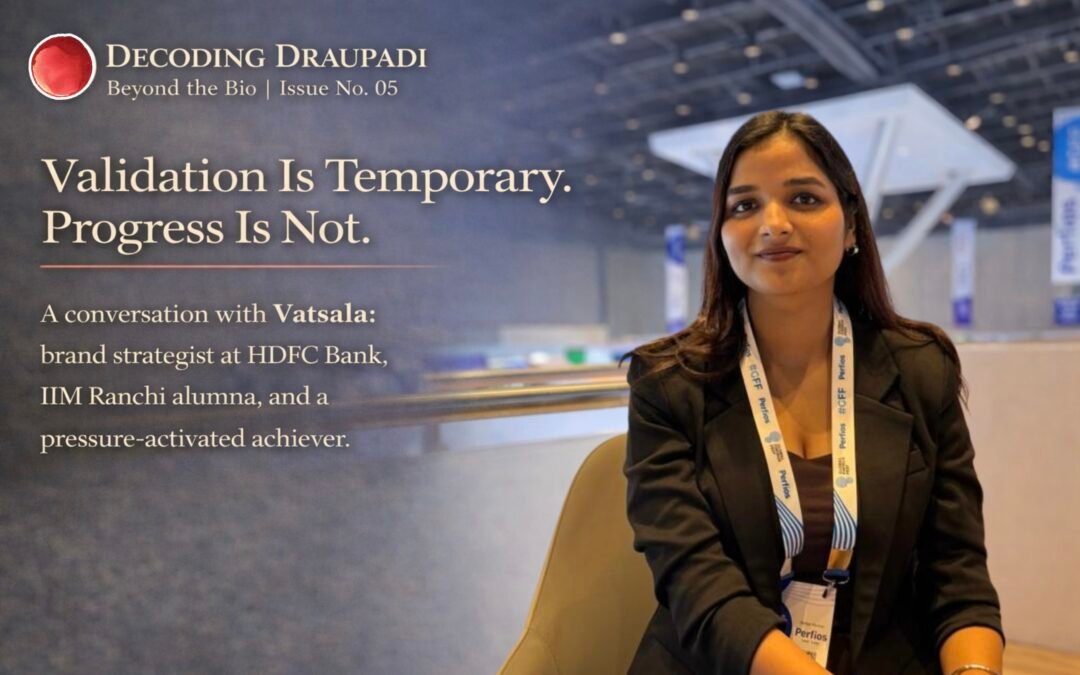
A conversation with Vatsala brand strategist at HDFC Bank, IIM Ranchi alumna, responsible middle child, and self-described pressure-activated achiever.
There is a particular kind of professional who doesn’t need applause to keep going. Vatsala is one of them. Trained at IIM Ranchi and now working in brand strategy at one of India’s largest financial institutions, she has built her career in environments that reward precision, structured thinking, and consistency none of which tend to come with a lot of fanfare.
But what makes Vatsala worth listening to isn’t the resume, it’s the quiet, rigorous honesty she brings to questions most people deflect. Questions about self-doubt, about the gap between theory and practice, about what it means to do good work when nobody is watching. She answered all of them with characteristic directness. And somewhere between a solo washroom dance session and a line about progress being undeniable, we found a woman who has figured out something important: that growth is less about adding, and more about shedding what no longer serves you.
On Identity All Versions, Showing Up
Most of us are never just one person. We’re someone at work, someone at home, someone in our private thoughts. Not your title or your bio who is Vatsala right now, across the different lives you’re living?
At work, I am a professional who cares deeply about doing things right. I take ownership seriously, and while I am an ambivert by nature, I’m constantly trying to balance delivering excellence with genuinely enjoying the process. Learning something new every day is non-negotiable.
As a friend, I would like to believe I am dependable. I am also carefree, occasionally lazy, and always up for fun. More often than not, I am the ‘voice of reason’ though my friends may debate that last part.
As a daughter, I am the responsible middle child, trying to be present and involved even while living away from home. Distance has only made intention more important.
As an individual, I am someone who knows exactly what needs to be done and sometimes still procrastinates. But give me pressure, and suddenly, I am unstoppable. It is chaotic, but it works.
Still figuring it all out. Still growing. Still showing up as all versions of me.
The responsible middle child who procrastinates until pressure strikes and then becomes unstoppable is a very specific, very real kind of person, and a lot of women reading this will recognise themselves in it immediately. What I find interesting is that Vatsala doesn’t apologise for the contradiction. She names it, owns it, moves on. That ease with complexity is its own kind of self-awareness. Most of us spend a lot of energy trying to resolve our contradictions. She’s just decided to carry them without drama.

On Unlearning When the Perfect Message Isn’t the Effective One
Coming from IIM Ranchi into hands-on brand strategy roles, what’s something you’ve had to unlearn about how brands should communicate, and what have you learned instead about how they actually do?
Coming from IIM Ranchi, I was trained to believe that good brand communication is structured, polished, and intellectually tight. You are taught frameworks, sharp positioning statements, and the importance of saying the right thing in the right way.
What I have had to unlearn is the idea that the most correct message is always the most effective one. In the real world, audiences don’t engage with brands because the messaging is perfect. They engage because it feels clear, relevant, and human. Some of the best-performing communication I have worked on was not the most sophisticated. It was the simplest. It spoke directly to a real need, in language the customer actually uses, not language the brand prefers.
I have also learned that brand communication is less about broadcasting and more about listening. Data, customer behaviour, and feedback often tell you things no framework can predict. Sometimes, what works is not what you planned, but what you are willing to adapt to.
Most importantly, I have learned that effectiveness is not measured by how impressive the strategy sounds internally, but by how effortlessly it makes sense to the customer.
“The most correct message is not always the most effective one.”
This is one of the most honest things a brand strategist can admit — that the rigour you were trained in, the thing you were graded on, is sometimes the exact thing you need to set aside when you’re actually in the room with a real audience. What Vatsala is describing is the shift from brand communication as performance to brand communication as service. The customer doesn’t care how clean your framework is. They care whether you understand them. And that’s a very different brief.
On Internal Tension Authenticity Over Performance
Early in brand careers there’s often a tension between shaping the narrative for an audience versus shaping direction within yourself. Has that pressure shown up for you at HDFC Bank or in earlier roles?
Yes, that pressure has definitely shown up for me, especially while working at HDFC Bank. In brand work, you are constantly shaping narratives thinking about what the customer needs to hear, how they feel, what will build trust, and what will drive action. But at the same time, there is a quieter, internal narrative. Questions like: Do I fully believe in this direction? Am I adding real value? Am I growing, or just executing?
Early on, I felt the need to always have clarity and confidence, even when I was still figuring things out. Over time, I have learned that it is okay for your internal process to be imperfect while your external output remains intentional.
This tension has made me more conscious about choosing authenticity over performance. It has taught me to listen more closely both to the customers and to myself. Not every decision needs to be driven by pressure. The best decisions often come from clarity, not urgency.
It has also shaped how I approach learning. I focus more on being curious, less on proving myself, and more on improving myself. Because in branding, just like in life, the strongest narratives are not forced. They are built with honesty, consistency, and time.
“The strongest narratives are not forced. They are built with honesty, consistency, and time.”
The gap between internal uncertainty and external confidence is something most professionals carry quietly, especially early on. Vatsala names it without drama: your internal process can be messy as long as your output is intentional. That’s not a performance tip, it’s permission. Permission to not have it all figured out inside while still showing up and doing the work. The two things can coexist, and recognising that is genuinely freeing. It also, interestingly, makes the work better because you stop performing and start actually thinking.
On Validation: How You Know You’re Doing Good Work
A lot of work goes unnoticed. No applause for thinking deeply, holding things together, or showing up consistently. When there’s no external validation, no praise, no visible win, how do you know you’re doing good work?
When there is no praise, no visible win, and no external validation, I have learned to look inward. I know I am doing good work when I feel clarity instead of confusion. When I am not just executing, but understanding. When I can defend my decisions, even if no one asks me to.
I see it in my day-to-day life. The problems that once intimidated me now feel familiar. The things I once hesitated to say, I now say with confidence.
And most importantly, I see it in my work. Showing up. Delivering. Improving. Repeating.
Because validation is temporary. But progress is undeniable. And if I am learning, improving, and staying true to the standards I set for myself that is how I know I am on the right track.
“Validation is temporary. But progress is undeniable.”
In a culture that has made visibility and praise the primary metrics of professional success, Vatsala’s internal compass is genuinely countercultural. The benchmark she’s describing can I defend this decision, does this problem feel more familiar than it did before, am I understanding rather than just executing is not something anyone can give you or take away. It’s built quietly, over time, by showing up. And it is, as she says, undeniable. I’ve been thinking about that word a lot. Undeniable. Not visible. Not celebrated. Just real.
On Self-Doubt: The Washroom, the TED Talk, the Reset
Self-doubt doesn’t always look dramatic. Sometimes it’s quite a pause before speaking, second-guessing a decision, feeling behind without knowing why. When self-doubt comes up for you at work, what do you usually do with it?
When self-doubt shows up at work, it often feels like a constant battle between you and the voice in your head that chose the worst possible timing to appear.
I try not to let negative thoughts take over, but when they do, I have learned how to interrupt them. Sometimes it is as simple as putting on music and having a quick solo dance session in the washroom. Other times, it is a 5-minute TED Talk with myself reminding myself of who I am, what I have done, and why I belong in the room.
It may sound small, but those moments reset everything. Because self-doubt does not disappear overnight. You just get better at not letting it stay.
“Self-doubt does not disappear overnight. You just get better at not letting it stay.”
The washroom dance session. I love this more than I can explain not because it’s funny, though it is but because it’s specific. It’s real. Nobody is writing that in their LinkedIn post about overcoming imposter syndrome. And that specificity is exactly what makes it useful. The tools that actually help us through hard moments are rarely the polished, productivity-app ones. They’re small, private, a little ridiculous, and they work. Vatsala’s framing of self-doubt as something you interrupt rather than eliminate is also exactly right. The goal isn’t to never feel it. The goal is to shorten how long it gets to stay

On Unlearning: Shedding What No Longer Serves
Growth isn’t only about adding skills or experience it’s about unlearning habits, beliefs, or expectations we picked up early on. What’s something you’ve had to unlearn as you’ve grown?
I had to unlearn the idea that confidence comes first. In real life, confidence often follows your actions. You speak, you try, you ship, you iterate and only then does confidence build.
Growth, for me, has been less about adding, and more about shedding what no longer serves me. The pressure to have all the answers. The fear of being wrong. The need for constant validation.
Unlearning has made space for better work and a calmer version of myself.
This might be the most important thing in the entire interview. The belief that you need to feel confident before you act and that you wait until you’re ready is one of the most persistent and most limiting stories women tell themselves in professional spaces. What Vatsala has landed on is the correct sequencing: action first, confidence as a consequence. You don’t earn the right to speak by feeling certain. You earn it by speaking. And then speaking again. And again, until it stops feeling like a risk. The shedding she talks about is real too. I think about how much mental space gets freed up when you stop needing validation for every move you make.
On Advice: Grace for Beginners
Looking back at where you are now and where you started, what would you want someone just beginning their journey to worry less about?
If there is one thing I would tell someone just starting out, it would be this: worry a little less. You are going to make mistakes. Everyone does. And most of the time, those mistakes feel much bigger to you than they actually are. You do not need to be so harsh on yourself while you are still learning.
Early in your journey, there is a tendency to attach your entire identity to your work. But over time, you realise that a job is just one part of your life, not your whole life.
Take the time to learn. Be curious. Ask questions. Allow yourself to be a beginner. Learning does not come from getting everything right. It comes from showing up, staying open, and trusting that you will figure things out along the way.
Be sincere. Be patient. And give yourself the same grace you so easily give others.
“Give yourself the same grace you so easily give others.”
That last line is the one that lands. Most of us are extraordinarily generous with other people’s mistakes and extraordinarily unforgiving with our own. It’s such an obvious asymmetry when you say it out loud and yet it persists. Vatsala’s reminder is simple, and worth writing down somewhere you’ll actually see it: the kindness you extend to a friend who’s figuring things out, the patience you give a colleague who’s learning you are allowed to extend that to yourself. You are, in fact, also figuring things out. You are also still learning. That’s not a flaw. It’s just where you are right now.
— End of Interview —
Vatsala is a brand strategist at HDFC Bank and an alumna of IIM Ranchi. This interview was conducted as part of the Decoding Draupadi Brand Manager Series.
If something in this conversation stayed with you, there are more where it came from. Come find us on Instagram: @decodingdraupadi