
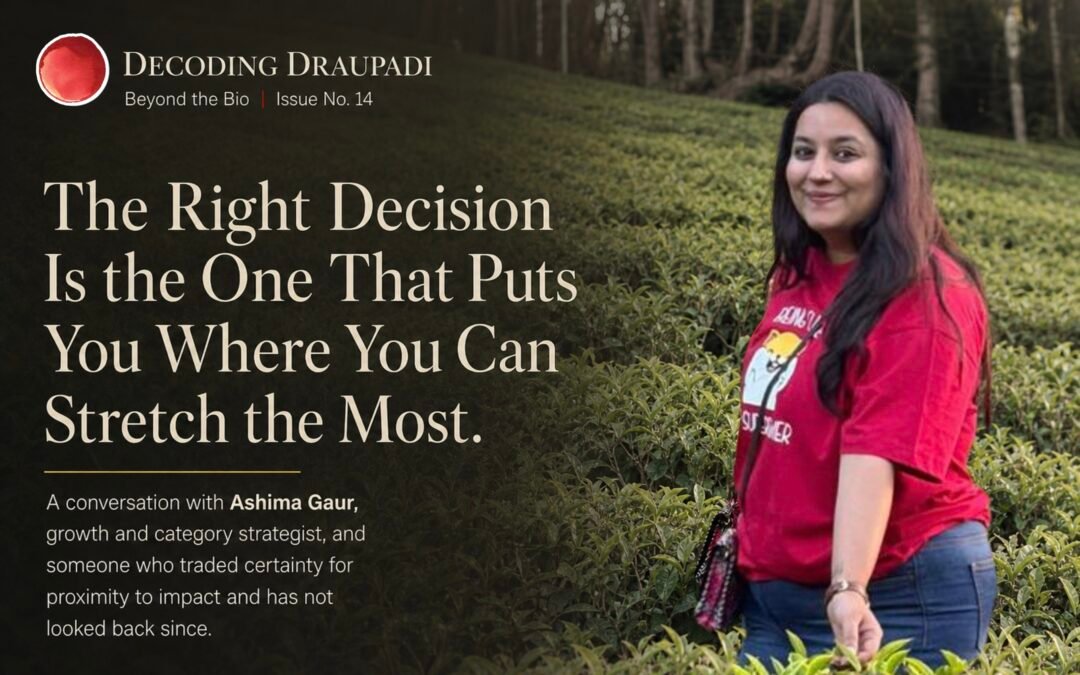
A conversation with Ashima Gaur, growth and category strategist, and someone who traded certainty for proximity to impact and has not looked back since.
Ashima Gaur left a stable healthcare MNC role straight out of her MBA for a category role at Swiggy.
From the outside, it looked like trading certainty for chaos. From the inside, that was exactly the point. She wanted to be close to fast decisions, real ownership, and visible impact. She found all three at a leading quick commerce company.
She is the kind of person who reduces friction before it becomes a problem, makes calls with partial information, and tracks the early indicators before anyone else notices something is off.
She also still has imposter syndrome. She has just stopped waiting for it to go away.
OWNING ALL THE VERSIONS
Who is Ashima right now, across all the different lives you are living?
At work, I am focused, dependable, and clear about what I bring to the table. I take responsibility, make decisions, and do not shy away from pressure.
In my personal life, I am someone who feels deeply but is also learning to choose what is right for me, not just what feels familiar.
With myself, I am independent, but also honest enough to pause and ask if I am growing, if I am aligned, if I am truly happy.
In my social world, I am expressive, confident, and fully myself. I enjoy my life and my people and do not hold back from showing who I am.
All these versions coexist and instead of trying to simplify them, I have learned to respect them. Because growth, for me, is not about becoming one fixed version of myself. It is about becoming more aligned with who I already am.
“Growth is not about becoming one fixed version of yourself. It is about becoming more aligned with who you already are.”
She does not describe her versions as a tension to resolve. She describes them as something she has learned to respect. That is a different relationship with complexity, one that comes from having sat with it long enough to stop needing it to be simpler. For someone who operates in fast, high-stakes environments at work, that kind of internal steadiness is not incidental. It is probably what makes the rest possible.

ANCHOR ON THE GOAL, MOVE ON THE LEVER
What has working in fast-moving growth environments taught you about making decisions without the luxury of time or perfect information?
In the industry I am in, decisions cannot wait. Often, multiple teams are blocked until you take a call.
My approach is to first anchor on the primary goal: are we driving volume, margins, or partner commitments? Then prioritise the one lever that will move it fastest, whether that is price correction, inventory push, or campaign visibility.
I make the call based on the best available data and past patterns, communicate it clearly so teams can execute, and define what success looks like upfront.
Just as importantly, I track early indicators like conversion, offtake, or stock movement. If the call is not landing, I pivot quickly.
It is not about perfect decisions. It is about taking ownership, giving clear direction, and being fast to adapt when the market responds.
“It is not about perfect decisions. It is about taking ownership and being fast to adapt when the market responds.”
This is one of the most practically useful answers in this series. Not because it is a framework, but because it is a real description of how someone who is good at fast decisions actually thinks. Anchor first, then move. Define success before you execute. Track early, not late. These are not instincts that arrive fully formed. They are built from being in the middle of enough decisions that went wrong before they went right.
REDUCING FRICTION BEFORE IT BECOMES A PROBLEM
What is the most important thing you do at work that has no metric attached to it and that most people around you probably do not notice?
One thing that often goes unnoticed is how much effort goes into aligning different stakeholders before a decision is even made.
A lot of my time goes into having the right conversations early: understanding what my internal teams, partners, and cross-functional stakeholders are optimising for, where the friction points are, and where things could potentially break.
This does not always show up as a metric, but it makes execution significantly smoother. When alignment is done well upfront, decisions move faster, there is less back-and-forth, and teams can focus on delivering rather than debating.
One of the most important things I do is reduce friction before it becomes a problem, so the actual work can move quickly and efficiently.
The invisible work of alignment is something almost every woman in this series has named in one form or another. What Ashima adds is the precision: she knows exactly where the friction points are before anyone else has named them, and she handles them quietly before they become blockers. That is not a soft skill. That is a strategic one. And the fact that it does not show up in any metric is exactly why it is so undervalued.

SPENDS AMPLIFY GROWTH. THEY DON’T CREATE IT.
There is probably a widely held belief in your industry about what good growth looks like that you quietly disagree with. What is it?
One belief I quietly disagree with is that growth is primarily driven by aggressive discounting or visibility spends.
In quick commerce especially, it is easy to default to more spends equals more growth. But in my experience, that kind of growth is often short-lived and not very efficient.
Sustainable growth comes from getting the fundamentals right: assortment, availability, pricing architecture, and how consistently you show up for the consumer. When those are strong, spends amplify growth. They do not create it from scratch.
Good marketing is not just about driving spikes. It is about building systems that make growth repeatable and more efficient over time.
“Spends amplify growth. They don’t create it from scratch.”
This is the quick commerce version of what Ruchi said about desirability and what Gayathri said about marketing amplifying but not creating. The pattern across this series is consistent: the women who have been closest to the numbers longest all arrive at the same conclusion. The fundamentals have to be there first. Everything else is just acceleration. And acceleration without a foundation is just expensive noise.
TRADING CERTAINTY FOR PROXIMITY TO IMPACT
There is usually one decision in your career that looked wrong from the outside and turned out to be exactly right. What was it?
One decision that really stood out was leaving a stable healthcare MNC role, a PPO straight out of my MBA, for a category role at a leading quick commerce company.
From the outside, it looked like I was trading certainty for chaos. But for me, that was exactly the point. I wanted to be in the middle of fast decisions, real ownership, and visible impact, not just well-defined processes.
The shift was intense. Suddenly I was making calls that directly moved business metrics, working with ambiguity every day, and learning at a pace that is hard to replicate in more structured setups.
What it taught me more than anything is that growth comes from proximity to impact. When you are close to the business, you think sharper, act faster, and build conviction much earlier in your career.
The right decision is not always the safest one. It is the one that puts you in an environment where you can stretch the most.
“Growth comes from proximity to impact. When you are close to the business, you think sharper and build conviction much earlier.”
The PPO from an MBA is considered one of the safest, most desirable outcomes of a business school education. Ashima turned it down for ambiguity. Not recklessly, but deliberately. She knew what she was choosing and why. And the way she describes what she found on the other side, pace, ownership, conviction, is the kind of thing you only know from having been there. That is not a career story. That is a values story.

BECOMING SOMEONE WHO CAN STAY STEADY IN DISCOMFORT
Outside of your job title and your company, what are you building?
Outside of my job title, what I am really building is resilience and self-awareness.
A big part of that has been learning to take on things I do not naturally enjoy but that are necessary for the outcome. Tough conversations, pushing back, working through ambiguity. Growth often sits in the uncomfortable parts of the job.
At the same time, I am learning to be okay with not being liked by everyone. When you are making decisions that impact multiple stakeholders, alignment does not always mean agreement. So I am building the ability to stand by the right call, communicate it clearly, and not take resistance personally.
Beyond the role, I am really working on becoming someone who can stay steady in discomfort, make objective decisions, and prioritise outcomes over approval.
“I am working on becoming someone who can stay steady in discomfort and prioritise outcomes over approval.”
Prioritising outcomes over approval is one of those things that sounds straightforward and is genuinely hard to practise. Especially for women in roles where being liked has often been the informal currency of influence. Ashima is not pretending she has cracked it. She is describing it as the project she is actively working on. That honesty makes it more useful, not less.
IMPOSTER SYNDROME AS A GROWTH SIGNAL
Most people have one fear they have learned to perform confidence around. What is yours?
For me, it is imposter syndrome.
In fast-paced roles with a lot of ownership, there are moments where you question if you are truly ready for the decisions you are making, or if you just learned to operate quickly enough that it looks like you are.
Over time, I have learned to work through it rather than wait for it to go away. I focus on preparation, clarity of thought, and staying close to the problem. That usually builds enough confidence to move forward.
It does not fully disappear. But I have realised it is often a signal that I am operating at the edge of my growth, which is exactly where I want to be.
“Imposter syndrome is often a signal that you are operating at the edge of your growth. Which is exactly where you want to be.”
This is the reframe that changes everything. Not imposter syndrome as a problem to fix, but as a compass. If it is there, you are at the edge. If it disappears completely, you might have stopped stretching. Ashima has not eliminated the doubt. She has learned to use it as information. That is a very different relationship with fear, and a much more sustainable one.
A Note From Decoding Draupadi
What stayed with us after this conversation is Ashima’s relationship with discomfort.
She does not avoid it. She does not glamourise it either. She just uses it as a signal: if it is uncomfortable, she is probably in the right place. If it has gone quiet, she might need to stretch further.
That is a philosophy worth borrowing. For careers, yes. But also for the conversations we are trying to have in this community. The honest ones are rarely the comfortable ones. And they are always worth having.
If this felt like someone you know, share it with her.
— End of Interview —
Ashima Gaur is a growth and category strategist currently at Flipkart. This interview was conducted as part of the Decoding Draupadi Brand Manager Series.
Ashima trades certainty for growth. We built a community for women who think the same way. Come find yours at @decodingdraupadi.