
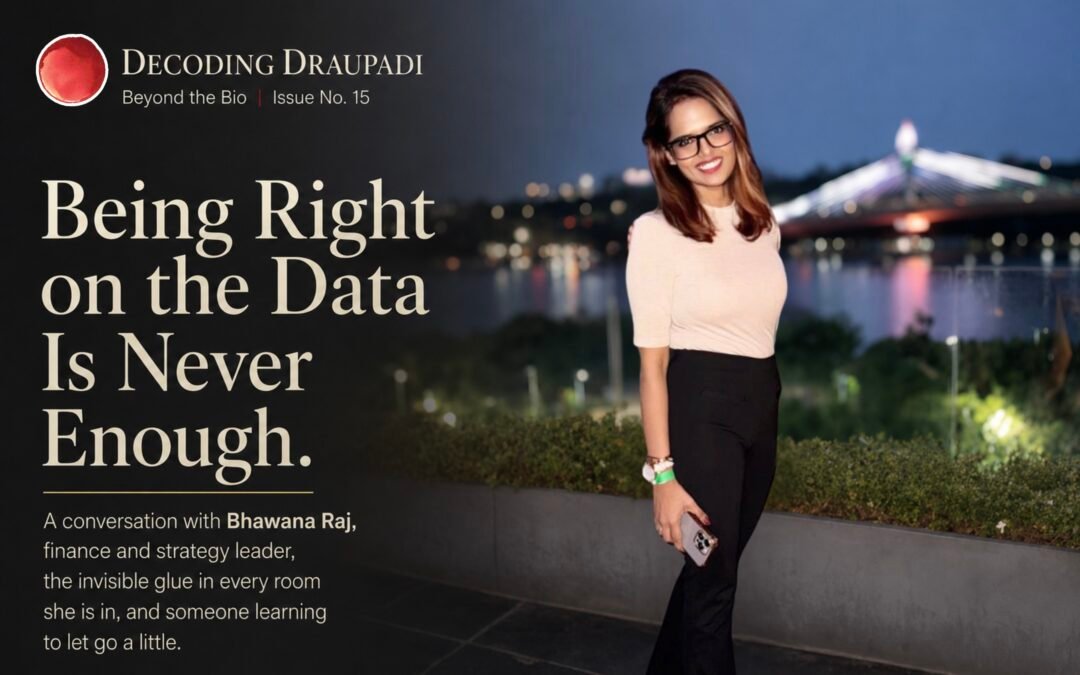
A conversation with Bhawana Raj, finance and strategy leader, the invisible glue in every room she is in, and someone learning to let go a little.
Bhawana Raj leads a team of over fifty people. She is the person everyone turns to when things need to get done.
She is also, privately, someone who is tired of always being the one who has to hold things together. Not in a way that makes her want to stop. Just in a way that makes her wonder what it would feel like to fall back sometimes, without the weight.
She describes herself as the Monica Geller of her friend group. She has learned to use her fear as a check rather than a constraint. She is currently in a phase she calls transition from execution to intentional growth.
This is a conversation about what it looks like when the most dependable person in the room is also quietly learning to depend on herself differently.
THE PERSON EVERYONE RELIES ON, WHO LONGS TO LET GO
Who is Bhawana right now, across all the different lives you are living?
At work, I am the person who shows up consistently for my team of fifty-plus people. I am ambitious and genuinely love what I do, so there is a drive to excel that feels very natural to me. I am the one people turn to when things need to get done, and I take ownership of that seriously.
At home, I am the dependable daughter. But what has evolved beautifully over the years is that I have also become a friend to my parents. With my siblings, I have become much more intentional about nurturing those relationships because I understand how irreplaceable they are. With my friends, I am pretty much the Monica Geller of the group. I value my female friendships and cherish them.
But here is where it gets interesting. Personally, in my quiet moments, I am navigating this fascinating contradiction. I am the person everyone relies on, who takes charge, who has it together. And yet Privately, in quiet moments, I wish I could just fall back and not care so intensely about everything. Not because the responsibility feels like a burden, but because I know there is a more relaxed version of me worth making space for.
I think who I am right now is someone learning to honour all these versions of myself, even when they do not perfectly coexist. Growth might mean finding ways to create space for that more relaxed version of me, even while embracing the leadership and responsibility that feels so core to who I am.
“In quiet moments, I wish I could just fall back and not care so intensely about everything. That is not a weakness. That is just honesty”
The Monica Geller reference is doing a lot of work here. Organised, dependable, the one who holds everything together and also the one secretly exhausted by it. What Bhawana is naming is one of the quietest costs of being the reliable one: you rarely get to experience what it feels like to be held. That is not a complaint. It is just an honest accounting of what the role actually takes.
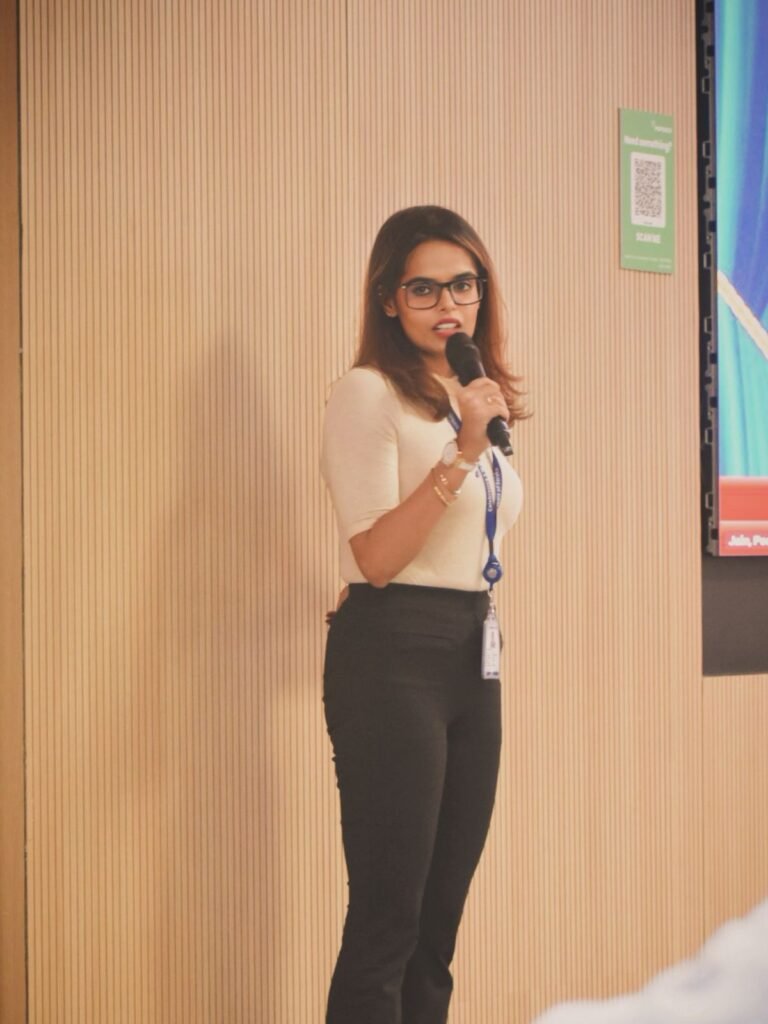
BEING RIGHT ON THE DATA IS NEVER ENOUGH
What has working closely with numbers taught you about how decisions are actually made in large organisations?
On the surface, decision-making seems very data-driven. And it is. But behind the scenes, decisions are rarely just about the numbers. Data gives you direction and credibility, but it is interpretation, context, and alignment that really drive outcomes.
A lot of decisions are a balance between what the numbers say, what the business can realistically execute, and what stakeholders and consumers need. Timing, communication, and how clearly you simplify the story behind the numbers can influence decisions just as much as the analysis itself.
It has taught me that being right on the data is not always enough. You need to make it understandable, relevant, and actionable for different audiences. Decision-making has become less about just analysing numbers and more about connecting the dots between data, people, and business context.
“Being right on the data is not always enough. You need to make it understandable, relevant, and actionable for different audiences.”
This is the finance leader’s version of something we hear across every function in this series: the technical skill is the starting point, not the destination. Bhawana has learned that the most rigorous analysis in the room means nothing if it cannot travel across different people and contexts. The story behind the numbers is often the harder thing to build. And the more important one.
THE INVISIBLE GLUE
What is the most important thing you do at work that has no metric attached to it and that most people around you probably do not notice?
One of the most important things I do that often goes unnoticed is acting as the connector between numbers, people, and priorities.
In finance, outputs like forecasts, pricing, or plans are visible. But what is not visible is the work behind making those numbers meaningful. I spend a lot of time enabling my team to align with stakeholders, validating assumptions, and ensuring risks or gaps are identified early so things do not fall through the cracks.
At the same time, leading a team of fifty-plus people means a big part of my role is creating structure and stability. Simplifying complex asks, setting clear direction, and ensuring my team has the context and support to focus on delivering quality insights, not just numbers.
A lot of this does not show up in a metric. I think of it as the invisible glue: quietly connecting the dots and enabling both the business and my team to operate with clarity and confidence.
“I think of it as the invisible glue. Quietly connecting the dots so everything else can move.”
The invisible glue is one of the best descriptions of senior leadership we have heard in this series. It is not the output that gets presented. It is the work that makes the output possible. Bhawana is not romanticising it. She is just naming it clearly. And for a team of fifty people, that kind of invisible work is probably what keeps the whole thing from fraying.

STOP DILUTING YOUR VOICE
What is one thing you have had to actively undo about how ambitious women are supposed to behave?
One thing I have had to actively undo is the tendency to second-guess myself, especially because I have often been the youngest person at the table.
Early on, that translated into holding back. Being very careful about how strongly I voiced opinions or how visibly I showed ambition. There is also an unspoken expectation for women to be agreeable, to not come across as too much. I think I internalised some of that.
Over time, I realised that both the doubt and the restraint were not serving the work or the team. Clarity and conviction create more trust and direction.
So I have consciously worked on trusting my perspective more, showing up with confidence, being direct, taking ownership, and not diluting my voice. It is not about being the loudest in the room, but about being clear and intentional.
That shift has helped me show up more authentically as someone who is both empathetic and decisive, without feeling like I have to trade one for the other.
“Clarity and conviction create more trust and direction. I stopped diluting my voice.”
Being the youngest in the room and a woman in a finance function: two reasons to hold back, both of which she named and both of which she chose to move past. The line about not feeling like you have to trade empathy for decisiveness is the one worth sitting with. Because the assumption that those two things are in tension is exactly what she had to undo.
FROM EXECUTION TO INTENTIONAL GROWTH
If you had to describe where you personally are in your own arc right now, what phase would you call it and what is driving it?
I would describe my current phase as a transition from execution to intentional growth.
For a while, my focus was on building credibility: delivering consistently, taking on ownership, and proving I can handle scale and complexity. That is still important. But what is changing now is how I approach it.
I am becoming more intentional about where I invest my energy, moving from just getting things done to thinking about impact, prioritisation, and how I enable others, especially given the size of my team.
At the same time, on a personal level, I am learning to create a bit more balance. I have been someone who leans into responsibility quite naturally, but now I am consciously trying to build space to step back, reflect, and not carry everything with the same intensity.
So it feels like a reinvention in some ways. Not of what I do, but how I do it. Being just as driven, but more deliberate, more balanced, and more focused on long-term impact.
The reinvention she is describing is quieter than most. There is no pivot, no dramatic change of direction. The ambition is the same. The pace is the same. What is changing is the relationship to it: less intensity for its own sake, more intention about where it goes. That is a more sophisticated form of ambition, and it usually only arrives after you have proven you can do the hard version first.

USING FEAR AS A CHECK, NOT A CONSTRAINT
Most people have one fear they have learned to perform confidence around. What is yours?
One fear I have had to learn to manage is the fear of not doing justice to the scale of responsibility I have been given.
On the outside, I come across as confident and in control. But internally, there are moments where I question whether I am stretching myself too thin or carrying more than I should, especially leading a large team across multiple priorities.
It is not a fear that stops me. But it does push me to stay very on top of things, sometimes even over-indexing on ownership.
Over time, I have learned to channelise it. Instead of seeing it as self-doubt, I see it as a sign that I care about doing the role well and not taking it lightly.
What has changed is that I do not let that fear drive me into overworking or overthinking as much anymore. I have started trusting my team more, delegating better, and accepting that not everything has to be perfect for it to be effective.
The fear is still there. But it is more managed now. I use it as a check rather than letting it become a constraint.
“I use the fear as a check, not a constraint. It tells me I care. It no longer tells me what to do.”
The fear of not doing justice to responsibility is a very specific kind of fear. It is not imposter syndrome exactly. It is closer to the weight of genuinely caring. Bhawana has not eliminated it. She has reclassified it. From threat to signal. That reclassification is the whole move, and it took her years of leading fifty people to get there.
THE PERIOD WHERE I FOUND BETTER BALANCE
Five years from now, having a real conversation with someone you respect. What do you hope you are able to say about this period of your life?
I think I would want to say that this was the period where I became more intentional, both as a leader and as a person.
Professionally, I would want to look back and feel that I did not just deliver results, but that I built strong teams, enabled people to grow, and made decisions that had real, lasting impact. That I moved from just owning outcomes to shaping direction.
Personally, I would hope to say that I figured out how to be a little easier on myself. That I did not carry everything so seriously all the time, and that I created space to enjoy the process, not just chase the next milestone.
Overall, I would want to describe this phase as one where I found better balance between ambition and ease, ownership and trust, doing and being.
If I can say that, I would know this period really mattered.
“I want to describe this phase as one where I found better balance between ambition and ease, ownership and trust, doing and being.”
The last line is the one. Not that I performed well. Not that I hit the numbers. But that this period mattered. Bhawana is already thinking about her life in the kind of terms that most people only arrive at much later, if at all. And the balance she is reaching toward: ambition and ease, ownership and trust, doing and being, is not a compromise. It is a more complete version of the same drive she has always had.
A Note From Decoding Draupadi
What stayed with us after this conversation is the contradiction Bhawana named in her very first answer.
She is the person everyone falls back on. She is also the person who privately longs to fall back sometimes too.
We think that contradiction lives in a lot of the women reading this. The ones who hold things together so consistently that nobody thinks to ask how they are holding up.
That is exactly the kind of thing this series exists to say out loud. If this felt like you, you are not alone in it.
If this felt like someone you know, share it with her.
— End of Interview —
Bhawana Raj is a finance and strategy leader. This interview was conducted as part of the Decoding Draupadi Brand Manager Series.
For the woman who holds everything together and is quietly figuring out how to hold herself too. This community is for you. @decodingdraupadi.