
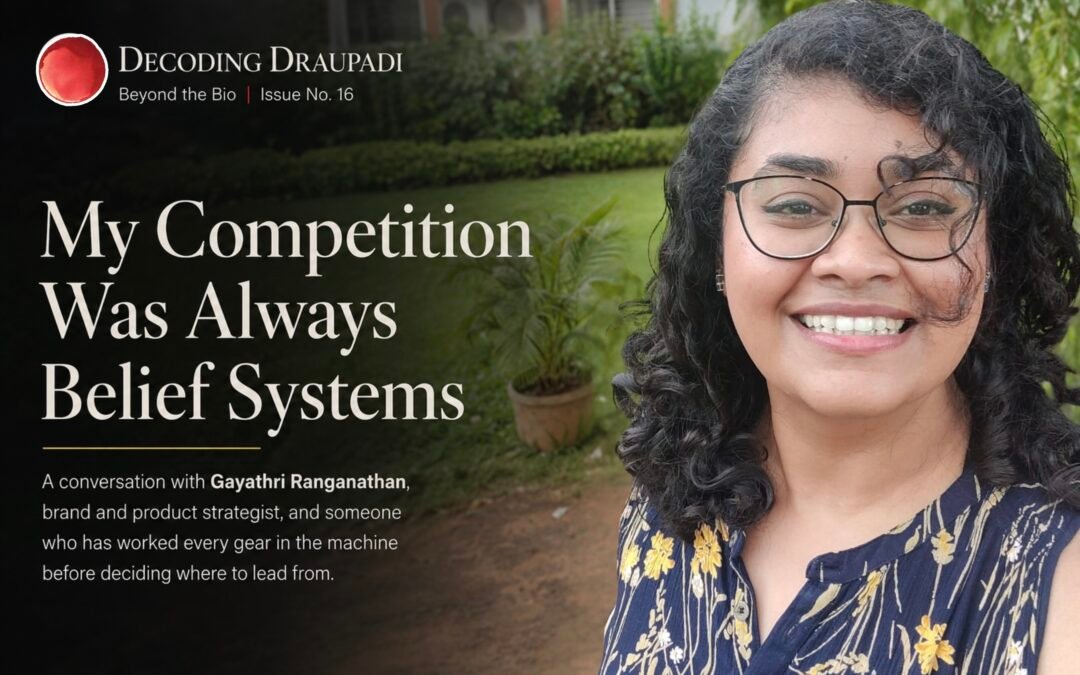
A conversation with Gayathri Ranganathan, brand and product strategist, and someone who has worked every gear in the machine before deciding where to lead from.
Gayathri Ranganathan has not followed a straight line.
Retail marketing, sales leadership, brand strategy, product. Each role a different gear in the same machine, each one teaching her something the previous one could not. She did not plan it that way, and is proud of it anyway.
She has owned P&L, built narratives for diamond jewellery in a country where gold has always been the default, and learned that the hardest thing to shift is not behaviour. It is belief.
Professionally, she knows exactly where she is going. Personally, she is still learning how to rest. She is honest about both.
A WORK IN PROGRESS WEARING A COMPOSED FACE
Who is Gayathri right now, across all the different lives you are living?
To be honest, Gayathri right now is a work in progress wearing a very composed face and a warm smile.
Professionally, I know where I am and where I am heading. That is very clear to me.
Personally, I am still learning how to rest, build other important priorities in life, embrace my flaws, and learn to love myself.
What I can confidently say is that I do not hide or shy away from these versions of me anymore. They are finally comfortable coexisting, which makes me feel the most honest I have been to myself.
“They are finally comfortable coexisting, which makes me feel the most honest I have been to myself.”
The composed face and the warm smile alongside the still learning how to rest. That is the gap most people manage very carefully. Gayathri is not performing either version. She is just naming both. And the fact that she can hold them at the same time without needing to resolve them is, actually, its own kind of clarity.
EVERY GEAR HAS TO MOVE FOR THE MACHINE TO RUN
When you look at your journey across retail, sales, brand, and product, what has shaped the way you understand what it actually means to build something?
This journey is something I am very proud of, and it was not really planned.
If you notice, each of these roles plays a crucial part in the value chain, just like a set of gears. When one moves, the others have to move for the machine to run. To become a leader, I have always believed you must clearly understand the key departments and how their contributions impact the business. Decision making at strategic levels becomes easier, and more importantly, teams feel understood.
Retail marketing taught me how to be agile and develop attention to detail to support the last mile conversion. Sales taught me that value is always negotiated, consumer trust is built at the point of sale, and working hand in hand with partner stakeholders is critical. Brand helped me understand that values and principles built over time must never have any gaps between what you say and what you do. Product is where it all starts and ends.
Working across all of these functions has made me a better listener, taught me to always question the status quo, and to always know exactly why the business is doing well.
“To become a leader, you must clearly understand every department and how their contribution impacts the business. That is when teams feel understood.”
The gear analogy is doing real work here. Gayathri is not describing a career that drifted across functions. She is describing one that was built with intentional understanding of how each part connects. That is a very different thing. And it explains why her strategic instincts are grounded in something most senior leaders are missing: the memory of what it actually feels like to be in every room before the one she is in now.

THE COMPETITION WAS ALWAYS BELIEF SYSTEMS
What have you learned about building a category or narrative from the ground up, especially in a space as emotional and cultural as diamond jewellery?
Categories like diamond jewellery have always had their barriers. Gold in India has always enjoyed the mindset of asset, of need. What I learned was that my competition was always belief systems.
It was important to go deeper and understand aspirations, wants, desires, personalities, cultures, and identities. To speak to her, the consumer, in a way that she feels it and associates strongly.
What humbled me was how a diamond jewellery piece is a core memory for her. A feeling. So building a narrative that feels authentic and personal became the entire job. And it was equally critical for our stakeholders to believe in that narrative, because that belief is what delivers the right experience at every touchpoint.
“My competition was always belief systems.”
Six words. That is the entire insight. You are not competing with another jewellery brand. You are competing with what people believe jewellery is supposed to mean. Gold means security, tradition, asset. Diamond means something else, and that something else has to be felt before it can be chosen. Gayathri understood that the marketing problem was actually a cultural one. That shift in framing is everything.
P&L FORCES YOU TO ASK HARDER QUESTIONS
How has owning P&L and business outcomes changed the way you think about marketing decisions and trade-offs?
P&L ownership forces you to bring in immense clarity while navigating the tension between brand building and performance. It forces you to think strategically and define the role each function has to play to drive profits and growth.
You start asking harder questions. Every department becomes more pointed, more actionable, more oriented toward a single goal. The luxury of vague ambition disappears. What is left is the work.
Short answer. And it does not need to be longer. Owning a P&L is one of those experiences that compresses everything into clarity very fast. You stop being able to afford strategic ambiguity because the numbers make the ambiguity visible. Gayathri has lived that. And the way she describes it, asking harder questions, getting every department pointed toward one goal, is exactly what that clarity looks like in practice.
MEASURING MEANING THROUGH IMPACT
How do you personally evaluate whether the work you are doing is meaningful, beyond just visible outcomes?
Measuring meaning through impact is what has always mattered to me. Impact on numbers, impact on brand.
But what also matters today is how I am growing as a person and a professional. Am I asking the right questions, being honest, and learning something new? These questions make work more meaningful to me.
“Am I asking the right questions, being honest, and learning something new? These questions make work more meaningful.”
The internal benchmark she is describing here sits alongside the external one, not instead of it. She has not abandoned the numbers. She has just added a second set of questions that the numbers cannot answer. That is a healthy relationship with ambition: one that keeps both the external and internal scorecard running at the same time.

FROM PROVING TO BUILDING
How has your relationship with ambition evolved as your scope and ownership have grown?
Early on, ambition for me was about proving myself. Proving I belong, proving I am capable of senior roles with more scope. That kind of ambition is fuel, but it also exhausts you because it depends on constant external response.
Over time, my ambition has become more about what is getting built. The impact I leave on people, on functions, on things that go beyond numbers. Credibility and trust are what are getting built now.
“Early ambition was fuel. It also exhausted me. Now I am more interested in what is getting built.”
The shift from proving to building is something we hear across almost every issue of this series. But Gayathri names what the first mode actually costs: it depends on constant external response. When validation is the fuel, the tank is always at someone else’s mercy. The move to building is the move toward something that sustains itself. That is not a small shift. It is the whole game.
STRATEGY WITHOUT EXECUTION IS JUST A SLIDE DECK
What is something about the transition from execution to strategic leadership that people do not fully understand until they experience it themselves?
Both roles are critical to understand and experience. Strategic roles are where the decisions are made, but without being aware of how things are executed and what impact they have across the value chain, even the best decision can fall flat or cause damage.
Stakeholder confidence in leadership, their happiness, and their full buy-in to the decision is what allows strategic decisions to be implemented in the most impactful way. Strategy without that is just a slide deck.
“Strategy without stakeholder buy-in is just a slide deck.”
She does not romanticise the strategic seat. She knows what makes it work: the people below it who believe in it enough to execute it well. That belief does not come from authority. It comes from having been in the room with them before you were leading it. Gayathri has been in every room. And that is exactly why she understands what the room needs from her now.
A Note From Decoding Draupadi
What stayed with us after this conversation is something Gayathri said about her competition.
Not another brand. Not another product. Belief systems. The deeply held ideas about what things mean, what women deserve, what counts as valuable.
We think that applies to more than jewellery. The work this series is doing is the same: competing with the belief that women in brand roles do not need to talk about the hard parts. That the professional version is enough. That the rest stays private.
It is not. And Gayathri knows that better than most.
If this felt like someone you know, share it with her.
— End of Interview —
Gayathri Ranganathan is a brand and product strategist with experience across retail marketing, sales, and brand leadership. This interview was conducted as part of the Decoding Draupadi Brand Manager Series.
If you are done proving and ready to start building, this community is for you. @decodingdraupadi.