
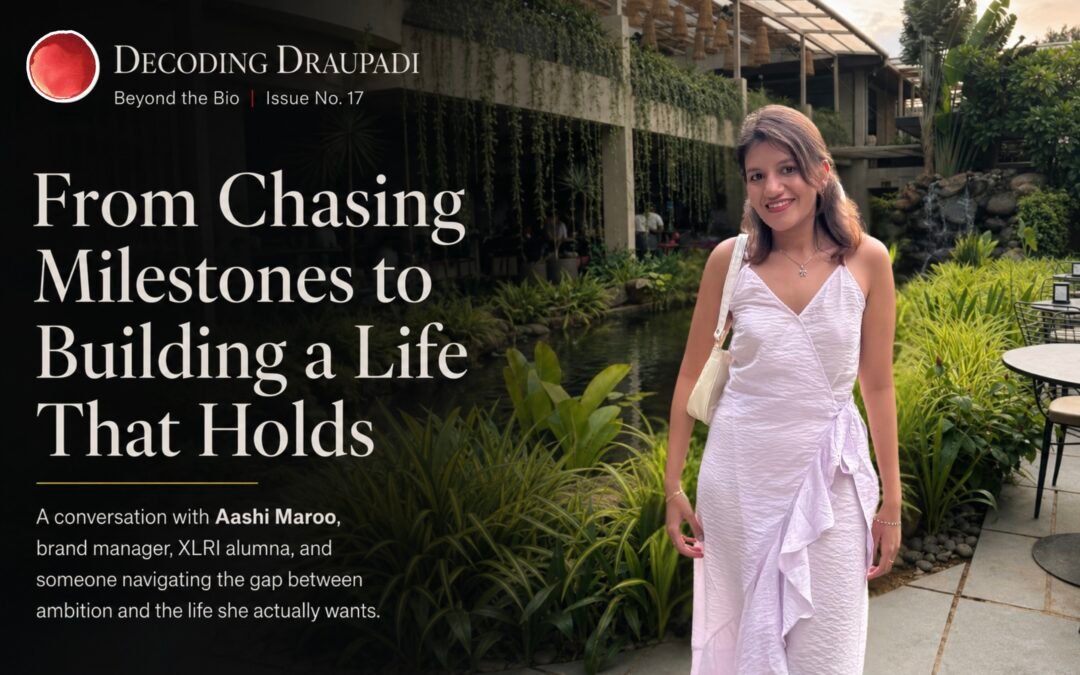
A conversation with Aashi Maroo, brand manager, XLRI alumna, and someone navigating the gap between ambition and the life she actually wants.
Aashi Maroo has done everything the plan said she should.
Studied well. Got into XLRI. Landed strong roles at Reliance and ITC. Moved from learning to owning. Ticked the milestones.
And now she is sitting with a question that the plan never prepared her for: what does a good life actually look like, not just a good career?
She does not have the answer yet. She is honest about that. And that honesty is exactly why this conversation is worth reading.
ON MEETING DIFFERENT VERSIONS OF HERSELF
Who is Aashi right now, across all the different lives you are living?
I think I am in a phase where I am actively meeting different versions of myself, and not all of them fit together neatly yet.
At work, I am someone who is learning to take ownership more seriously. I have moved from executing tasks to owning parts of a business. It is exciting, but it also comes with a lot more self-questioning.
Outside work, I am trying to build a life that feels balanced, but I am realising how hard that actually is. I want to be consistent with the gym, eat well, learn new things, stay connected with people, and still do well at work. And most days, it feels like I am falling short somewhere.
With friends and family, I am probably the most myself. Someone who values familiarity and does not have to constantly prove anything.
And in my own head, there is a constant conversation between ambition and self-development. Between building a career and building a life. So right now, I feel like I am in a phase of figuring out how all these versions can coexist without burning out.
“There is a constant conversation between ambition and self-development. Between building a career and building a life.”
This tension comes up in almost every conversation we have in this series. The woman who is doing well by every external measure and still quietly asking: is this the life I actually want, or just the one I planned for? Aashi names it without drama. That takes honesty. And we think a lot of women reading this will feel exactly this in their chest.

ON WHAT BRAND BUILDING ACTUALLY LOOKS LIKE
What has surprised you most about the difference between how brand building is taught and how it actually happens in real life?
What surprised me most is how non-linear brand building actually is.
In theory, it is very structured. You define the consumer, find a sharp insight, build a clear positioning, and execute consistently. It all looks very logical.
In reality, you are constantly navigating constraints: timelines, budgets, stakeholder opinions, and sometimes incomplete data. Decisions are rarely made with full clarity.
The balance between short-term and long-term is also much harder than it sounds. You are expected to drive immediate results while also thinking about brand building over time.
The biggest shift for me has been understanding that brand building is not just about having the right answer. It is about making the best possible decision in imperfect situations and moving forward with conviction.
“Brand building is not about having the right answer. It is about making the best possible decision in imperfect situations and moving forward with conviction.”
Every brand manager who has ever sat in a room with a half-finished brief, an incomplete data set, and a deadline knows exactly what Aashi is describing. The textbook version of strategy assumes you have everything you need before you decide. The real version does not. What she has figured out early is that conviction in an imperfect situation is itself a skill, and not a small one.
ON THINKING INDEPENDENTLY INSIDE LARGE SYSTEMS
What have you learned about working within large structures while still trying to think independently?
Earlier, I used to think structure limits creativity. Now I think it gives direction.
Structures tell you what is fixed: processes, timelines, priorities. The real thinking happens in how you work within that.
Independent thinking, I have realised, is not always about big disruptive ideas. Sometimes it is about questioning things that everyone has accepted, or improving small parts of a system that no one has looked at closely.
Ideas alone do not go far either. You need alignment. You need to simplify your thinking so others can see what you are seeing.
So now I think of independent thinking as less about having a different idea and more about making that idea actually work within the system.
“Independent thinking is less about having a different idea and more about making that idea actually work within the system.”
This is a maturity that takes most people years to arrive at. The early career instinct is to push against the structure, to see constraints as the enemy of good work. What Aashi is describing is the next level: understanding that the structure is not the obstacle, it is the playing field. And the best players know the rules well enough to find the space inside them.

ON THE WEIGHT OF ACTUALLY OWNING THINGS
What has the transition from being trained to actually taking ownership of outcomes felt like for you?
It has been a mix of excitement and discomfort.
When you are learning, there is a safety net. You can observe, ask questions, and even make mistakes without feeling the full weight of it.
Ownership feels different because your decisions now have visible outcomes. When something works, it feels rewarding. When it does not, you feel it more personally.
Initially, I overthought everything. I wanted to be sure before taking a call. But over time, I have realised that clarity often comes after you act, not before.
So now I am more comfortable taking decisions with partial information and learning along the way.
The shift from learning mode to ownership mode is one of the quietest and most significant transitions in an early career. Nobody announces it. One day the safety net is just gone. What Aashi describes, the overthinking, the need for certainty before acting, and the gradual letting go of that, is exactly what that transition feels like from the inside. And the lesson she has landed on, clarity comes after you act, is one of the most useful things anyone can carry into the years ahead.
ON THE WORK NOBODY CLAPS FOR
What is your relationship with the work that happens in the background, the kind the outside world does not reflect back?
This is something I have struggled with.
There are parts of work that feel invisible and sometimes even meaningless. Like doing repetitive updates week on week, or maintaining things that do not feel like they are adding real value in the moment.
Earlier, it used to frustrate me a lot. It felt like effort without impact.
But over time, I have started seeing two sides of it. Some invisible work is actually what keeps everything running smoothly. It may not be glamorous, but it builds discipline and reliability.
But not all invisible work is valuable. And I think it is important to recognise that and not just accept everything blindly.
So now I try to do what is needed, but I also question where my time is going and whether it could be better used. I am still figuring out that balance.
“Not all invisible work is valuable. It is important to recognise that and not just accept everything blindly.”
This is one of the more honest answers in this series about the invisible parts of work. Most people either romanticise the grind or resent it. What Aashi does is something more useful: she separates the invisible work that has value from the invisible work that does not, and she refuses to treat them the same way. That distinction matters. And it gets more important, not less, as careers grow.

ON AMBITION GETTING MORE COMPLICATED
How has your relationship with ambition evolved? What does ambition look like for you now?
Earlier, ambition for me was very straightforward. It was about doing well in college, getting into XLRI, landing a good role, growing fast. It was milestone-driven.
Now, it feels more complicated.
I still care about doing well professionally, but I am also constantly thinking about the kind of life I want alongside it. I want to be healthy, consistent, present with people, and have time for myself. But all of that requires effort too.
And that is where the tension comes in. Ambition now feels like a balance between career growth and self-development. And honestly, it does not feel fully figured out yet.
I think I am slowly moving from chasing milestones to trying to build a life that feels sustainable.
“I am slowly moving from chasing milestones to trying to build a life that feels sustainable.”
We hear a version of this shift in almost every issue of this series. The moment when the milestone stops feeling like the destination and starts feeling like just another step. Aashi is early in her career by most measures, and she is already asking the question that takes some people decades to get to: sustainable for whom, and toward what? That question is not a crisis. It is the beginning of a much more interesting kind of ambition.
ON WHAT TO WORRY LESS ABOUT
What would you want someone just beginning their journey to worry less about?
I think people should worry less about having everything figured out early.
There is a lot of pressure to make the right choices: right company, right role, right path. But most clarity actually comes from experience, not planning.
Worry less about comparison too. It is very easy to measure yourself against others, titles, salaries, pace of growth. But everyone’s starting point and priorities are different.
And worry less about doing everything perfectly. You will outgrow things. You will change your mind. And that is not a mistake. That is part of the process.
“Most clarity comes from experience, not planning.”
Three things, simply said. No performance, no packaging. Just the honest version of what she has worked out so far. Most clarity comes from experience, not planning is the kind of line that sounds obvious until you realise how rarely anyone actually behaves that way, especially at the start. Aashi has lived it. And that is why it lands.

A Note From Decoding Draupadi
What stayed with us after this conversation is how early Aashi is asking the right question.
Not what is the next milestone. But what does a life that feels sustainable actually look like? That is a question most people arrive at much later, usually after chasing the plan for long enough that it stops feeling like theirs.
We built this series for exactly this. For the women who are doing well and still quietly wondering if there is a better version of well available to them. There is. And it starts with asking the question out loud.
If this felt like someone you know, share it with her.
— End of Interview —
Aashi Maroo is a brand manager and alumna of XLRI, with experience at Reliance and ITC. This interview was conducted as part of the Decoding Draupadi Brand Manager Series.
We built this for the woman who is still figuring it out and doing brilliantly anyway. If that is you, you belong here.@decodingdraupadi.