
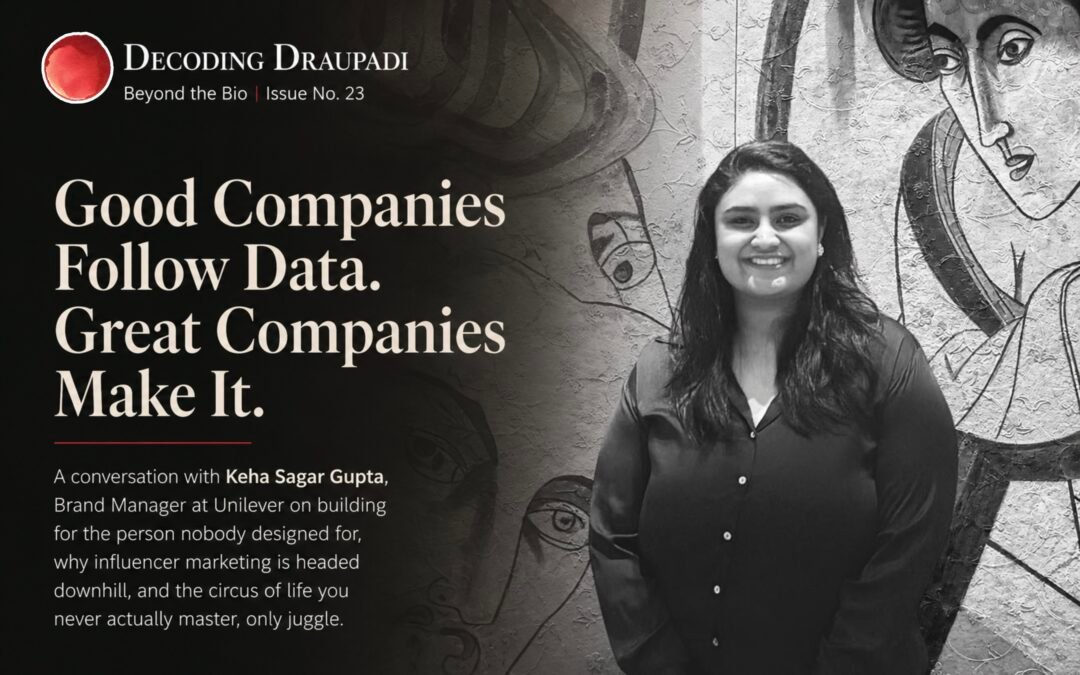
A conversation with Keha Sagar Gupta, Brand Manager at Unilever on building for the person nobody designed for, why influencer marketing is headed downhill, and the circus of life you never actually master, only juggle.
I was not prepared for Keha. I went into this conversation with my questions ready, and within ten minutes she had made me rethink influencer marketing, product design, and what it actually means to understand a consumer. She is the kind of person who takes your idea and hands it back to you three steps further than where you left it.
Keha Sagar Gupta has spent close to a decade across beauty, wellbeing, and food, building brands and products at companies like Unilever, where she currently leads the Knorr brand. She is someone who cannot work on something she does not personally believe in, and she will tell you that to your face. This conversation shows exactly why that is a strength, not a limitation.
A Responsible Joker in a Full Circus
Who are you right now, across the different lives you are living?
I think I’ll keep it funny and humorous. My life is a full circus right now, and I am trying to be a responsible joker. By that I mean I am juggling every day, trying to make sure the juggle does not turn into a struggle.
As a person, I grew up in a household that was very vocal, very woman-first, because of my father. We were only two sisters and nothing was ever differentiated by gender, so that concept never existed in my mind. There was nothing I thought I couldn’t do, because the thought never arrived.
That mindset took me to Miranda House, which was again a deeply woman-centric institute. Three years there made me a solid person who stopped bifurcating gender for anything I wanted to pick up, experience, or work on. Then I stepped into the workforce and realised, oh, there is something else going on here.
But I came from a place where my setup was never that I am less, or different, or behind. I just feel that everybody is a bunch of people here for some reason. And I have operated my career from that point.
Outside of work, I am still a person of five people. The ones I can really talk to. I love swimming, and I lost that for a while in the middle of figuring out career and life. I am glad it has come back to me in the last two or three years. Health is something no money and no success can buy you.
“I am trying to be a responsible joker. Juggling every day, making sure the juggle does not turn into a struggle.”
I loved how she opened with that image. The circus, the joker, the juggle. It’s funny and it’s also completely honest. And the part about her father and Miranda House shaping a mind where gender limits simply didn’t exist, that’s not a small thing to carry into a decade of workforce. You could hear it in everything she said after.

Korean Food, Squid Games, and a Brand That Was Ready
How do you personally decide when a brand is genuinely participating in culture versus just borrowing a trend to stay relevant?
Two things I always keep in mind when I pick up a brand: does it personally resonate with me, and can I have fun with it? If I don’t resonate with the brand, I won’t understand the consumer, I won’t understand the psychology, and I won’t find the need gap. You can only have fun with something when you like it yourself.
When I got Knorr, the brief was: this brand has been known for soups for ages. Can we do something about it? I did the research and realised the answer was already sitting in the question. Knorr has strong equity in the foods space. Why stop at soup? Anything international could be Knorr.
We found that women and young people were heavily into K-culture. It was a trend, and we knew it would not last forever. But as a business that needed to grow that year, we asked: what can we do with it right now? We designed Korean-first flavours from the ground up, launched them, and then got a data point: people into K-culture were also very into Squid Games. We ended up doing a tie-up with Netflix and made an ad around daring to slurp.
Culture, fun, and business growth happened at the same time. But it only worked because the brand had the equity to hold it. If the brand has no point of view, you cannot just hop onto a trend and expect it to stick.
“You can only have fun with something when you like it yourself. Otherwise there is no point.”
I personally had no idea she was behind the Knorr Korean launch. I remember those products. Finding out the person who designed them was sitting across from me was such a moment. And the Squid Games tie-up, that is a masterclass in connecting the right data points at the right time. The brand was already there. She just saw where culture was pointing.
Good Companies Follow Data. Great Companies Make It.
Was there ever a phase where you felt pressure to become a more acceptable or predictable version of yourself professionally?
It happens all the time. When you are a fresher, people welcome your ideas because they come from a fresh mind. But as you grow up the ladder, your point of view starts becoming competitive rather than being accepted. That was my first real challenge. I had to learn when to hold on and when to speak up.
In most cases, I still put my point of view forward. Take it or leave it. I have been in trouble for it, been told I am acting too smart or not bringing enough data. But I came from a strong angle: consumer transformation is evident. You cannot debate it with me.
What I always tell people who come under me now is this: good companies follow data. Great companies make the data. That is how disruption happens. But to pick up that disruption gap, you have to be open to hearing something that comes out of the odds. If you are not the person making things, there is no fun.
And it never ends. Even if I become a CMO someday, there will still be a board of directors above me. The guardrails just change shape.
“Good companies follow data. Great companies make the data. That is how disruption happens.”
This is the line I keep coming back to. She said it so casually, like it was obvious, and then just moved on. But it is not obvious at all. Most people in rooms full of data are using it to defend decisions they already made. Keha is describing something different: using your own instincts to create the signal before anyone else has it. That takes a very specific kind of courage.
The Circus Does Not Go Anywhere. You Just Learn to Juggle It.
What are you still privately figuring out, even though your career looks sorted from the outside?
Personally, there is a lot. But I think the most important skill I have developed is switching on and switching off. If you are in the workforce as a woman in urban India today and you do not have this skill, you will mess things up. A woman’s brain is wired differently, we keep thinking about multiple things at once, and there is nothing wrong with that biologically. But at work, you have to switch off what is happening at home. And when you are home, you have to switch off work. Otherwise neither gets the best of you.
The last few years have been messy for me. My career grew, I got married, I stepped away from my parents’ home for the first time, and everything that used to be taken care of was suddenly my responsibility. The circus that I joked about at the beginning of this conversation became very real. And somewhere in all of it, I lost time for myself. Not in a dramatic way, but quietly. My physical health was getting impacted. There was no me time, only we time.
One day I sat down with my husband and told him I don’t have time for myself and I don’t know what is going on. He listened, and then he said: who is telling you to do all of it? If you want to go for a run for an hour, just go. Things will be figured out.
That was the permission I needed to hear. Not that everything would be perfect. Just that stepping away for an hour would not break anything. And the latest realization I have come to is that the circus does not go anywhere. It is not going to stop. So probably you will never master it. You will only juggle it. And that is okay.
“You will never master the circus. You will only juggle it. And that is okay.”
This answer hit differently for me, honestly, because I think a lot of us are waiting for the point where it settles. Where the juggling stops and everything just runs. She is saying very plainly: that point does not come. But the way she says it does not feel like defeat. It feels like relief. Like she has finally stopped fighting a thing that was never going to go away, and found peace in the middle of it instead.
Influencer Marketing Is Headed Downhill. There, She Said It.
What is one trend in branding or marketing that you think people are overestimating right now?
Influencer marketing. And I know that is a controversial answer.
The dependency on it has increased, but the credibility has gone down. It has become the most expensive medium of marketing today, and the conversion to actual sales has dropped. And in a world where every young person wants to pick up a phone and become an influencer, the signal is getting buried under the noise.
When influencer marketing started, it worked because it was credible. Someone you followed was talking about a product because they genuinely used it and liked it. Now it is all paid partnerships and sponsored content. The products might be great. But the trust that made it work in the first place is eroding fast. Anything that moves from niche to mass loses its credibility and its scalability at the same time.
There is also a regulatory gap that worries me. When a big company puts out a product claim, there are a hundred legal checks and quality reviews before that goes live. An influencer with little knowledge can put out the same claim with no accountability. That gap is a real problem, especially in categories like health and finance.
I see it running downhill within the next year or two. Brands will keep investing for now, but the data on off-takes is already telling the story.
“Anything that moves from niche to mass loses its credibility and its scalability at the same time.”
I will be honest: I pushed back on this one a little during the call because I had not thought of influencers as paid media tools before, just as personal brands. But she reframed it completely. The moment a platform becomes mass and monetised, the original thing that made it trustworthy is gone. And then she asked me: would you rather take financial advice from someone with ten years at a serious bank, or someone who has never worked in finance? I had no answer. She did.

Storytelling Is What She Lives For
What kind of work makes you feel most creatively alive?
Storytelling and product. Both of them together.
Creating a product feels like handing a candy to a child. Either you are giving someone something they will enjoy, or you are solving a real problem they have been carrying. Before foods, I spent a lot of time in beauty and wellbeing, and one of the most meaningful things I worked on was a line for postpartum hair fall.
When I met postpartum mothers to understand what they were going through, they told me they had tried everything and nothing was stopping the hair fall. They were frightened to brush their hair because of how much came out. One woman said she felt she would never go back to looking the way she did before. That is not a beauty problem. That is a woman feeling like she has lost a part of herself.
So the story we told was not: you have hair fall, buy this product. The story was: what is happening to you is normal after what your body has been through. You just need to approach it differently. And here is why and how. The product had to work, and it did. But the story had to make her feel seen first.
That is what storytelling means to me. Not just what is the product, but why does it exist, who does it exist for, and what does she actually need to hear.
“The story had to make her feel seen first.”
The postpartum hair fall example stayed with me long after the call. She did not come at it from a market size or a revenue angle. She came at it from a woman sitting in her bathroom, scared to pick up a brush. That is where the product started. And that is exactly the kind of insight you cannot manufacture in a boardroom. You have to go meet the person. Keha did.
Marketing Is Not Advertising. Go to a Store First.
If someone younger wanted to enter brand management today, what is one thing no classroom or internship could ever really teach them?
First, go out into the market. A store, a mall, a retail space, anywhere. Just walk around and honestly ask yourself: do products excite me? Do the things happening in the market excite me? Because unless you are genuinely excited about the category you are going to build a career around, you will never do good work in it.
Second, ask yourself: do you actually believe in brands? If you think marketing is a gimmick, this is not the field for you. The person who does not believe in what they are making should not be the one making it.
And if those things do excite you, give yourself a challenge. Pick any product in any category and ask: what would I do with it? Think through the product, the proposition, the story, who you would sell it to, where, and with whom. Walk across the whole thing. If that exercise lights something up in you, you will probably be good at this.
The other thing I always say clearly: marketing is not advertising. I do not know where that idea came from, but it needs to go. Marketing is understanding what is actually happening in people’s lives. If you cannot observe the problem, you cannot find the gap. And if you cannot find the gap, you cannot build anything worth building.
“Marketing is not advertising. It is understanding what is actually happening in people’s lives.”
She gave me a live example of this during the call. I mentioned induction cooktops in the context of the LPG crisis, and she took that thought three steps further in about thirty seconds: Indian kitchens and habits, the resistance to change, and then she told me about a brand called Foodlabs that had already solved it by designing a hybrid product with just two buttons because the insight was that moms do not want ten buttons on an induction stove. I had to just sit there. That is the brain of someone who genuinely cannot stop seeing problems and possibilities everywhere she looks.

A Note From Decoding Draupadi
What stayed with us from this conversation is the postpartum hair fall story. Not because it is the most impressive thing Keha has built, but because of where it started. A woman scared to brush her hair. The insight. The product brief. The story.
Keha has spent a decade finding those moments and building backward from them. That is not a skill you pick up in a classroom. It comes from genuinely caring about the person on the other side of the product, and from having the patience to sit with her long enough to understand what she is actually carrying.
We are lucky she came and talked to us.
If this felt like someone you know, share it with her.
— End of Interview —
Keha Sagar Gupta is Brand Manager, Knorr at Unilever. This interview was conducted by Rishika Agrawal as part of the Decoding Draupadi Brand Manager Series.
She said the story has to make her feel seen first. For every woman building products for other women, this conversation is essential. Find it at @decodingdraupadi.