
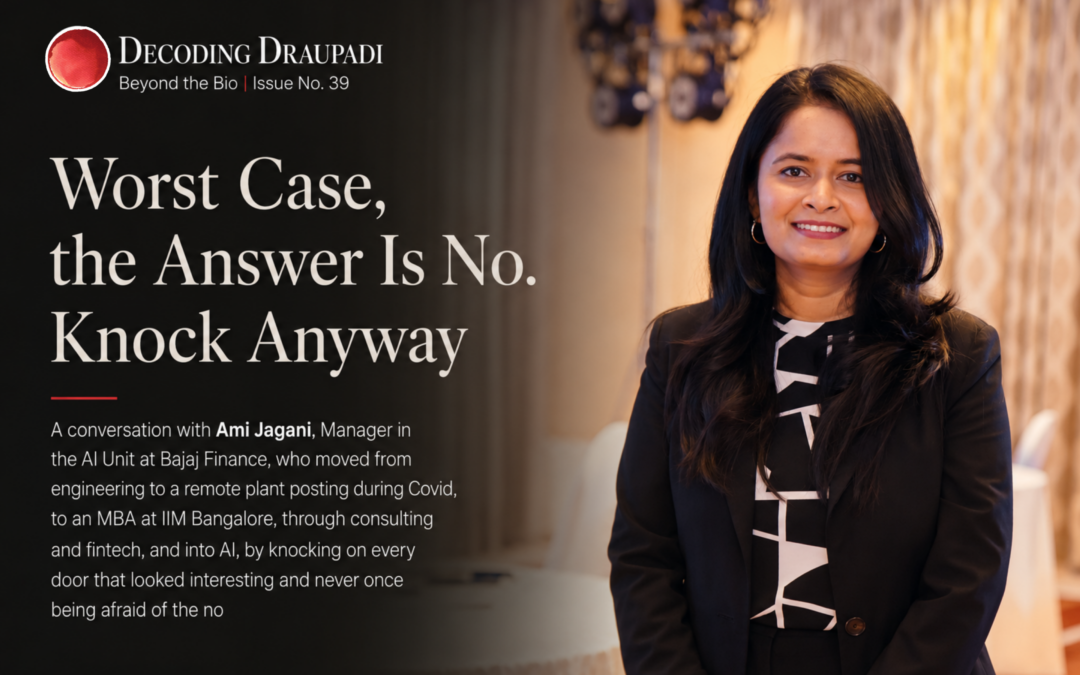
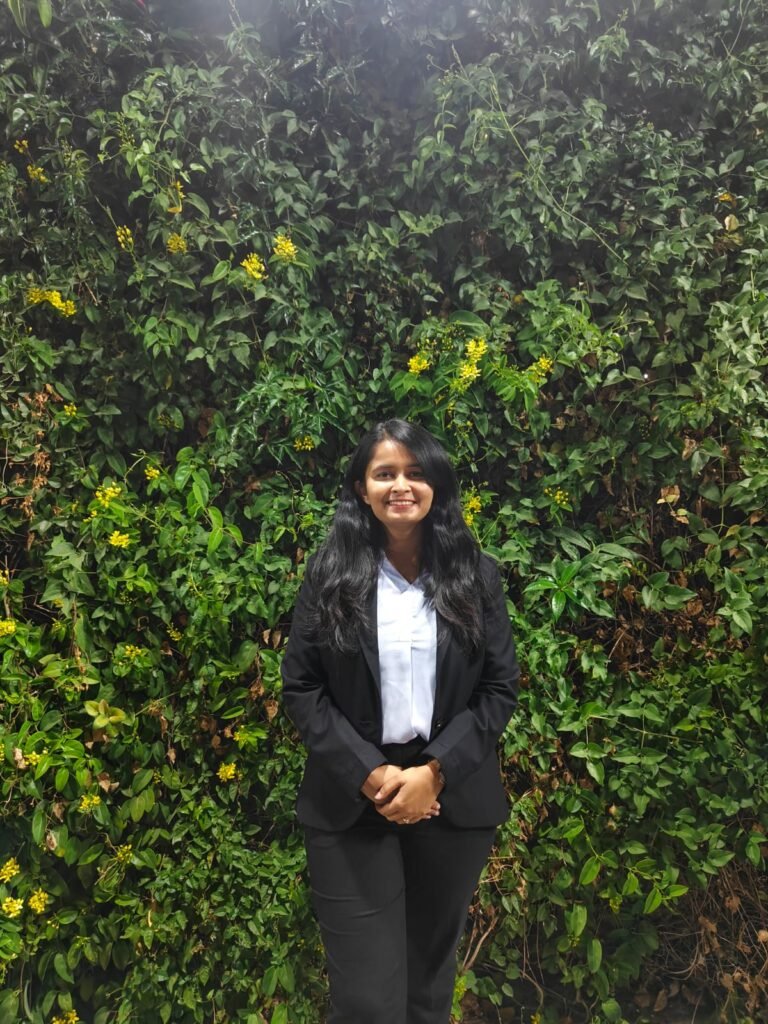
A conversation with Ami Jagani, Manager in the AI Unit at Bajaj Finance, who moved from engineering to a remote plant posting during Covid, to an MBA at IIM Bangalore, through consulting and fintech, and into AI, by knocking on every door that looked interesting and never once being afraid of the no
Life rarely moves in a straight line. More often it feels like a rollercoaster: unpredictable, full of turns nobody planned for. Ami Jagani’s career has the shape of someone who learned to enjoy that ride rather than just hang on to it. She started as an engineer at a remote plant posting during the Covid years, the kind of place where ordering a pizza takes an hour of phone calls. From there she went on to an MBA at IIM Bangalore, moved through consulting and fintech, and is now shaping AI data strategy at Bajaj Finance.
Career transitions are only half the story, though. The other half is in the smaller, almost reckless choices that reveal character: a ramp walk despite being deeply camera-conscious, a powerlifting team she joined without ever having touched an advanced gym machine, national case competitions entered purely for the thrill of solving a stranger’s problem. One instinct runs underneath all of it. If you do not yet know exactly where you want to end up, you can still try, and trying is its own kind of answer. Sometimes the path becomes clear not because you knew the destination in advance, but because each attempt taught you something about what you did not want to be.
The 20 Percent That Makes the 80 Percent Worth It
Who is Ami right now, across the different lives you are living?
If she had to list every role on paper, it would be a long list. But the role that matters most is whichever one she is doing well in at that moment.
At work, she is a manager, and what gives her the best feeling is when her team tells her a task became easier because of her, or that she helped them in some way beyond the normal job description. At home, marriage brought a list of milestones she had never had to think about before. She had zero idea how to run a house. Deciding what to cook, three times a day, every day, was new and genuinely hard at first.
She has become a new, self-taught cook. She paints in her free time. She writes. She loves visiting a newly opened cafe with a friend. And every time she discovers a new skill or quality in herself, it feels good. Across all the roles and all the chaos, that one nice moment, the twenty percent of peace or happiness, is what defines her. The chaos is worth it for that moment.
“Eighty percent of life is chaotic. But that twenty percent of peace, happiness, or a single good moment is what defines me, and I think the chaos is worth it for that.”
Most people answer this question with a list of roles. She answered it with a ratio. Eighty percent chaos, twenty percent the thing that makes it worth it. That kind of precision about your own emotional accounting is rare, and it tells you she has actually sat with the question before.
Worst Case, the Answer Is No
You have moved from engineering and operations to consulting, strategy, health tech leadership, and now AI. What has guided your decisions through these transitions: curiosity, opportunity, ambition, or a mix of all of them?
Looking back, she says, it was a mix of all of it. But in the moment, it was always whatever felt new or interesting.
After engineering, the obvious next step was a campus placement. Hers sent her to a remote plant location during the Covid era, fourteen hours from her hometown in Gujarat, the kind of place where ordering a pizza means an hour of figuring out logistics. She decided enough of engineering, watched people around her moving into management roles where they could actually shape decisions, and went and did an MBA at IIM Bangalore.
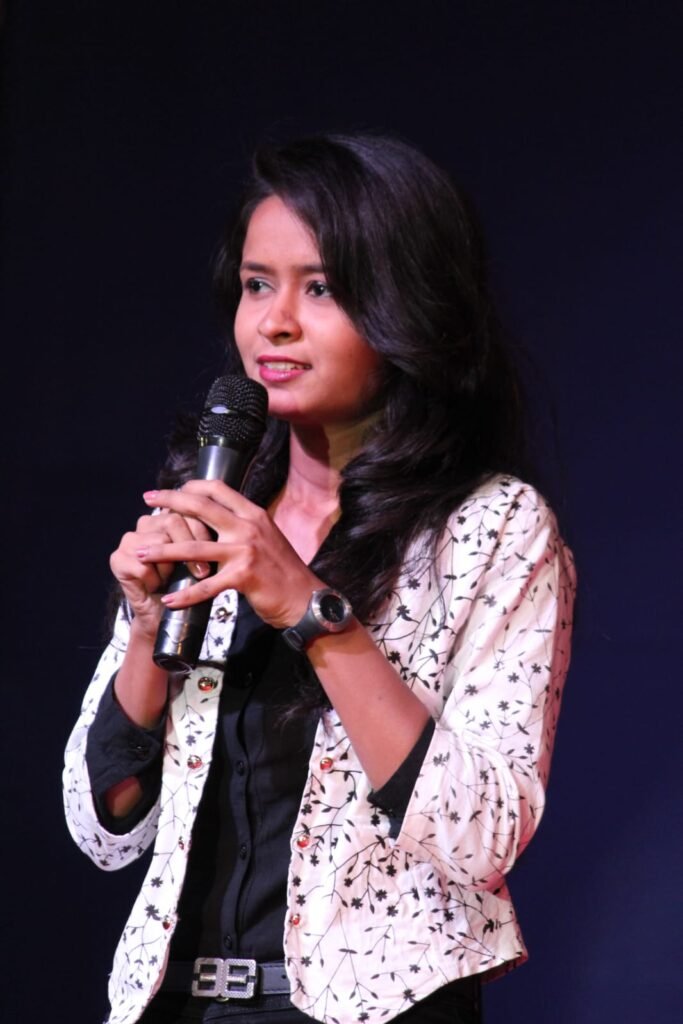
At IIM, she decided she was going to do crazy things in her life, and she has failed at a few of them miserably. She signed up for a ramp walk despite being self-conscious about being watched. She signed up for powerlifting having never used an advanced gym machine, because a team needed one more member and nobody else would say yes. She entered national case competitions because solving a stranger’s business problem on someone else’s campus sounded fun.
Consulting came naturally out of an internship. The shift to fintech at Bajaj Finance gave her room to move across projects. And when AI became the thing everyone in the building was talking about, she jumped towards it.
“The worst answer you can get is no. But you can never stop yourself from trying.”
She names something most career advice dances around: the actual cost of trying is almost always smaller than it feels in the moment. People forget things quickly. The risk of asking is rarely as large as the fear of asking. She has tested that theory on a runway, in a gym, and in case competitions, and the theory has held.
Smaller Goals Cannot Be Ignored
What is a belief about success you had earlier in life that you no longer believe today?
Her longer-term goals, becoming a certain kind of person, reaching a certain stage, still hold true. But she no longer believes the smaller goals can be ignored along the way.
She uses the analogy of skydiving: people set it as a goal to overcome fear, but you can always start smaller. She started with a ramp walk, to get past her fear of being watched and judged. That was one step. The smaller steps still count. They build the confidence that eventually lets you take the bigger one.
It does not need to be as dramatic as skydiving. It can be starting a gym, signing up for a dance class, showing up at work and doing one small thing differently. Longer goals remain true. But the shorter ones, the ones that get dismissed as too small to matter, cannot be ignored.
“Longer goals remain true. But shorter ones cannot be ignored. Smaller steps build the confidence that eventually lets you take the bigger one.”
She also makes a second point worth holding onto: a five or ten-year goal cannot be the only thing you are living for during those years. You cannot defer your whole life to a single outcome and call the years in between a holding pattern. The responsibility for your own happiness sits with you, every single day along the way, not just at the finish line.
The Needle and the North Star
Has there ever been a period in your life where you felt pulled between who you were and who people expected you to be?
Many times. She has asked herself, more than once: is this really me? Would the eighteen-year-old version of myself have thought this way?
People hold onto a persona, she says, in friendships, in partnerships, with parents and bosses. You keep dwelling on an image of who you decided you were, and you keep performing it, even as you change. But people change with situations, with growth, with what they learn. The friend you had at eighteen is not the same friend you have at thirty. You have to be adaptable enough to let yourself, and other people, grow.
What matters to her is not staying the same person, but staying aligned with the same values as she changes. Kindness is the one she will not compromise, at any level of the corporate ladder. She does not want to be the kind of person others describe as rude or difficult to work with, because she believes most things can be accomplished simply by asking well and treating people with basic dignity.
She uses a compass analogy: if the needle drifts from her north star, she notices, and she corrects. If she has snapped at someone out of character, she goes back and apologises. The goal is to be able to look in the mirror at night and say, this is who I am, and I am okay with it.
“If you want your needle to keep pointing at your north star, you have to notice when it drifts, and come back to it.”
The compass metaphor does a lot of work here. It is not about never drifting. People get angry, snap, act out of character. It is about having a fixed point you keep returning to, and being honest enough with yourself to notice when you have moved away from it.
Consistency with Health and Showing Up
If you remove achievement, emotions, and external validation from the equation, what would make a year feel meaningful to you personally?
She has been thinking about this as she approaches her thirties. For a while now, she has neglected her health. The goal for the next year, and really for the rest of her life, is to show up for some form of physical activity consistently.
She started by learning to swim, something she had never done. Now the plan is strength training a couple of times a week. She picked this up partly from her father, who still works out every day of his life, waking at five or seven in the morning without fail. It is time, she says, to inherit that particular virtue.
Her reasoning is simple: at the end of the day, your body is the one thing that has to stick by you. Without it, every other goal becomes harder to chase, and so does being present for your family.
“At the end of the day, it’s your body that has to stick by you. Without it, everything else gets harder to chase.”
She makes an honest point about ageing here too: in your twenties, your body absorbs sleepless nights and bad habits without much consequence. In your thirties, it starts to push back. That recalibration, not as a crisis but as information, is exactly the kind of thing worth hearing from someone a few years ahead of where you are.
Be the Safe Space
What kind of conversation do you wish people had more often but rarely do?
The kind she has had with her parents: open, vocal, willing to talk about problems and actually listen to the other person’s. Not everybody communicates through words. Some people show care through actions instead. But having at least one person you can genuinely emote to, who can hold that space for you, is a rare and important thing.
In an era where people face a lot of anxiety, where social chaos is constant, and where opening up online does not feel safe and opening up to a friend does not always feel safe either, that one person matters enormously. If everything stays bottled up, it tends to come out eventually in some form you would rather avoid.
Her advice: build that safe space for yourself, wherever you can find it, parent, partner, friend. And just as importantly, be that space for somebody else. Despite everything technology offers now, the basic human need to be heard and to communicate has not changed since the earliest era of human history.
“If everything gets bottled up, it eventually comes out in a form you would rather avoid. Build that safe space, and be one for somebody else too.”
She is careful to note this does not have to be one specific type of relationship. It can be a parent, a partner, a friend, a colleague. The point is not who. The point is that the space exists at all, for you and from you.
Two or Three Decisions That Were Worth It
Looking back, what has been one of the most unexpectedly rewarding decisions of your life?
Many candidates, but two stand out.
The first was the remote plant posting straight after engineering, during Covid, with no weekends to speak of and nothing much to do besides the work itself. At the time it was difficult and isolating, far from anything familiar. But surviving that phase gave her something she had not had before: a real sense of her own resilience and independence.
The second was the MBA. People debate whether an MBA is worth it financially, and she does not dismiss that debate. But the value she actually took from it was never going to show up on a spreadsheet. She met people from completely different backgrounds, made some genuinely great friends, and found her partner there. Yes, it came with a sizeable education loan. No, she would not trade the experience for anything else.
Her father has been her loudest cheerleader through all of it. He taught her to drive at eighteen, insisted she be able to go anywhere on her own, and still reminds her that the ambition is hers to carry and hers to achieve. Having that kind of person in your corner, she says, is what lets you keep climbing.
“When you enter a decision, you might not know if it was worth it. But when you exit, you definitely know.”
She frames the MBA’s value entirely outside the financial debate that usually dominates that conversation. Not whether it paid for itself in salary terms, but whether it gave her something she could not have gotten otherwise. That is a more honest way to evaluate a major life decision than the spreadsheet version most people default to.
A Note From Decoding Draupadi
What stayed with us is the ramp walk. Not the powerlifting, not the case competitions, not even the remote plant posting during Covid. The ramp walk, because she names exactly why she did it: not to become a model, but to get over the fear of being watched and judged. That is a precise, deliberate use of discomfort as a tool. She picked a fear and then walked straight into it, on purpose, in front of people.
Say yes to what stretches you. Knock on the door. And if you are still unsure exactly where you are headed, that is alright too. You do not need to see the whole destination to take the next step. Sometimes trying is enough on its own. Sometimes discovering what you do not want is the most honest way to find out what you do.
If this felt like someone you know, share it with her.
Eighty percent of life is chaotic. The twenty percent that is not is what makes the chaos worth it. More at @decodingdraupadi.
Ami Jagani is Manager in the AI Unit at Bajaj Finance. This interview was conducted as part of the Decoding Draupadi Brand Manager Series.