
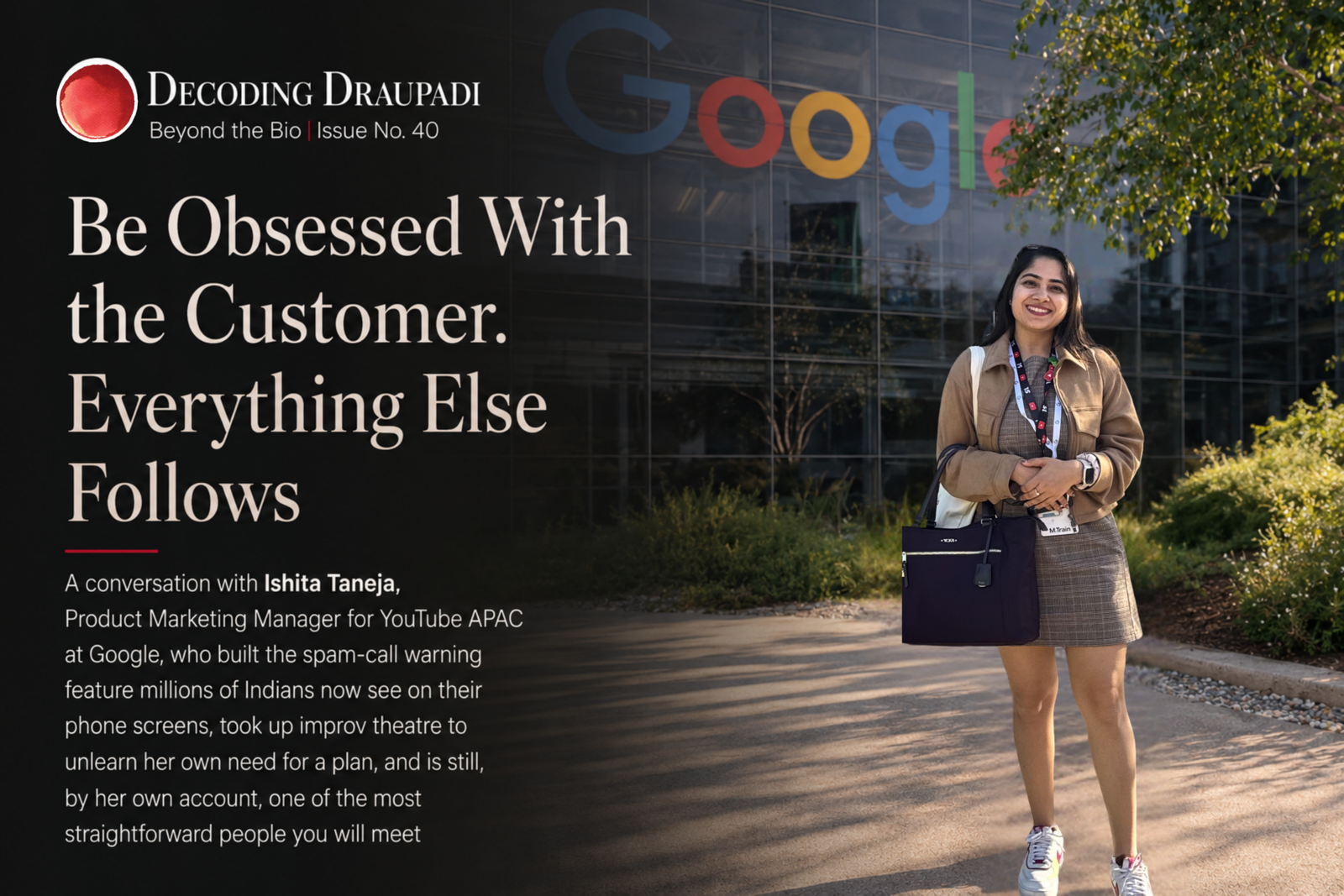
A conversation with Ishita Taneja, Product Marketing Manager for YouTube APAC at Google, who built the spam-call warning feature millions of Indians now see on their phone screens, took up improv theatre to unlearn her own need for a plan, and is still, by her own account, one of the most straightforward people you will meet
Ishita Taneja has moved through consulting, retention marketing, acquisition marketing, and now product marketing at YouTube APAC. Before Google, she spent years at Airtel, where she led the cross-functional team behind the spam-call warning that now appears on phone screens across the country. She also recently completed a beginner’s course in improv theatre, performed in front of an audience of fifty, and describes it as the most useful thing she has done for her own brain in years.
What makes this conversation worth reading is the consistency underneath all of it. Different industries, different products, different countries on her current remit. The same obsession with the customer, every time.
Resilient, Multitasking, and Allergic to Titles That Do Not Mean Much
Who is Ishita right now, across the different lives you are living?
Titles are fungible, she says. They change, and they are not always proportionate to the effort behind them. So she defines herself differently: someone resilient, who sets her mind to something and achieves it through hard work and consistency. Someone who multitasks across varied interests, because she believes in a well-rounded personality beyond work. And someone who deeply values community, family, and friendship: being a daughter, a sister, a great friend, all of it matters just as much as anything on her resume.
Her hobbies tell the rest of the story. Travel, fitness in every form, boxing, running, swimming, Pilates, hiking wherever she goes. A fascination with history, art, and culture that turns into walking tours of her own city, Delhi, tracing what existed before. And recently, improv theatre.
She took up improv specifically because she recognised something about herself: she has always been the planned, structured, ten-steps-ahead person. And she realised that does not actually serve her, or anyone, because life does not move according to a plan. Improv’s ethos, as she puts it, is presence over preparation. You show up as yourself, trust the moment, and go with the flow.
“Presence over preparation. You show up as yourself, you trust yourself in the moment, and you go with the flow.”
Most people pick up a new hobby because it sounds fun. She picked up improv as a deliberate intervention on her own personality, to train herself out of an obsession with planning. That is a much more interesting reason, and it says more about her than the hobby itself does.
Be Obsessed With the Customer
You have worked across consulting, retention marketing, growth marketing, and now product marketing at YouTube. Looking back, what has stayed constant in the way you solve problems, even as your titles and responsibilities have changed?
She has been a marketer throughout, even during her consulting years, where she had a fair touchpoint with the marketing workstream before her MBA. After the MBA, she has been a marketer through and through, and she loves it. It is, she says, her identity.
If there is one guiding principle behind being a good marketer, it is being obsessed with the customer. Getting into their psyche, their behaviours, their trigger points, their pain points, their aspirations. It connects closely to psychology, another genuine interest of hers. Across retention marketing, acquisition marketing, and product marketing, the one thing that has stayed constant is her ability to understand the customer deeply, regardless of what the role is called.
“Being obsessed with the customer. That is the one fundamental tagline of being a good marketer, no matter what the role is called.”
Titles changed. Industries changed. The actual skill she leaned on never did. That kind of through-line is rare to hear described this cleanly, and it is the clearest answer in this series to the question of what actually transfers across a career.
Never Had to Mask an Idea, Because She Never Had a Bizarre One
Was there ever a phase where you felt pressure to become a more acceptable or conventional version of yourself professionally?
She does not think she faced that particular challenge, and she has a clear reason why: she is a straightforward person. What she thinks, she says. She does not shy away from sharing her thoughts. So it was never a case of having unconventional or bizarre ideas she had to mask in order to fit in, because her ideas, her campaigns, were always rooted in logic and in what the business actually needed. She had simply always thought things through before bringing them forward.
“It’s not like I myself would have bizarre ideas that I’d have to mask. My ideas were always rooted in logic and the need of the business.”
This answer, paired with her decision to take up improv, is the most interesting tension in the whole conversation. She has never had to hide an unconventional idea at work, because she has never really had one. The unscripted, spontaneous side of her had to be built deliberately, through a theatre class, rather than discovered through professional rebellion.

Humanity, Above Everything
What is one belief or value you hope you never compromise, no matter how your career or your life evolves?
Humanity. In tough professional situations, the pressure always exists, but what makes the difference is taking a step back, looking at the larger picture, and remembering to be humane to the person in front of you. Offering kindness and empathy. Climbing the corporate ladder matters, but everyone carries their own story, their own struggle, their own different starting point. Mindfulness and respect have to come with that.
She points to her own experience as proof of what this looks like in practice. She went through a genuinely difficult personal period while she was at Airtel, and the company, her peers, her bosses, supported her through it without rushing her. She believes her life could have gone in a very different direction without that humanity. It made all the difference.
“Climbing the corporate ladder is really important, but everyone has their own story. You have to bring in respect and treat everyone with humanity.”
She does not present this as an abstract value. She names a specific period where she needed exactly this from the people around her, and got it. That makes the value feel earned rather than aspirational.
Stop Assuming Everything Will Go to Plan
What is something you have changed your mind about in the last few years?
That everything will always go well. When you are young, she says, you tend to carry an overly optimistic view of the world, assuming everything will turn out as planned. What she has learned instead is the importance of contingency, of pivoting and recalibrating whenever a setback shows up. The fix is not assuming things will go well. It is having the confidence that you will make things right when they do not.
“Don’t assume everything will go well. Just have the confidence that you will make it right.”
This pairs naturally with her decision to take up improv. Both are versions of the same lesson: certainty about the plan is less useful than confidence in your own ability to respond when the plan does not hold.

The Feature Behind the Warning on Your Phone Screen
What kind of work gives you the deepest sense of meaning or excitement, the kind that reminds you why you entered marketing in the first place?
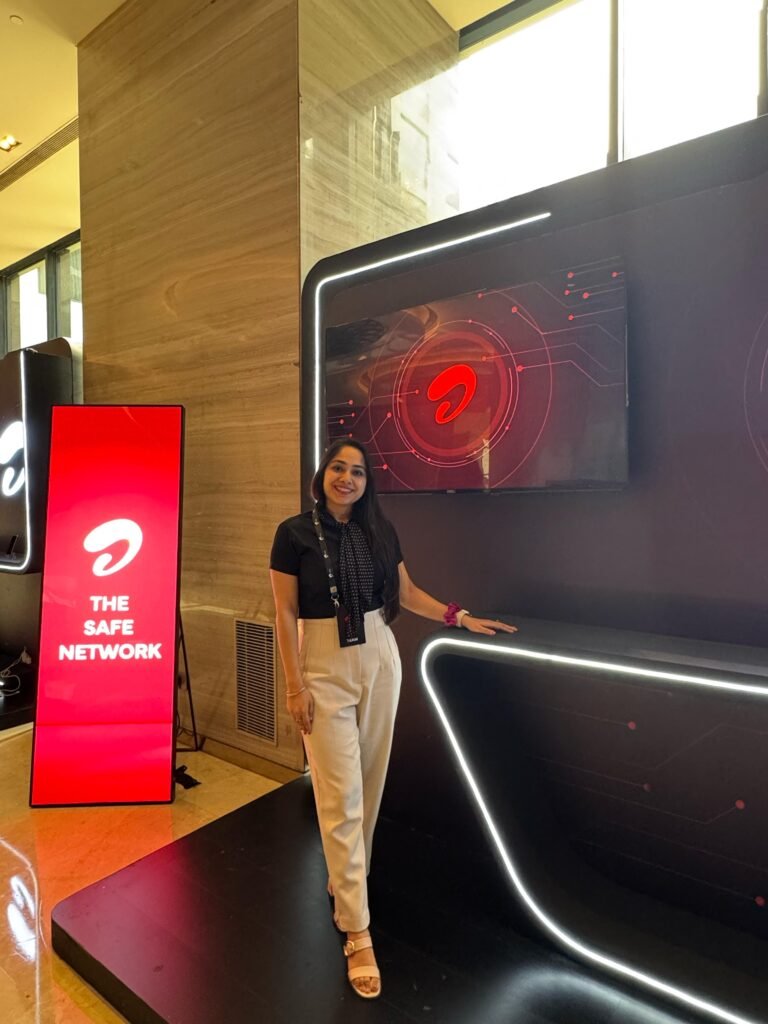
Customer interaction, and specifically, hearing directly from someone that something she built genuinely helped them. The most pivotal project of her career so far happened at Airtel, where she led, cross-functionally, the launch of a spam protection feature. Right beneath an incoming call’s number, the screen would display a warning identifying it as a likely spam call, no third-party app required.
When the feature launched, friends reached out to tell her how relieved they were, specifically because they no longer had to worry about their parents being scammed over the phone. That, she says, was by far the most fulfilling piece of work she has done. Making a tangible difference in a customer’s actual life is what drives her.
“My friends told me they finally felt like their parents were protected. That was the most fulfilling work I’ve done. Making a real impact in someone’s life is what drives me.”
Most product features are invisible to the people who use them. This one is not. Millions of phones in India now display a warning that exists because of work she led. That kind of tangible, visible impact is rare in a marketing career, and she clearly knows exactly how rare it is.
Subject Matter Expertise, and a Well-Balanced Life
If success could no longer be measured through titles, income, recognition, and achievement, what would it mean to you?
Subject matter expertise, pursued for its own sake. She would love to be a genuine expert in her field, not for the titles or the promotions or the money attached to it, but for the actual knowledge required to make a significant contribution and be a differentiator. That is what would drive her towards success.
Alongside that, building a strong community and being present for the people around her, alongside the hobbies and interests she already makes time for. Living a well-balanced life, in her own words, is also a form of success.
“Success would mean subject matter expertise, not for the titles or the money, but for the contribution. And alongside that, just living a well-balanced life.”
She gives an answer rooted in mastery and balance rather than scale or recognition. Given how driven and accomplished she clearly is, the absence of ambition for status in this answer is notable. The thing she wants more of is depth, not visibility.

Confidence First. Self-Awareness Always.
What would you tell a woman ten years behind you, something nobody told you and that she will not find in any book?
When you are young, she says, you are anxious, you over-prepare, you try to control everything yourself. What actually makes the difference is having confidence in yourself regardless of outcomes. If you do not get into that college, if you do not land that dream job at that particular time, you will come out of it. If you stay consistent and resilient, you come out a winner.
Place that confidence in yourself at every stage of life. At the same time, keep evaluating. Identifying your own blind spots matters, because there is no growth without self-improvement, and self-improvement starts with self-awareness. Have a positive attitude towards learning and towards failure, and have the confidence to make it through.
“Place confidence in yourself at every stage of life. There’s no growth without self-improvement, and that starts with self-awareness.”
Confidence and self-awareness usually get framed as opposites, one about belief in yourself, the other about honest scrutiny of yourself. She is arguing they are the same discipline, practised together. You cannot have one without the other for very long.
A Note From Decoding Draupadi
What stayed with us is the spam-call feature. It is easy to talk about customer obsession in the abstract. It is much harder to point to something on millions of phone screens and say, I built that, and it is keeping people’s parents safe from scams. She did, and she said it plainly, without making a bigger deal of it than it already was.
The other thing worth holding onto is the improv class. A woman who describes herself, accurately, as straightforward, logical, and someone who has never had to mask an unconventional idea, deliberately signed up for a form of theatre built entirely on spontaneity and discomfort. Not because work demanded it. Because she noticed something about her own need for control and decided to do something about it herself.
If this felt like someone you know, share it with her.
Presence over preparation. A self-described planner took up improv theatre to unlearn her own need for a plan. More at @decodingdraupadi.
Ishita Taneja is Product Marketing Manager for YouTube APAC at Google. This interview was conducted as part of the Decoding Draupadi Brand Manager Series.