
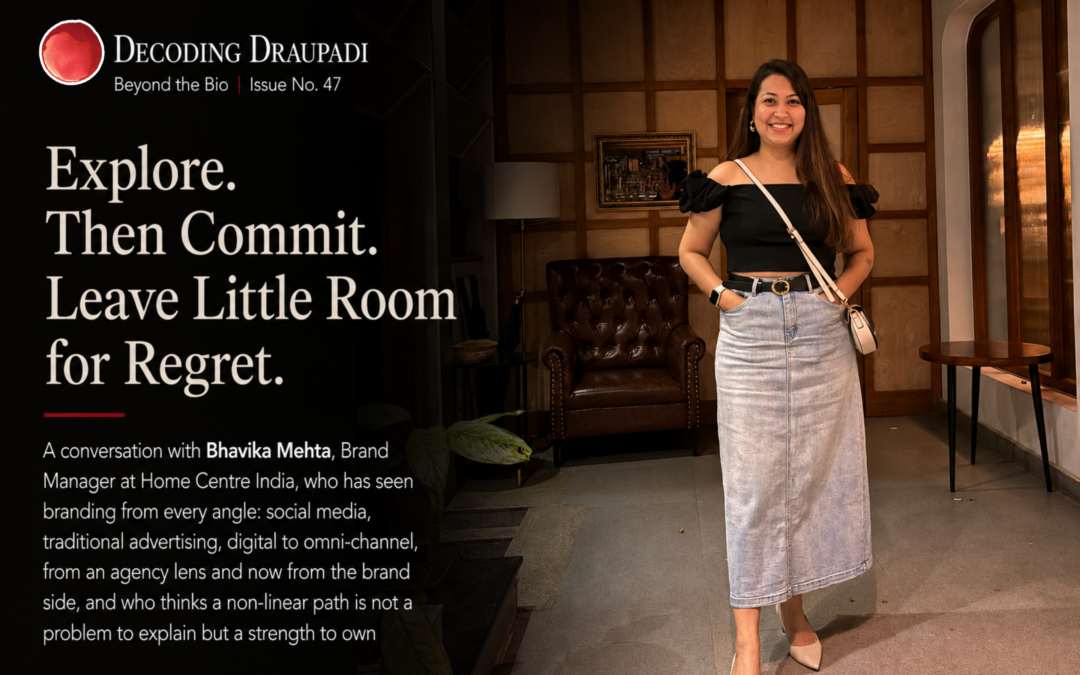
A conversation with Bhavika Mehta, Brand Manager at Home Centre India, who has seen branding from every angle: social media, traditional advertising, digital to omni-channel, from an agency lens and now from the brand side, and who thinks a non-linear path is not a problem to explain but a strength to own
Bhavika Mehta transitioned from creating advertising campaigns for brands to driving brand growth through marketing, moving from agency life into brand management at Home Centre India. That is an unusual number of vantage points for someone at this stage of a career, and it shows in how she thinks.
Her answers are precise without being defensive, grounded without being settled. She is still figuring some things out. She is also very clear about which things those are.
Different Environments Bring Out Different Sides
Who is Bhavika right now, across the different lives you are living?
She does not think we are the same person with everyone, and she does not think we should be. We naturally show different sides depending on who we are with. It is very rare for someone to see every version of us, and that is fine.
At work, she is collaborative, enjoys networking, and tends to volunteer for tasks that are new or different. She likes learning, taking ownership, and constantly pushing herself toward unfamiliar territory. Outside of work, she is still enthusiastic and full of energy, but also someone who genuinely enjoys her own space and does not always feel the need to be around people. Different environments bring out different sides.
Across all of those versions, though, certain things stay constant: her curiosity, her enthusiasm, and her desire to keep learning. The expression changes depending on the context. The core values do not.
“Our core values stay the same. While the way we express ourselves changes depending on the situation, what we believe in doesn’t.”
She names the distinction precisely: adaptation is not the same as compromise. Showing up differently in different rooms is not inauthenticity. It is the normal way a person with a consistent core actually moves through a varied life.

Nothing a Brand Does Is Random
You have seen branding from multiple sides: social media, advertising agencies, client servicing, brand partnerships, and now in-house. What is something you have learned about brands that most consumers never realise when they see a campaign?
Nothing a brand does is random. Every campaign, every visual, every line of copy, every newspaper ad, every social media post exists for a reason. Where, when, and how it appears is planned. What consumers rarely see is the effort that goes into making communication feel simple.
Understanding consumer behaviour, finding the right insight, building the strategy, and creating something that connects immediately is genuinely hard. Sometimes it works. Sometimes it does not. But every campaign is built with the specific intention of making the consumer’s journey easier and more memorable.
What people see is the final output. What they are actually responding to is months of cross-functional alignment: marketing, merchandising, agencies, designers, planners, operations, and many others working toward one common goal. When you are in the room watching ideas evolve into campaigns, it is fascinating to watch how everything gradually comes together.
Communication is not just about being creative. It is about solving a problem. Different pieces of communication are designed to achieve different objectives: creating awareness, driving store visits, building trust, increasing brand recall, encouraging a purchase. Every decision has a purpose.
“What consumers see is the final output. What they’re really responding to is months of cross-functional alignment working toward one common goal.”
She has been on the agency side and the client side. That gives her an unusually complete picture of the gap between what a campaign looks like to the person who made it and what it looks like to the person it reaches. Most people only ever see one side of that gap.
Acceptance Comes With Time, Consistency, and Quality of Work
Was there ever a phase where you felt pressure to become a more acceptable or conventional version of yourself professionally?
No. Every new workplace comes with its own culture and ways of working, so adapting is natural. But she has never felt the need to become a different or more acceptable version of herself in order to fit in.
Acceptance is a process, she says. It does not happen overnight. It comes with time, consistency, and the quality of your work. She has never tried to rush it. Her preference is to first understand the people, the culture, and how the organisation works, while staying true to who she is. If you keep learning, contribute consistently, and trust your abilities, acceptance follows on its own.
“Acceptance is a process. It comes with time, consistency, and the quality of your work. I’ve never felt the need to rush that.”
This is the least conflicted answer to this question in the series, and that is worth taking at face value. Not everyone who enters professional life has to fight for the right to be themselves. The conditions that allow that kind of early stability are worth paying attention to, and she is clear that she has had them.

Chasing What Is Next Versus Appreciating Where You Are
What is something you are still figuring out privately, even though externally your career may look very sorted?
Knowing yourself is a lifelong process, she says. It never really ends. From the outside, her career may look sorted. Privately, she is still working out the right balance between always chasing the next thing and appreciating the phase she is actually in. Should she keep pushing for the next opportunity, or slow down and enjoy where she is? She does not think there is a perfect answer. She is still figuring it out.
What keeps it from being anxiety is her attitude toward it. Every new challenge teaches her something new about herself. She is curious about discovering parts of herself she has not encountered yet, and she thinks that journey of self-discovery is what makes the whole thing worthwhile.
“I’m still figuring out the right balance between always chasing what’s next and appreciating where I am today. I don’t think there’s a perfect answer.”
She names this honestly and without performance. The push-pull between ambition and presence is something most people feel and few name this directly. Framing it as an active question rather than a resolved one is more useful than pretending it has been figured out.
Ambition Evolves. It Does Not Have to Exhaust You.
Do you think ambition becomes healthier or more exhausting as people grow older?
Ambition evolves with us, she says. When you first enter the industry, everything is new and learning or trying something for the first time is genuinely exciting. Then come the small milestones: the first appreciation email, the first sign that people are beginning to recognise your potential. That is where the journey of ambition and growth truly begins.
As you grow, you learn more about yourself: what energises you, what does not, and where you actually want to invest your time and effort. She has realised it is important to keep challenging yourself with meaningful opportunities while also knowing your limits, and knowing when to stay the course versus when it is time to move on.
If you stay curious and keep learning, ambition becomes healthier over time. As you grow older, she thinks, you get better at setting goals on your own terms rather than chasing them simply because you are expected to.
“As we grow older, we become better at setting goals on our own terms rather than chasing them simply because we’re expected to.”
The shift from chasing goals because of expectation to setting goals because of choice is the most consistent pattern across the women in this series. She names it clearly: ambition does not have to become heavier. It becomes more accurate to who you actually are, and that is a different thing entirely.

There Is So Much Logic Behind What Influences People
What kind of work gives you the deepest sense of meaning or excitement, the kind that reminds you why you entered this field in the first place?
Understanding consumer behaviour. She is fascinated by how people think, make decisions, and behave in different situations. What can look like a simple purchase or a small interaction almost always has a deeper reason behind it, and she genuinely enjoys analysing those patterns and using them to make informed decisions.
That is what brought her to marketing in the first place. It is a field where creativity matters, but it is equally driven by psychology, data, and strategy. There is so much logic underneath what influences people, and she finds that logic deeply interesting. She is still exploring and learning, but consumer psychology is the part of the field she is most curious about and the one she wants to keep building expertise in.
“Marketing is a field where creativity is important, but it’s equally driven by psychology, data, and strategy. There’s so much logic behind what influences people.”
She named consumer behaviour in Q4 as the thing that keeps her curious, and she names it again here as the thing that brought her into the field. When someone’s answer to what excites them now and what drew them in originally is the same thing, that is not a coincidence. That is a through-line.
Explore. Then Commit.
If someone younger feels anxious because their career path looks non-linear or unconventional, what would you want to tell them?
Do not see it as a disadvantage. A non-linear career gives you a perspective that many people do not have. Every role, every industry, every experience teaches you something different, and those things tend to come together in ways you do not realise until later. Make it your strength, not something to explain away.
At the same time, do not keep exploring forever. Once you have experienced different paths, take the time to understand what genuinely excites you, what you are naturally good at, and what kind of work gives you a sense of purpose. Then commit to it. Exploring before choosing is healthy, she says: it helps you make an informed decision and leaves little room for future regret.
“Explore before choosing. It helps you make an informed decision and leaves little room for future regret.”
She says this from a career that has covered social media, agencies, client servicing, brand partnerships, and in-house brand management. She is not advising exploration from a distance. She is describing, accurately, what the exploration she actually did gave her. And what it gave her is the ability to commit with real conviction rather than with the nagging feeling that she settled too early.
A Note From Decoding Draupadi
What stayed with us is the Q4 answer: the tension between chasing what is next and appreciating where you are. She does not resolve it. She says she is still figuring it out, and she says it without apology or anxiety. That is the most useful framing of that particular struggle we have heard in this series, because it names the question without pretending there is a clean answer.
The through-line that runs from her answers on storytelling, to consumer behaviour, to what gives her meaning, is the same thing each time: there is logic underneath the surface of what people do, and finding that logic is what makes the work interesting. That consistency is not something she states directly. It is just what she keeps returning to, which is how you know it is actually true.
If this felt like someone you know, share it with her.
As we grow older, we become better at setting goals on our own terms rather than chasing them simply because we’re expected to. Full interview at @decodingdraupadi.
Bhavika Mehta is Brand Manager at Home Centre India. This interview was conducted as part of the Decoding Draupadi Brand Manager Series.