
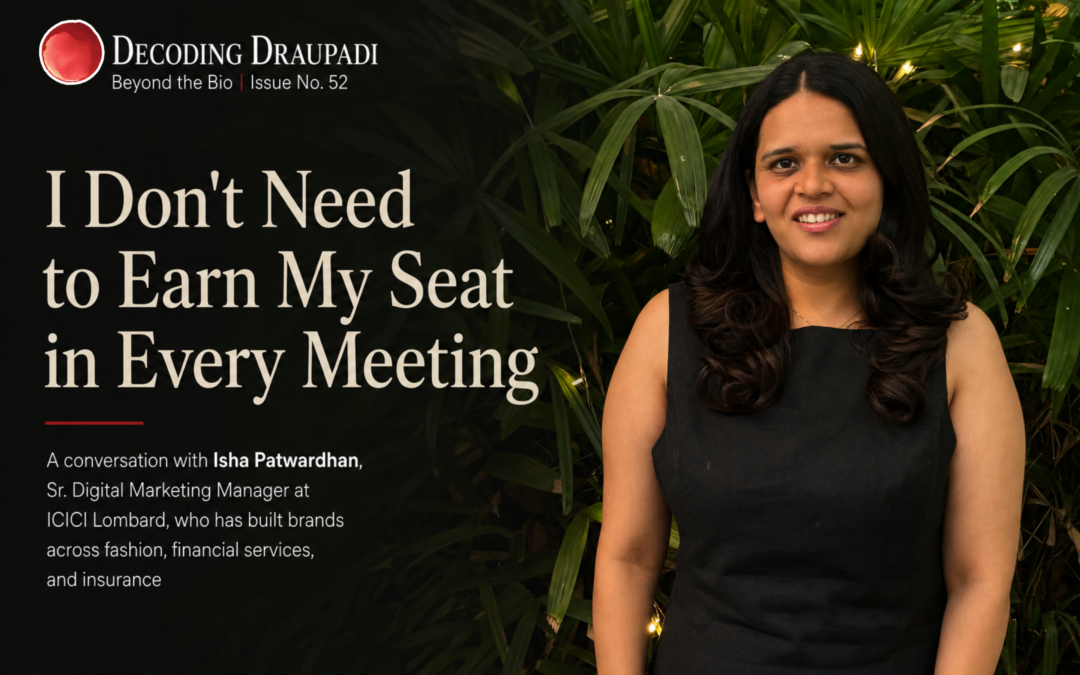
A conversation with Isha Patwardhan, Sr. Digital Marketing Manager at ICICI Lombard, who has built brands across fashion, financial services, and insurance
Isha has spent her career moving between categories that share almost nothing on the surface, fashion, financial services, insurance, and carrying one conviction across all of them: people don’t buy products, they buy what those products make them feel. What runs underneath everything she said is a quieter shift too, from proving she belongs in the room to trusting that she already does.
All Just Parts of Who I Am
Who is Isha right now, across the different lives you’re living?
I think the simplest way to describe myself right now is that I’m someone who’s constantly growing, but never alone. I’m someone who cares deeply. That’s probably the one thing that has stayed constant across every version of me.
I care about my work and genuinely want to do it well. I care about my family and friends, and about making sure they know I’m there for them. I care about my relationship, and creating a space where both of us can grow individually while still growing together.
Right now, work is probably where I’m learning the most. I’ve recently stepped into a new role, and it’s pushed me to think differently, and get comfortable with not having all the answers yet. At the same time, I find myself constantly trying to balance that ambition with being present for the people who matter to me.
I don’t think these are different versions of me. They’re all just parts of who I am. If there’s one thread connecting them, it’s that I want to show up wholeheartedly, for my work, for my people, and for myself.
“I don’t think these are different versions of me. They’re all just parts of who I am.”
Most people answer this question by listing their roles. Isha answered it by naming the one thing that doesn’t change across them. That’s a harder question to sit with, and a more honest one to answer.

People Don’t Connect With Products, They Connect With What Products Make Them Feel
What have fashion, financial services, and insurance taught you about what actually makes people trust or choose a brand?
One thing that’s stayed with me across fashion, financial services and now insurance is that while the products are very different, people aren’t.
As marketers, we tend to think in categories. Consumers don’t. No one wakes up thinking, “Today I’ll engage with insurance content.” They’re thinking, “My birthday’s coming up, what should I wear?”, “I want to upgrade my phone,” or “My parents are getting older.” They’re trying to solve a problem or fulfil a need, and brands become relevant only when they fit naturally into that moment.
Moving across these industries also showed me how customer decision-making changes as the stakes get higher. Buying a top or a pair of sneakers can be impulsive. Upgrading a phone on EMI involves a little more thought. Choosing health or motor insurance is a deeply considered decision because you’re asking people to prepare for something they hope never happens.
But despite those differences, I’ve come to believe that what makes people choose a brand is consistent. People don’t connect with products; they connect with what those products help them feel. In fashion, that’s confidence and self-expression. In financial services, it’s aspiration, access and progress. In insurance, it’s trust and peace of mind.
The brands that stay with us understand this well. Nike rarely talks about the technology in its shoes; it makes you believe you’re capable of more than you think. Closer home, Comet isn’t just selling sneakers, it has built a community around individuality and self-expression. Groww didn’t just make investing digital; it made first-time investors feel investment was approachable.
That’s the common thread I’ve seen across categories. The product may change, but the role of a brand doesn’t. It has to create an emotional connection before it earns consideration. Features may capture attention, but it’s trust, relevance and how a brand makes people feel that ultimately drive choice.
“People don’t connect with products; they connect with what those products help them feel.”
It’s easy to say this in the abstract. What makes Isha’s version convincing is that she’s tested it across three categories with almost nothing in common, and gotten the same answer each time.
Someone Already Trusted Me With This Seat
When you’re entering a new room where you haven’t built credibility yet, what’s your instinct?
If you’d asked me this a few years ago, my answer would have been very different.
For most of my career, I’ve been the youngest person in the room, whether it was during my MBA, at Bajaj Finserv, or now as one of the younger Senior Managers at ICICI Lombard. Early on, I carried that label into every meeting. Before I even spoke, I was already thinking about how to prove that I deserved to be there.
Looking back, I realise I spent more energy proving myself than allowing myself to learn.
Now, being the youngest in the room has become a source of confidence rather than pressure. I’ve become more comfortable with the fact that I don’t need to earn my seat in every meeting. Someone has already trusted me with that seat.
I still want to contribute, of course, but I no longer feel the need to have an opinion on everything from day one. I think I’ve become more comfortable saying, “I don’t know enough yet,” and giving myself the time to learn before I speak.
“I don’t need to earn my seat in every meeting. Someone has already trusted me with that seat.”
This is a quieter kind of confidence than the one we usually celebrate. Not louder in the room, just less at war with herself before she’s even spoken.
Looking for the Next Learning Curve, Not the Next Step
What’s something about ambition you understand differently now than when you started?
For me, ambition has always come from wanting to grow. What has changed over the years is how I define growth.
When I started my career, I imagined growth to be fairly linear. Every role would naturally build on the previous one, with a bigger title, more responsibility, and a clear sense that I was moving upwards.
My career hasn’t really looked like that.
One of the biggest shifts for me happened at Bajaj Finserv. I moved from managing social media campaigns to working on digital communication strategy. On paper, it wasn’t the obvious “next step” because the two roles were quite different. One taught me how to understand audiences, create content and execute campaigns. The other pushed me to think more strategically, connect business objectives with communication, and look at the bigger picture.
At the time, I remember wondering whether I was moving sideways instead of forward.
But when I look at the role I’m in today, I don’t think I could have done it with just one of those experiences. I needed both. They filled different gaps, and together they shaped the marketer I am today.
I think that’s probably what’s changed the most about ambition for me. Earlier, I looked for the next step. Now, I find myself looking for the next learning curve, even if it doesn’t look like the obvious move at first.
“Earlier, I looked for the next step. Now, I find myself looking for the next learning curve.”
The move that looks sideways on a resume is so often the one that actually builds someone. Isha’s answer is a good reminder that a title jump and a growth curve are not always the same graph.
Sometimes I Can’t Is Enough
What’s something you’re still learning to ask for without feeling like you need to justify why you deserve it?
I’m still learning to say no without feeling like I need to justify it.
I tend to be quite involved in the lives of the people I care about. If a friend needs something, my family needs something, my partner needs me, or even someone at work needs help, my instinct is usually to figure out how I can make it work. I like being someone people can rely on, so saying no can sometimes feel like I’m letting someone down.
And when I do say no, I often feel the need to explain why, as if I need a good enough reason for the other person to know that I still care.
I’m slowly learning that I don’t always need to have a compelling reason to say no. I can care deeply about someone and still not be available to them every time. Sometimes, “I can’t” is enough.
“I can care deeply about someone and still not be available to them every time. Sometimes, “I can’t” is enough.”
The people who give the most are usually the ones who feel they need a permission slip to give less. Isha naming this so plainly is its own quiet act of practice.

The One Thing She Won’t Let Become a Metric
If you could protect one part of your life from ever becoming about productivity, achievement, or progress, what would it be?
If there’s one thing I’d protect, it would be my relationships. Not because they don’t contribute to my growth, they absolutely do, but because I don’t want to ever measure them by what they contribute to it.
My partner, my friends, my family, these are the people I go to when something great happens, when something goes wrong, and for all the little things in between. I learn so much from them, but more importantly, I just genuinely cherish having them in my life. I’d want that to remain untouched by the pressure to constantly be achieving or becoming better.
“I don’t want to ever measure them by what they contribute to my growth.”
It says something that the woman who has spent this whole interview talking about growth draws her one hard line around the people she refuses to grow from. That’s not a contradiction, it’s a boundary.
A Note From Decoding Draupadi
The detail that stayed with us is the smallest one, that Isha still feels the pull to explain herself every time she says no, even now, even to the people who love her most. Not because she doubts her decision, but because caring, for her, has always come with the instinct to justify it. Watching her name that and start to let it go is exactly the kind of quiet, unglamorous growth this series exists to put on record. If this felt like someone you know, share it with her.
Isha Patwardhan is a Sr. Digital Marketing Manager at ICICI Lombard. This interview was conducted as part of the Decoding Draupadi Brand Manager Series.
Loved this? Follow @decodingdraupadi for the next one.