
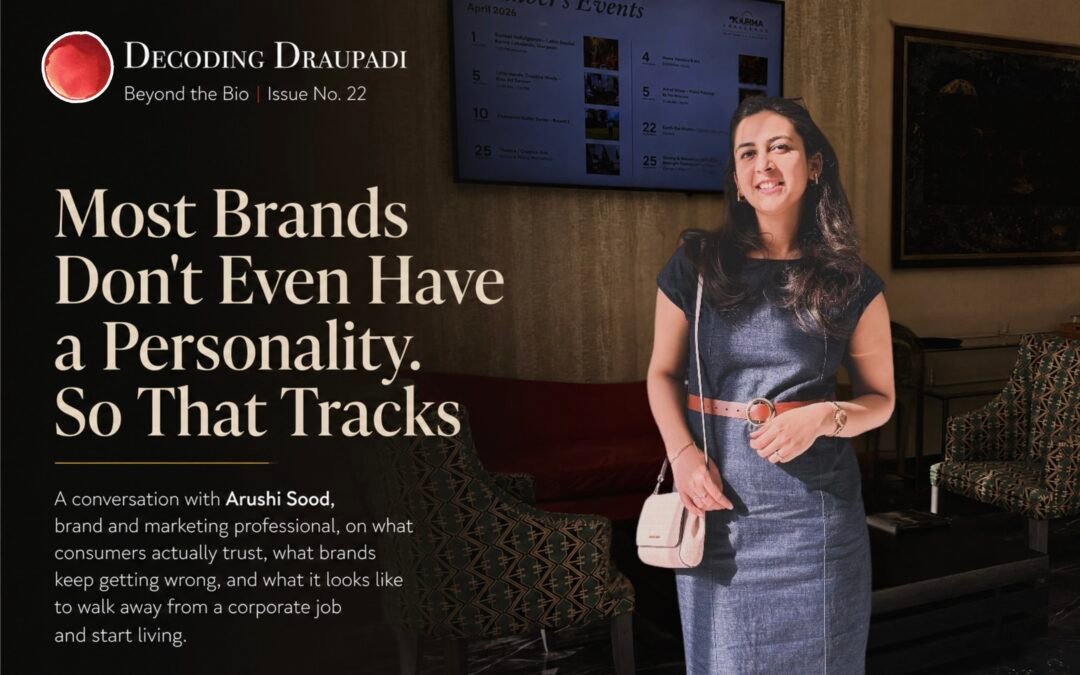
A conversation with Arushi Sood, brand and marketing professional, on what consumers actually trust, what brands keep getting wrong, and what it looks like to walk away from a corporate job and start living.
Arushi Sood has spent years building trust for brands in beauty, wellness, and everyday care. She knows what makes consumers actually come back, and she knows what brands do that makes them cringe from the inside. Six months ago she left a high-paying job at one of India’s biggest startups, and she has been figuring out who she is without a job title ever since.
This conversation is unusually honest. It goes between industry critique and personal unravelling, and the thread running through all of it is the same: things that look good on the surface often miss what actually matters underneath.
Rebuilding Slowly, Messily
Who is Arushi right now, across the different lives she is living?
I’ve been struggling with this ever since I took a career break. While I was working, the default introduction was always the company and designation I held. For the last six months, I’ve stripped myself of that. And in its absence, I’m either rebuilding myself or figuring myself out. I’m not sure which yet.
My Instagram page is my brain dump. It’s full of contradictions, messiness, and real raw thoughts I have throughout the day. That’s probably the most accurate portrait of who I am right now.
As women, we attach a lot of our worth to how well we manage home, work, relationships. We’re all taught to be superwomen who can do it all. I’m realising I am not a superwoman. So who am I? A woman touching her 30s who’s unlearning everything she was taught about work, success, and life. Figuring out what life means without a corporate job. Rebuilding with meaning, slowly, messily.
“I’m either rebuilding myself or figuring myself out. I’m not sure which yet.”
There is something quietly radical about not knowing. Most people in this position would reach for a tidier narrative: I left to pursue my passion, I needed rest, I had a plan. Arushi is not doing that. She is sitting in the uncertainty and naming it out loud, and that takes more courage than a polished pivot story.

The Brand Has to Make You Feel Like You Made a Smart Choice
What has building and scaling categories in beauty, wellness, and everyday care taught you about what actually makes people trust a brand?
Consumers today are smart and can smell inauthenticity from far away.
There are multiple touchpoints for a consumer to fully trust a brand. Before buying, it’s about how well you position yourself as something desirable, something they can’t survive without, something they need to have for social purposes because it is edgy and trendy. Once they try the product because of the hype, the product has to actually deliver. And then the loop continues: marketing keeps them engaged, the product keeps them coming back.
But underneath all of it, the brand has to make the consumer feel like they made a smart choice. Not just once. Every single time. The brands that get this right aren’t the ones with the biggest campaigns. They’re the ones whose actions match their promises, consistently, at every touchpoint.
“The brand has to make the consumer feel like they made a smart choice. Not just once. Every single time.”
That loop she is describing, hype gets them in, product keeps them coming back, is simple and most brands still break it at step two. They pour everything into acquisition and then the product under-delivers. She has clearly watched this happen up close, and the fact that she names the feeling as the thing being protected, not just the metric, says something about how she thinks about this work.
Translating Between Rooms.
What is the most important thing you do at work that has no name in a job description and no metric attached to it?
Translating is the work. Between what a customer actually wants and what the product team thinks they want. Between what the data says and what it actually means. Between what leadership is asking for and what the team needs to hear to execute it. Sensing when something looks good on paper but won’t land, and course-correcting before it becomes a problem.
“Sensing when something looks good on paper but won’t land, and course-correcting before it becomes a problem.”
The translating part is worth naming separately because it is genuinely its own skill, and almost nobody is formally trained for it. Reading a room, reading a brief, reading what the data is actually trying to say versus what someone wants it to say. Arushi has clearly spent years doing this and it shows in how precisely she describes it.

More Content Is Not More Relevance
What is a widely held belief in your industry that you quietly disagree with?
So many, honestly.
Everyone wants to appeal to Gen Z right now, and in doing so, brands overuse slang they think Gen Z uses. Instead of understanding the actual psychology of this generation, what they want, what they fear, what they value, brands try to imitate what they think Gen Z is. And it leads to cringe content and dissonance.
Brands also think they have to participate in every trend and every topical moment, whether it fits their personality or not. Most brands don’t even have a personality, so that tracks.
And the big one: more content equals relevance. It doesn’t. There’s this pressure to be everywhere all the time. But deliberate quality content always beats content that’s just filling a calendar.
The best brands operate like people with a personality that’s hard to ignore. That’s when consumers start to actually trust you, like you, and choose you every time.
“Most brands don’t even have a personality. So that tracks.”
That line is doing a lot of work in a small space. She is not being cynical for its own sake. She is pointing at the source of all the symptoms she just described: brands chasing Gen Z slang, participating in trends that don’t fit, producing content that fills a calendar rather than meaning anything. All of it is downstream of not knowing who you are. She has said the diagnosis in seven words.
Unexplainable Joy. Then Empty.
The first time you spent your own money on something that wasn’t practical, something just for you. What was it? What did it feel like?
I grew up in a household that believed in savings. I had everything I needed to study better, I was the first one to get a computer, I had a huge study table, all the books I needed, the best stationery. But when it came to spending on footwear, clothes, accessories, that’s where we saved. So when I started earning, I did not look at price tags at all. For the longest time my only motivation to earn money was to be able to spend on everything I wanted without having to worry about price tags.
All the big brands I used to only dream about buying, getting them gave me this unexplainable joy. Weirdly made me feel powerful. But in all honesty it was a fleeting feeling and soon started to feel empty, transactional, and normal.
“It gave me this unexplainable joy. Weirdly made me feel powerful. But in all honesty it was a fleeting feeling and soon started to feel empty, transactional, and normal.”
She is describing, from the inside, the exact loop she talked about in Q2. The hype gets you in. Then the product has to deliver something more lasting. And for a category built on status and aspiration, sometimes it just doesn’t. The fact that she lived this as a consumer and then went on to build for those same categories gives her a vantage point most brand managers don’t have.

I Am Living. Truly Living.
There is usually one decision in your career that looked wrong from the outside and turned out to be exactly right. What was it?
I think I am in that phase right now. From the outside it may look like a huge mistake: walking away from a high-paying job at one of the biggest startups in India, leaving it all behind. It may seem like I ruined my career, but I think it is setting me on a completely different trajectory of self-growth.
I am living, truly living right now. Realising the things I am capable of. I am a very camera-shy person, underconfident in general and not at all photogenic, but I am out here creating content, putting myself out there for everyone’s judgement, sharing my thoughts. I definitely wouldn’t have done this if I were still working. And I wouldn’t learn the things I am learning about myself, about the world I was in, if I hadn’t started creating content.
“I am living, truly living right now.”
She says she is camera-shy, underconfident, not photogenic, and then tells you she is out here creating content and sharing her thoughts publicly. That gap between who she says she is and what she is actually doing is where the real story lives. Most people wait until they feel ready. Arushi seems to have decided that waiting is the thing she cannot afford anymore.
The Timeline Is Almost Entirely Made Up
What would you want someone just beginning their journey to worry less about?
The timeline and what people will think.
There’s this invisible schedule everyone seems to be running against: where you should be by 25, what you should have figured out by 30, what success is supposed to look like and when. It’s almost entirely made up. But it causes very real anxiety and very real bad decisions. Stop thinking about what people will say about where you are personally or professionally. They are not living your life, they don’t fully understand your circumstances, and they are not paying your bills. Do what feels right by you.
Especially to women, I’d say: you don’t have to be a superwoman who is doing everything perfectly at all times. You’ll break. We are underestimated all the time and we take it upon ourselves to prove the other person wrong by pushing harder, by being harsh on ourselves. And in doing so we hurt ourselves the most.
“The timeline is almost entirely made up. But it causes very real anxiety and very real bad decisions.”
She opened this conversation not knowing whether she is rebuilding or figuring herself out, and she closes it telling you the timeline is made up. Those two things are connected. She walked away from a schedule that had a very clear shape, and she is in the middle of finding out what life looks like without it. The advice is not theoretical. She is living it while she gives it.

A Note From Decoding Draupadi
What stayed with us from this conversation is the moment Arushi says she is not a superwoman. Not as defeat. As relief. As a thing she is finally allowing herself to say out loud, at 30, after years of performing the opposite.
So many of the women in this series are accomplished, composed, moving fast. Arushi is doing something different. She is slowing down in public. Sharing the messiness on Instagram, creating content as a camera-shy person, sitting with not knowing. And she is calling that living. Truly living.
We think that takes more than any job title ever could.
If this felt like someone you know, share it with her.
— End of Interview —
Arushi Sood is a brand and marketing professional, previously at Urban Company and Honasa Consumer. This interview was conducted as part of the Decoding Draupadi Brand Manager Series.
Camera-shy, underconfident, not photogenic. Currently creating content and living, truly living. Know someone in this exact in-between? Send her this. Find us at @decodingdraupadi.