
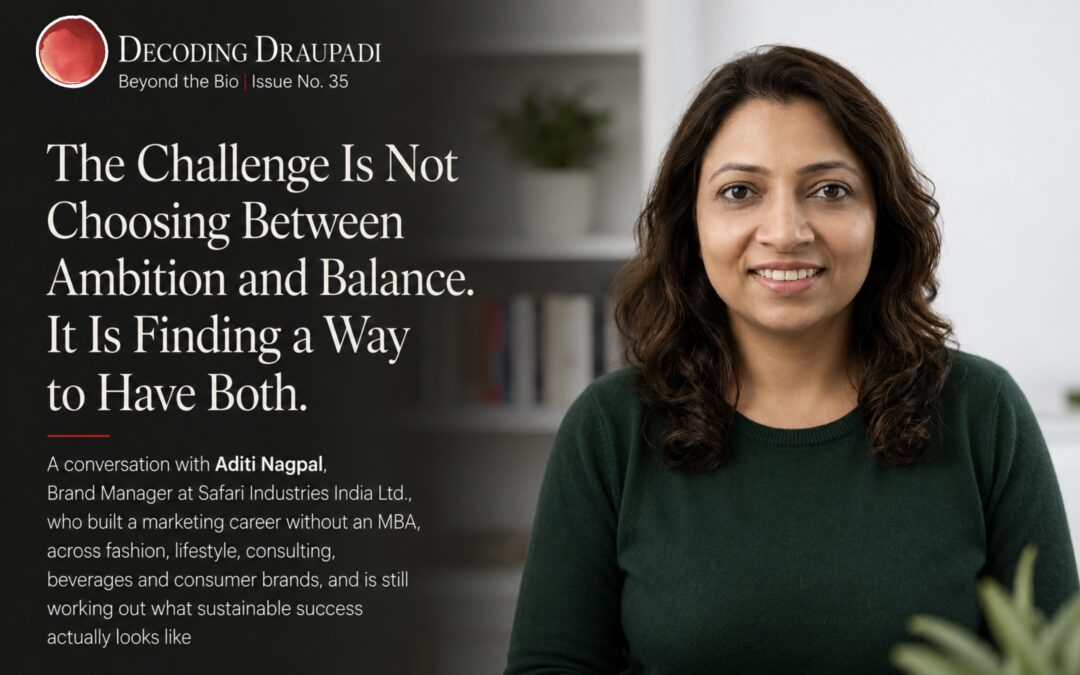
A conversation with Aditi Nagpal, Brand Manager at Safari Industries India Ltd., who built a marketing career without an MBA, across fashion, lifestyle, consulting, beverages and consumer brands, and is still working out what sustainable success actually looks like
Aditi Nagpal has moved across fashion, lifestyle, consulting, beverages, and consumer brands. She does not have an MBA. She was passed over for roles because of it. She built her edge from a design background instead, and that edge, the ability to connect creativity with business outcomes, has become one of her strongest assets. Also , instead of seeing this as limitations, chose to continuously invest in herself through specialized courses and certifications that helped broaden her strategic thinking and marketing challenges .
She is a mother, an early riser, a food person, and someone who is still, honestly, figuring out what it means to have both the career and the life. That combination of clarity about her strengths and honesty about what she has not yet solved makes this a useful conversation.
5 AM, Coffee, and a Little Bit of Peace
Who is Aditi right now, across the different lives you are living?
Light-hearted and fun-loving. The kind of person who just needs a workout, a good cup of coffee, and a little peace to take on the day.
She is an early riser, up at 5 AM most mornings, working out a few days a week, enjoying the quiet before the day gets busy. She is also a mother, and like many working mothers, she carries the constant guilt of not spending enough time with her daughter. It is a feeling that never quite goes away, but it also reminds her of what matters most.
Food is a big part of her life. She loves finding local places when she travels, and she finds real joy in cooking, though she wishes she had more time for it. Beyond work, she keeps a small and close circle: family and friends she makes a conscious effort to stay near.
At the end of the day, she is someone who finds joy in simple pleasures, meaningful connections, and making the most of the moments in between.
“I carry the constant guilt of not spending enough time with my daughter. It never quite goes away, but it also reminds me of what matters most.”
She names the guilt plainly, without performing it and without resolving it. That is the most accurate way it can be described. It does not go away. It also does not win. Both things are true and she holds both.

Growth and Alignment. That Is the Decision.
How do you know when it is time to stay and build deeper versus when it is time to make a completely new move?
She has never made a move purely because of the industry. Fashion, lifestyle, consulting, beverages, consumer brands: across all of it, the driver has always been the opportunity to learn, build, and create impact.
The decision to stay or move comes down to two things: growth and alignment. If she is still learning, being challenged, and can see a clear path to create value, she stays and builds deeper. When she can no longer see a future path that aligns with her aspirations, values, or growth ambitions, that is when it is time to move.
She describes the relationship between a person and an organisation as a two-way street. The best work happens when there is mutual momentum, when both the individual and the organisation are pushing forward together. When that alignment no longer exists, it is often a sign that it is time to find the next challenge.
“The best work happens when there is mutual momentum, when both the individual and the organisation are pushing forward together.”
Mutual momentum is a precise framing. It removes the anxiety from the decision to leave: it is not about loyalty or disloyalty, it is about whether the conditions for good work still exist. When they do not, moving is not giving up. It is good judgment.
No MBA. One of Her Biggest Strengths.
Was there ever a phase where you felt pressure to become a more acceptable or conventional version of yourself professionally?
Yes, absolutely. She does not have a formal MBA degree. Early in her career, there was a persistent underlying pressure to fit the conventional mould of what a marketer was expected to look like on paper. She was even told directly that while her candidature was strong, she was being passed over because she did not have an MBA. As part of her own learning process, she has continued to take specialized courses and certifications instead, building her strategic thinking in her own way.
For a while, that made her question whether she needed to follow a more traditional path to be taken seriously. Over time, she realised her non-conventional background was actually one of her biggest strengths.
Coming from design gave her a different way into marketing. It taught her how to simplify complex ideas, build compelling communication, and think deeply about consumer experience. Today, she does not see her career path as a disadvantage. It is proof that there is not just one route to becoming a marketer. The ability to connect creativity with business outcomes has become one of her strongest assets, and it is something she would not trade for a more conventional journey.
“My non-conventional background turned out to be one of my biggest strengths. Coming from design taught me to simplify, to communicate, and to think deeply about consumer experience.”
Being told directly that you are being passed over for not having a degree is a specific kind of professional rejection. The fact that she did not go get the degree, and instead doubled down on what made her different, and was right about it, is the thing worth noting here.

The Challenge Is Not Choosing. It Is Having Both.
What is something you are still figuring out privately, even though externally your career may look very sorted?
She is still figuring out what sustainable success looks like for her. She wants to keep growing professionally, remain financially independent, and perhaps build something of her own. But equally, she wants the time and freedom to be present for her daughter, take care of herself, and enjoy life.
The challenge, she says, is not choosing between ambition and balance. It is finding a way to have both. That is something she is still consciously working towards.
“The challenge isn’t choosing between ambition and balance. It’s finding a way to have both.”
She does not frame this as a problem she has solved. She frames it as something she is actively working on. That honesty is what makes this answer useful rather than aspirational. Most people at this stage of a career have the same question. Very few say so plainly.
A Marathon, Not a Sprint
Do you think ambition becomes healthier or more exhausting as people grow older?
Healthier, she says. At least in her experience. Early in a career, ambition is often tied to titles, milestones, and proving yourself. Over time, you realise that success is a marathon, not a sprint.
It is important to be ambitious. But it is equally important not to overcommit or burn yourself out chasing a perfectly planned path. Careers rarely unfold exactly as intended. Sometimes the role you dream of does not work out. That is okay.
She has learned to stay open to opportunities that were not part of the original plan. Some of the most meaningful moves in her career, including Bira 91, came from taking an alternative path rather than holding out for a specific outcome. You do not always know what is waiting around the corner.
Today her ambition is less about chasing the next title and more about continuous learning and meaningful work, while also making room for the things that matter outside of it.
“Some of the most meaningful moves in my career came from taking an alternative path rather than holding out for a specific outcome.”
The Bira 91 detail earns the point. She is not speaking in generalities about staying open to opportunities. She is naming a specific move that came from flexibility rather than a plan. That specificity is what separates advice that lands from advice that sounds right but does not stick.

The Tip of the Iceberg
What is one thing about the marketing and branding industry that people glamorize too much from the outside?
The visible side: celebrity collaborations, ad films, photoshoots, events, social media campaigns. That is the part everyone sees. It is exciting. But it is only the tip of the iceberg.
What people do not see is everything underneath. The real work is understanding consumers: what they need, what motivates them, what will make them choose your brand over another. Building awareness, consideration, and purchase behaviour requires deep consumer understanding, strategic thinking, and constant problem-solving. That is the less visible side. It is also the far more important one.
“The real work is understanding consumers. That is the less visible side of marketing. It is also the far more important one.”
She has worked across enough formats to know both sides of this. The photoshoot is real. The strategy session that determined whether there would be a photoshoot is also real, and far longer. The ratio of visible work to invisible work in marketing is almost always misunderstood by people looking in from outside.
It Is Too Early to Be Worrying About Your Career Trajectory
If someone younger feels anxious because their career path looks non-linear or unconventional, what would you want to tell them?
She recently spoke to a young professional who had just started her career and was already worried about whether she was on the right path. A few months of work experience, and already anxious about how she would eventually transition into the role she aspired to.
Her advice was simple: it is too early to be worrying about your career trajectory. In the early years, the job is not to have everything figured out. It is to learn. How businesses operate, what different functions do, what excites you, and just as importantly, what does not.
Instead of obsessing over where you will be in five years, focus on opportunities that let you grow, build skills, and gain exposure. Careers are rarely linear. Most people end up in roles they could not have predicted when they started. Having a direction is good, but letting the pressure of a perfectly mapped-out plan force you into rushed decisions is not.
Some of the best opportunities come from paths you never planned for. Stay curious, keep learning, and trust that the dots will connect over time.
“In the early years, your job is not to have everything figured out. It is to learn.”
She gives this advice from a career that did not follow a conventional path. She was passed over for not having an MBA and built her edge from design instead. She moved across five industries. She did not plan Bira 91. The advice she is giving is the advice she actually lived. That is why it is worth listening to.

A Note From Decoding Draupadi
What stayed with us is the line about the challenge not being choosing between ambition and balance, but finding a way to have both. She did not say she had figured it out. She said it is something she is still consciously working towards.
That is the honest version of a conversation that usually gets resolved too quickly in both directions. Either people say they have found balance, or they say they have chosen ambition. Aditi is saying neither. She is saying she wants both and she has not stopped trying to find a way. That is a more useful thing to hear.
If this felt like someone you know, share it with her.
In the early years, your job is not to have everything figured out. It is to learn. She said this after five industries and no MBA. More at @decodingdraupadi.
Aditi Nagpal is Brand Manager at Safari Industries India Ltd.. This interview was conducted as part of the Decoding Draupadi Brand Manager Series.