
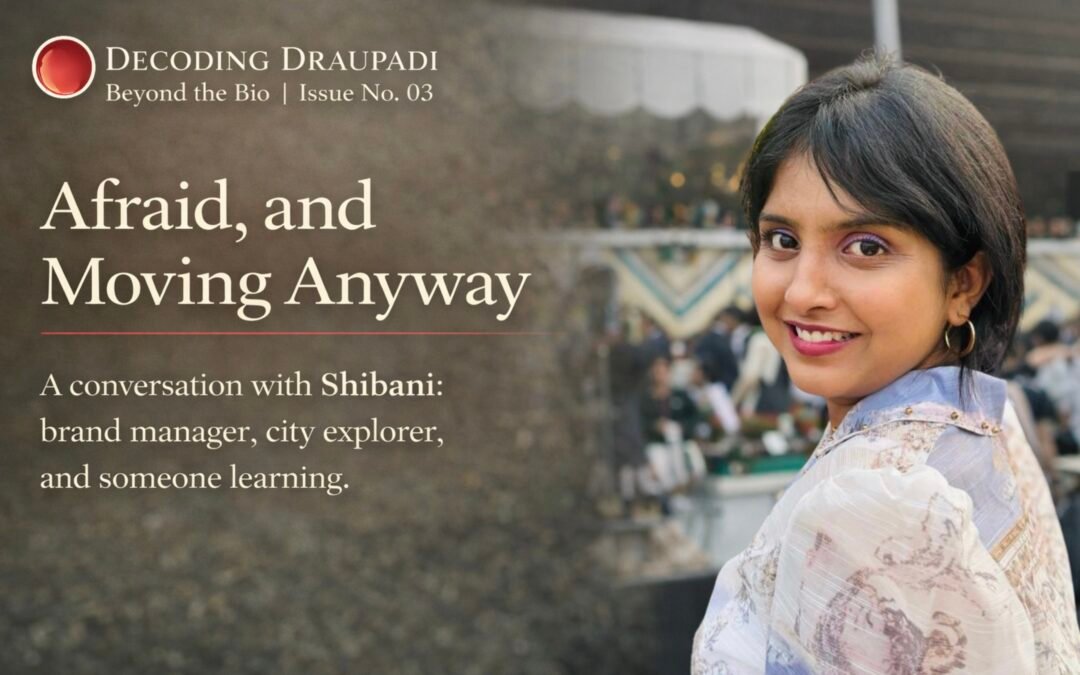
A conversation with Shibani: a brand manager, a city explorer, and someone learning, one step at a time, that the detours are where the real learning lives.
Shibani has built a diverse cross-category marketing journey, starting with on-ground sales experience, then moving into beauty and personal care, followed by e-commerce and digital-first retail, expanding into mom and baby care, and currently working in healthcare. Each of those moves taught her something different about how brands build trust, and each of them she’ll tell you, also taught her something about herself. She is a person of many quiet passions: cooking, singing, chess in the park, dance classes she only recently started, and long picnics where time slows down. She is married, deeply loyal to old friendships, and by her own description, someone in motion.
She is also, refreshingly, someone who doesn’t pretend the hard parts weren’t hard. Fear, she tells us, is still very much a companion. Boundaries are still a work in progress. And ambition (the shape of it, the feel of it) has changed more than once. This is a conversation about all of that.
On Identity: Someone in Motion
Most of us are never just one person. We’re someone at work, someone at home, someone in our friendships, someone in our private thoughts. Not your title, not your bio, who is Shibani right now, across the different lives you’re living?
Right now, I feel like a person standing at a very interesting intersection of ambition, self-reflection, and growth.
At work, I am a brand manager who is deeply curious about how brands live in people’s lives, not just on shelves, but in culture, conversations, and everyday moments. I love thinking about consumers, storytelling, and how a brand can feel relevant and human. At the same time, this phase has been a learning curve. I’m trying to grow into someone who communicates with more clarity, confidence, and leadership, someone whose ideas carry weight in a room.
Outside of work, I am someone who, on weekends, loves to step outside of routine. I explore my city like a tourist, discovering hidden corners and small delights. I pour myself into creative outlets: cooking, and trying new things like dance, something I’ve never formally learned but feel a deep pull toward. I practice singing, play chess in the park, go on long picnics where time slows down. Sometimes I paint. Sometimes, after a deep reading session, I luxuriate in a quiet afternoon siesta, a small indulgence I truly treasure. And when the week’s weight is heavy, a spontaneous visit to a friend is just the reset I need.
In my personal relationships, I value loyalty, warmth, and depth. I’m married, and I care deeply about building a happy, supportive life with my partner and family. Despite years apart from my closest friends, I work hard to maintain those friendships even on the weirdest days or in the middle of the busiest weeks. Those relationships anchor me.
And then there’s a quieter, more private side of me, the one that constantly questions, observes, and tries to grow. Lately, I’ve been thinking a lot about who I am becoming. How to be more confident, less affected by negativity, and more aligned with the person I know I can be. So if I had to describe who I am right now, I’m someone in motion. Ambitious, thoughtful, occasionally uncertain, but deeply committed to building a meaningful life.
“I’m someone in motion, ambitious, thoughtful, occasionally uncertain, but deeply committed to building a meaningful life.”
What strikes us about Shibani’s answer is how fully she inhabits each version of herself. The professional who wants her ideas to carry weight. The woman who schedules dance classes with the same intention she brings to work. The friend who shows up even when life is hectic. These aren’t contradictions; they’re dimensions. And the willingness to hold all of them, including the uncertain, quieter parts, is exactly the kind of wholeness we’re here to talk about.
On Trust: How Brands Actually Earn It
What’s something about how brands build trust or connection that you’ve come to see very differently than when you first started?
When I first started, I thought brand building was largely about visibility, being present everywhere so that people would remember you when they needed the product. But working across different categories and markets has slowly changed how I think about trust entirely.
My earliest lesson came during my sales stint at Reckitt, working with hygiene brands like Harpic. Being on the ground inside stores, speaking with retailers, and watching how products actually moved off shelves showed me something important. Trust in a brand can be so strong that it essentially defines an entire category. The equity of Harpic was so high that local players began copying everything: the color of the bottle, its shape. They’d occupy the same shelf facings, and people would often pick them up by mistake. That showed me what category-defining trust actually looks like.
At L’Oreal, I began to see how geography shapes trust in specific ways. In the northern markets, Garnier Men sunscreen was performing disproportionately well. Once you understood the mountainous terrain, harsher sun exposure made sense. The product wasn’t just grooming; it was functional protection. That taught me that credibility is deeply contextual. A brand resonates when it solves a real, lived problem for a specific audience.
At Nykaa, I saw how regional brands like Mysore Sandal Soap or Anmol Coconut Oil commanded immense loyalty not through aggressive marketing, but through years of cultural familiarity and generational usage. Brand equity, I learned, often grows from memory, tradition, and regional identity.
Working on Softsens, a mom and baby brand, showed me trust in perhaps its most delicate form. When a product is meant for babies, the threshold for credibility is extremely high. Mothers don’t trust advertising. They trust each other. Community became the most genuine trust engine the brand had.
And now, in healthcare with Omnigel, that understanding has deepened further. Healthcare brands operate where credibility, responsibility, and scientific integrity are non-negotiable. Communication can’t just be persuasive; it has to be careful, factual, and trustworthy. The stakes are quieter but much higher.
Looking back, my view of brand building has shifted entirely from thinking about attention to thinking about credibility. Trust isn’t created in a single campaign. It’s built slowly, through consistent performance, cultural relevance, community validation, and responsible communication. The most trusted brands often speak the least loudly but deliver the most consistently.
“The most trusted brands often speak the least loudly but deliver the most consistently.”
Shibani’s answer is essentially a masterclass compressed into a few paragraphs. What makes it so valuable is that every insight is rooted in a specific, lived experience, not a framework. She didn’t read this in a textbook. She watched it happen on a shop floor in northern India, in a parenting group, on a pharmacy shelf. That kind of knowledge is the kind that actually sticks.

On Storytelling: When a Brand Needs a Face and When It Doesn’t
How do you personally decide when a brand needs a spokesperson and when it needs to step back and let the story, product, or community speak instead?
This question reminds me of a moment during my internship. I stood in front of a whiteboard and drew two simple doodles: a pair of wings, and a character called Fido. Within seconds, the panel recognised the brands and said their names: Red Bull and 7 Up. That moment stayed with me because it showed how powerful brand symbolism can be. Sometimes a brand doesn’t need a human face at all; its symbols, characters, or distinctive assets already carry the entire story.
I still hold that view today, but my thinking has definitely evolved. Early in my career, I believed brands could rely almost entirely on distinctive assets (symbols, colors, packaging) to build familiarity and recall. But after working across categories, I’ve realised that the decision to use a spokesperson is rarely universal. It’s deeply contextual.
In lifestyle or aspirational categories, a face can sometimes accelerate relatability. A spokesperson becomes cultural shorthand for the lifestyle the brand represents. But in categories rooted in functionality or trust, the brand itself often needs to remain the hero. Introducing a celebrity can sometimes overshadow the product rather than strengthen it.
I saw this clearly while working in the mom and baby category. Mothers trust other mothers far more than they trust celebrities. Authentic community voice (real users sharing experiences, exchanging recommendations, validating products within their circles) was the most credible spokesperson the brand could have.
So today, when I think about whether a brand needs a spokesperson, I start with a simple question: where does credibility already live? If it lives in the product, in performance, or in community, the brand should step back and let those voices lead. If the brand needs a cultural bridge, then a spokesperson can play a meaningful role. The strongest brands eventually become recognisable even without a face. When a simple symbol can instantly evoke a brand in someone’s mind, that’s when you know the storytelling has truly worked.
The whiteboard doodle story is exactly the kind of detail that makes someone’s thinking memorable. Shibani isn’t just sharing an opinion; she’s showing you the moment the idea was formed. And the framework she’s landed on (start by asking where credibility already lives) is one of the most practical, honest pieces of brand thinking we’ve heard in this series. this series.
On Emotional Labour: The Work That Isn’t in the Job Description
How much emotional labour does your work or life demand from you? And how do you protect yourself, if at all?
That’s a very real question, because a lot of what keeps work and life moving isn’t written anywhere in a job description.
As a brand manager, a fair amount of emotional labour goes into navigating people as much as navigating brands. You’re constantly aligning different teams, managing expectations, absorbing feedback, and sometimes holding your ground when you believe in an idea. There are days when you carry the weight of a campaign or a decision while also making sure the room feels collaborative and positive. A lot of that work is invisible (reading the room, knowing when to push and when to step back, making sure stakeholders feel heard even when timelines are tight).
At a personal level, I naturally tend to hold space for people. I care deeply about my relationships with my partner, my friends, and my family, and I try to stay present for them even when life gets hectic. Some of my closest friendships have survived years of distance and busy schedules, and that requires real effort.
But I’ve also realised that constantly giving emotional energy can be draining if you don’t consciously create ways to restore it. I’ve started protecting that space through small rituals that help me reset (exploring my city, cooking something elaborate, dance workshops, singing, chess in the park, a long reading session, a quiet picnic). Travel helps too. It always gives me perspective on my problems versus the world’s.
I’m still learning how to balance it better, how to show up for people and responsibilities without absorbing everything emotionally. But if there’s one thing I’ve understood, it’s that protecting your inner space isn’t selfish. It’s what allows you to keep showing up with clarity, warmth, and resilience.
“Protecting your inner space isn’t selfish. It’s what allows you to keep showing up with clarity, warmth, and resilience.”
The invisible labour Shibani is describing (reading rooms, holding space, showing up even when you’re running low) is something most women in professional and personal roles will recognise immediately. It doesn’t show up on a performance review. It doesn’t get applauded. But it is, very often, the thing holding everything together. Naming it is the first step to protecting it.
On Ambition: What It Looks Like Now
How has your relationship with ambition evolved? What does ambition look like for you now?
Early in my career, ambition looked very straightforward to me. I thought it meant moving quickly, proving myself, and getting things right as soon as possible. But my first job humbled me quite a bit. I realised I was naive in many ways. There were things about the industry, organisations, and even my own working style that I simply didn’t understand yet. What that phase taught me, though, was that nothing was ever going to stop me from filling my vessel with wisdom and knowledge. If I didn’t understand something, I would learn it.
I’ve moved across multiple organisations, and that can raise questions about stability. But the truth is, each move happened while I was trying to find my footing and understand where I could grow the most. I chose to treat those shifts as opportunities to diversify my experience across sales, beauty, e-commerce, mom and baby care, and now healthcare. Each taught me something new about consumers, markets, and the many ways brands build meaning in people’s lives. In a way, I had to carve my own path.
Because of that journey, ambition for me now looks very different from when I first started. Earlier, it was about proving something to the world and perhaps to myself. Today, it is more about building stability while continuing to grow. I want to deepen my expertise, take on meaningful challenges, and keep expanding how I think as a marketer and as a person.
What I seek now is ambition that feels sustainable. I want to wake up each day excited to learn something new, to execute something that keeps me on my toes intellectually and creatively. And at the same time, I want a sense of calm in the work — a quiet confidence that I am growing in the right direction. Ambition, for me now, is no longer about speed or titles. It’s about continuous learning, meaningful work, and building a life and career that is both challenging and deeply fulfilling.
“Ambition, for me now, is no longer about speed or titles. It’s about continuous learning and building a life that feels both challenging and deeply fulfilling.”
The shift from proving ambition to sustaining it is one that takes most people years to articulate. What Shibani describes wanting to feel excited and calm at the same time might sound contradictory, but it isn’t. It’s actually one of the most mature professional postures there is: to want challenge without chaos, growth without urgency. That’s not settling. That’s clarity.

On Boundaries: The Hardest Ones to Set
What has been hardest for you to set boundaries around?
If I’m being honest, the hardest boundaries for me to set have been in my professional life.
By nature, I’ve always been upfront and straightforward. I tend to say what I think, and I genuinely enjoy helping people solve problems. But somewhere along the way, the corporate environment softened that instinct in a different direction. I became more accommodating, more careful, and at times a little too willing to give.
I’ve often found myself pouring from my own jar (shaping ideas, stepping in to smooth rough edges, ensuring things reach the finish line) only to watch the acknowledgement of that effort quietly drift elsewhere. It has been a humbling lesson. Not because helping people is something I regret, but because without boundaries, effort can become invisible and ownership can blur.
In my personal life, I’ve become far more comfortable with boundaries. With friends, family, and my own time, I’m quite clear about what I can give and when I need space. But professionally, it’s something I’m still learning to navigate.
For a long time, saying yes felt like the natural extension of being collaborative and dependable. Saying no felt abrupt, almost unnatural. But I’ve slowly begun to realise that constantly extending yourself without pause can leave little room for your own work to be seen and valued in its fullness. So right now, I’m learning it one step at a time (to pause before stepping in, to ask whether something truly requires my involvement, and to be clearer about the space my work occupies). Boundaries aren’t about distancing yourself from people. They’re about safeguarding the worth of what you bring to the table and making sure you don’t empty your own well before you’ve had the chance to replenish it.
“Boundaries aren’t about distancing yourself from people. They’re about safeguarding the worth of what you bring to the table.”
The image of pouring from your own jar until it’s empty and watching the credit drift elsewhere is one that will land hard for a lot of women reading this. It is one of the oldest and most persistent dynamics in professional spaces: the person who holds things together is often not the person who gets the credit for them. Shibani is not bitter about it. She’s just clear-eyed. And she’s doing the slow, unglamorous work of learning to protect what she brings.
On Fear: Sleeping With It and Moving Anyway
What’s something you’ve learned to be less afraid of over time?
For a long time, I was quietly afraid of getting things wrong, of making a decision that might not work out, of choosing a path that others might question, or of feeling like I was somehow falling behind.
But if I’m being completely honest, fear is still very much a companion in my life. I sleep with it each day.
It’s probably not the ideal approach, but I tend to think through things repeatedly, calculating possibilities over and over in my head, what could go wrong, what could go right, what the consequences might be, until the fear slowly loses its grip. And when that mental storm settles, I usually wake up the next day a little lighter, a little clearer, and ready to move again.
Early in my career, I carried a strong sense that there was a ‘right’ trajectory everyone was expected to follow. When my own journey began to look a little different (moving across organisations, navigating difficult professional dynamics, trying to understand where I truly fit) it sometimes felt like I had taken a wrong turn. There were moments when I wondered whether those choices would define me in ways I didn’t intend.
But over time, I’ve learned to be far less afraid of that uncertainty. What once felt like instability has actually become the very thing that shaped my perspective. Each transition taught me something new about industries, about people, and about myself. Growth rarely happens in perfectly linear ways. Sometimes the detours are where the real learning lives.
So today, I’m less afraid of things not working out exactly as planned. I’ve slowly started replacing fear with curiosity. Instead of worrying about whether I’m getting everything right, I try to ask what a situation is trying to teach me. That shift hasn’t removed fear entirely, but it has made me braver in spite of it.
“I’ve slowly started replacing fear with curiosity. That shift hasn’t removed fear entirely but it has made me braver in spite of it.”
She sleeps with fear each day. That line alone is worth the entire conversation. There is something deeply honest about a woman at this stage of her career admitting she hasn’t conquered her anxiety, but instead describing the precise, unglamorous process of sitting with it until it loosens. Replacing fear with curiosity isn’t a destination. It’s a daily practice. And Shibani is doing the work.
— End of Interview —
Shibani is a brand manager currently working in healthcare. This interview was conducted as part of the Decoding Draupadi Brand Manager Series.
Enjoyed this conversation? There’s more where that came from. Follow us on Instagram at @decodingdraupadi for more real, unfiltered conversations with women building careers on their own terms.