
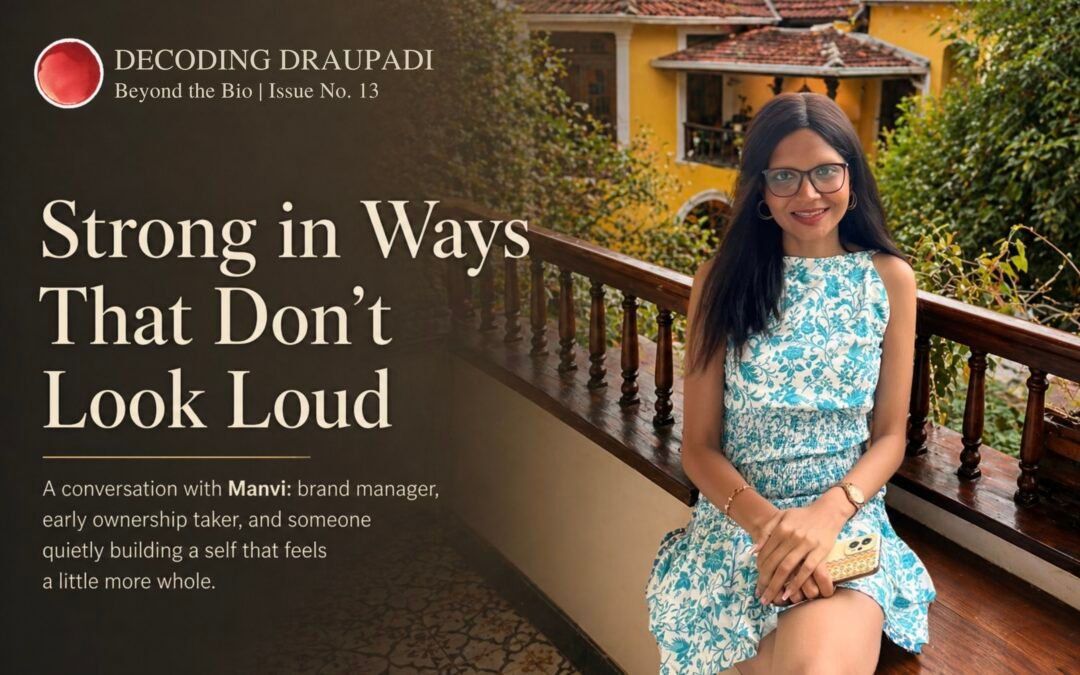
A conversation with Manvi, brand manager, early ownership taker, and someone quietly building a self that feels a little more whole.
Manvi moved fast. From social media and communications into brand ownership earlier than most, she has spent the last few years figuring things out in real time, taking responsibility before she felt ready, and holding things together in ways that rarely show up on a job description.
She is from MICA, has a crochet sunflower on her desk that she calls her emotional support plant, and describes herself as someone who is strong in ways that do not look loud.
We asked her the questions underneath the questions. She answered every single one.
Feeling a Lot Without Showing It
Most of us are never just one person. Not your title, not your bio. Who is Manvi right now, across the different lives you are living?
I think right now, I am someone who feels a lot but does not always show it in obvious ways. On the surface, my life looks very work-focused. And it is. It gives me structure, a sense of control, and honestly, a kind of comfort. It is the one space where things make sense.
Honestly, I am very emotional, and always have been. Feeling things deeply is just how I am wired, but over time I have gotten used to holding a lot of that inside. I adjust, show up, and make space for others. It comes naturally, but it also means I do not always make enough space for myself.
At home, with my mom, my brother, and my bhabhi, things feel simple and real. No overthinking, no trying to be a certain version of myself. And then there is the part of me that still belongs to my MICA days. That version felt fuller, lighter, more expressive. I am attending one of those friends’ weddings now, which feels like revisiting a version of myself I really loved being.
There is also a quieter history I carry. Of being seen a certain way growing up, of dealing with things that affected how I looked and how I felt about myself, and slowly learning how to accept it instead of fight it every day. I do not talk about it often, but it has shaped me more than I realise.
If I had to describe who I am right now: someone who is strong in ways that do not always look loud. Someone who gives a lot, maybe sometimes more than she should, and is still figuring out how to balance ambition with just living.
“Someone who is strong in ways that do not always look loud. Still figuring out how to balance ambition with just living.”
There is a particular kind of exhaustion that comes from being the person who holds things together without anyone noticing. Manvi names it without drama, the adjusting, the showing up, the making space for others. What stays with us is her honesty about the quieter history she carries. The things that shaped her that she rarely says out loud. That kind of self-awareness, naming the thing even when you do not fully talk about it, is its own form of strength.
Stepping In Before You Are Ready
You moved quite quickly across roles, from social media and communications to brand ownership at a relatively early stage. What has that shift taught you about stepping into responsibility before you fully feel ready?
I do not think I have ever really felt fully ready for any of the roles I have stepped into. And maybe that is the point.
When I moved into owning a brand, it felt like a big shift. Earlier I was executing, building pieces of something. Suddenly I was expected to think end to end. Decisions, campaigns, outcomes, all of it sitting with me. I was figuring things out in real time more often than I was confident.
What that phase really taught me is that readiness is slightly overrated. You do not step into responsibility because you feel ready. You step into it, and then you grow into it. A lot of that growth is uncomfortable. It is asking questions you think you should already know the answers to. It is making calls and then second-guessing them.
I have also realised that doing everything on your own is not always strength. In the beginning, I leaned into that a lot. Over time, I understood that real ownership is also about knowing when to ask, when to collaborate, and when to step back. Stepping in before I felt ready made me more adaptable than anything else could have.
“Readiness is slightly overrated. You do not step into responsibility because you feel ready. You step into it and then grow into it.”
This is one of the most honest things you can say about early career growth, and also one of the least often said. The narrative around confidence and readiness tends to be retrospective: people say they were ready only after they have already proved it. Manvi is saying something more useful: she was not ready, she went anyway, and that is actually how it works for most people. The willingness to step forward first and find your footing along the way is not recklessness. It is how competence actually gets built.
Making Sure Things Do Not Slip
There is usually a lot of work that happens behind the scenes, with no name on a job description and no metric attached to it. What is the most important thing you do at work that fits that description?
The most important thing I do at work, something that does not really have a name, is holding things together in ways that are not always visible.
Because I have moved roles quickly, I have often found myself in situations where things are not fully structured yet. There are expectations, but not always clear processes to get there. In those moments, I naturally step in to make things work, whether that is aligning teams, clarifying briefs, or just making sure everyone is moving in the same direction. It is not something anyone assigns to you, and it is not something that gets measured.
I also think I spend a lot of time thinking slightly ahead, trying to catch gaps before they become actual issues. It can feel small in the moment, but it avoids a lot of back and forth later. So if I had to put it simply: I make sure things do not slip through the cracks, even when it is technically not my job. A lot of meaningful work actually lives in that space.
Every team has someone who does this. The person who catches the thing before it becomes a problem, who makes sure the brief actually makes sense before it goes out, who holds the context that nobody else is holding. It is rarely the most visible work. It is often the most essential. Manvi has named it, which is already more than most people do.
On Spending on Yourself
The first time you spent your own money on something that was not practical, something just for you. What was it? What did it feel like?
The first time I really spent on something that was not practical, it was not one thing. It slowly became my desk.
It started with one small thing, something cute, something unnecessary. And then it kept building. A poster set that did not serve any purpose except making me feel like this space is mine. A tiny octopus plushie sitting in the corner like quiet company on long days. A little note to self showpiece I do not always read, but like knowing it is there. A crochet sunflower that has somehow become my emotional support plant. And my favourite: a very I am just a girl aesthetic heart coffee cup that makes even a regular coffee feel a little nicer.
None of it was practical. None of it was needed. But for the first time, I was not spending on utility or logic. I was building a space that reflected how I feel, or maybe how I want to feel on the days when work gets a bit too much. It did not feel like a big purchase. But it felt like I was slowly claiming a part of my life as my own.
“For the first time, I was not spending on utility or logic. I was building a space that reflected how I feel.”
The desk answer is the one we keep coming back to. Because it is not really about the objects. It is about the moment a woman stops optimising for usefulness and starts making room for what makes her feel like herself. An octopus plushie, a crochet sunflower, a coffee cup that is slightly dramatic. These are not small things. They are the first language of self-permission.
On Relationships Changing: The One With Yourself
Work changes the people closest to us, sometimes quietly, sometimes dramatically. Which relationship in your life has changed the most since you started working?
The relationship that has changed the most is the one I have with myself.
Before I started working, I did not think about myself in such defined ways. I was just living, studying, being around people, feeling things without over-analysing them. Work changed that quietly. It made me more aware of who I am, my strengths, but also my patterns. Like how I tend to take on more than I should, how I find it hard to say no, how I sometimes tie my sense of worth too closely to how well I am doing professionally.
I have become more independent, which is a good thing. But it also means I rely on myself a lot more, sometimes even emotionally. And that changes how you show up in other relationships too. You become slightly more contained.
But if I am being honest, the biggest shift is internal. I have become someone who is more driven, more structured, more aware, but also someone who is still figuring out how to not lose the softer, lighter parts of herself in the process. The relationship that has changed the most is the one where I am still learning how to be both, ambitious and gentle with myself at the same time.
“I am still learning how to be both. Ambitious and gentle with myself at the same time.”
This answer will land for a lot of women reading this. The way work quietly reshapes your relationship with yourself, the independence that is genuinely good but also means you absorb more alone, the awareness of your own patterns that comes with experience but also with a certain weight. Manvi is not lamenting it. She is just naming it clearly. That is harder than it sounds.
On What You Are Building
Outside of your job title and your company, what are you building? And is there something you wish more women in brand roles talked about openly with each other?
I do not think I am building something you can neatly name yet. But if I had to put words to it, I am building a life that feels like mine and not just one that looks right on paper.
Underneath everything, there is a quieter project running in parallel. I am trying to build a version of myself that does not always need validation from being productive. Someone who can say no without overthinking it. Someone who does not feel guilty for choosing herself.
I am also slowly building my voice. There was a time I stood on a stage and spoke about things that were not easy to say out loud. I remember how different that felt. Honest. Unfiltered. I do not think I have fully accessed that version of myself again, but I know she exists. And I think, in small ways, I am trying to come back to her.
As for what I wish more women in brand roles talked about openly: I think it is this. The version of yourself that work does not see. The softer parts, the uncertain parts, the parts that are still figuring things out. We are all quite good at presenting the put-together version. And I think we would all feel a little less alone if we talked more honestly about what is running underneath it.
That last part is exactly why this series exists. The put-together version is visible everywhere. The version underneath it, the one still learning to say no, still trying to reclaim her voice, still figuring out what she actually wants, that one rarely gets space. Manvi is giving it space here. And we think a lot of women reading this recognise themselves in it.
On Fear: Being Replaceable
Most people have one fear they have learned to perform confidence around. What is yours?
I think my fear is being replaceable. Not in an obvious way, because on the surface I have learned how to be confident, dependable, someone people can rely on. I know how to show up, deliver, take ownership. And over time, you get good at carrying that without letting the doubt show.
But underneath that, there is this quieter thought: what if everything I am doing is just expected? What if I am doing a lot, but not something that is distinctly mine? I think that is why I push myself the way I do. Not just to perform well, but to feel like I matter in a way that is not easily interchangeable.
There is also another layer. I have gotten used to being put together on the outside, even when I am not fully feeling that way inside. And the fear is that if I slow down or do not hold that version together, things might slip. How people see me, how I see myself. So I keep going. I keep building and proving.
I do not think this fear is entirely a bad thing. It drives me in many ways. But I am also learning that I do not want everything I do to come from that place. I want to reach a point where I am not just trying to be needed, but comfortable just being enough.
“I want to reach a point where I am not just trying to be needed, but comfortable just being enough.”
Being replaceable is not a fear people name easily, because naming it requires admitting that you sometimes do not feel irreplaceable. Manvi names it and then goes one layer deeper: the fear is not just about the job, it is about being seen. About mattering in a way that is distinctly hers. Most of the drive that looks like ambition from the outside is actually this, the quiet, persistent work of trying to feel like you cannot be easily substituted. She knows that about herself. That level of self-awareness is already the thing that makes her distinct.
A Note from Decoding Draupadi
What stayed with us after this conversation was Manvi’s desk. Not because of what is on it, but because of what it represents. A crochet sunflower. A coffee cup that is slightly dramatic. Objects that serve no purpose except to say: this space is mine, and I am allowed to feel good in it.
We built this series for the women in brand circles who are doing a lot, holding a lot, and not always getting credit for either. Manvi is one of them. And the thing she is quietly building, a self that does not need to earn its own permission, is something we think a lot of the women reading this are also building. Just without always having the words for it.
If this felt like someone you know, or someone you are, share it with her.
— End of Interview —
This interview was conducted as part of theDecoding Draupadi Brand Manager Series.