
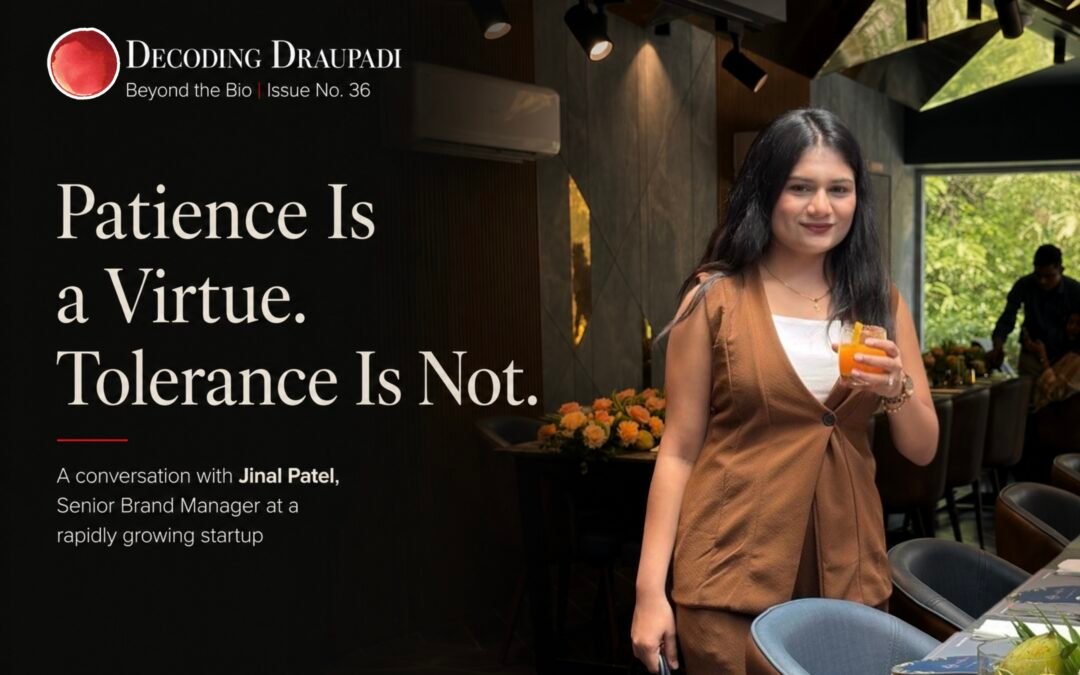
A conversation with Jinal Patel, Senior Brand Manager at a rapidly growing startup
Jinal Patel is 26. She has worked across community building, public relations, client servicing, and brand management. She published her views in her masters’ dissertation on the impact of social media on mental health of the youth. She became a PRO at a university at 22, replacing someone double her age. She confronted a manipulative founder, got promoted, and left anyway.
She is sharp, opinionated, and still figuring things out. That combination, knowing a lot and admitting what you do not yet know, is what makes this conversation worth reading.
A Mixture of Chaos and Calm
Who is Jinal right now, across the different lives you are living?
By default, she says, Jinal is extremely empathetic, very ambitious, strong-minded, and at the same time very vulnerable. A mixture of chaos and calm, silence and screams, and everything in between.
She is a feminist who studied journalism and mass communication and has strong, well-researched opinions. She got married a year and a half ago and is now navigating the gap between everything she knows intellectually about equality and the actual lived reality of marriage as an institution. That gap, she says honestly, is harder to close than she expected.
She is also a wannabe content creator, building slowly, getting good responses, and is happy about that. And she is someone with a lot of opinions, experiences and conversations, but has limited people to have a heart-to-heart with. That changed post-marriage, when friendships built over twenty-four years quietly became harder to maintain.
Professionally, she is at a point where opportunities are chasing her rather than the other way around. And that shift in dynamic, she says, changes how you see everything. You stop asking what you can get and start asking what actually matters.
“Jinal is a mixture of chaos and calm, silence and screams, and everything in between.”
She answered this question the way very few people do: honestly about the tension between who she thought she would be and who she is actually becoming. That gap is not a failure. It is the most interesting part of anyone’s story.

Empathy at Work. Empathy at Home.
Has working so closely with different kinds of people changed the way you approach your own relationships and friendships outside work?
In her first two jobs, she was told: you are talented, you are smart, but in terms of maturity you have a long way to go. She was bubbly, impulsive, and would easily cross the line between professional and personal. Over the years, she learned how to be different in different rooms without losing herself.
Managing a team of brand managers, running ten brands across food and beverage, lifestyle, real estate, tech, and automobile, and effectively managing household responsibilities,, she learned the rarest quality she has seen in the most successful people around her: being at the top and still being humble.
She also learned that you can hold very strong viewpoints and still deliver them in a polite, effective way. That lesson changed her work relationships. It changed her personal ones too. Especially in her marriage, where she entered as the more professionally accomplished partner. She made a deliberate choice not to carry that into her home. Because of that choice, she says, she is flourishing in both.
“Approaching relationships with extreme empathy is very important. Being firm at the same time is not a contradiction.”
The detail about her marriage is the one to hold. She names it directly: she was more successful than her partner when they married. She chose not to make that a weight. That kind of deliberate choice rarely gets talked about, and it is exactly the kind of thing that determines the quality of a life.
Confident People Have Insecurities Too. They Are Just Better at Carrying Them.
What is something people often misunderstand about confidence?
That confident people do not have insecurities, second thoughts, or nervousness. They do. They are just really good at carrying them without letting them show.
Even the most confident person, she says, walks into a room full of people who are smarter, more accomplished, richer, or more experienced, and feels the effect of that. The difference is that they fake it when they cannot make it. And eventually, faking it long enough starts to feel real.
What she believes: Being the richest person in the room may not be in your control. Being the most beautiful may not be either. But being the most knowledgeable, the most prepared, the most confident, that is always within reach. And those two things together, knowledge and confidence, can take you into rooms you never imagined yourself entering.
“Being confident in the room is always within your control. And it can take you to rooms you never imagined yourself entering.”
The fake it till you make it point is not new. But her framing of why it works is sharper than most: she is not saying pretend to be something you are not. She is saying confidence is a practice, not a trait, and the more you practice it, the more it becomes yours.

Patience Is a Virtue. Tolerance Is Not.
Is there a part of your personality that has become stronger with age, and a part that has become softer?
Stronger: the belief that patience is a virtue, but tolerance is not.
She grew up hearing the opposite. People around her regularly glorified tolerance: that person is so good for tolerating such a difficult boss, that woman is so admirable for staying in a toxic relationship. She used to not have strong views on this. Now she does. Tolerating things that should not be tolerated is not a virtue. It is something that should be resisted, even when the world applauds it.
Softer: the red flag, green flag binary. She used to categorise quickly. One uncomfortable thing and she would file the person under a verdict. Over time, she realised people are not black or white. They are grey. She has her own moments of jealousy, insecurity, and unkind thought. Holding everyone else to a standard of perfect consistency that she herself does not meet stopped making sense. Now she looks for patterns, not single incidents. And she gives people the room to be more than their worst moment.
“Patience is a virtue. Tolerance is not. You will have to fight against the world to hold onto that distinction, but it is worth it.”
This is one of the more precise things said in this series. The difference between patience and tolerance is not usually articulated this clearly. Patience is choosing how you respond. Tolerance is accepting what should not be accepted. She has decided which one to keep.
What Nobody Mentions When Talking About Growth
What is something people rarely talk about when discussing growth and career progression?
The happiness ratio.
Career progression, she says, gets attached to money and position. Both of those things matter. But what rarely enters the conversation is the satisfaction you feel at the end of a day. The quality of the environment you work in. The creative fulfilment of doing work you actually love. The colleagues you spend more waking hours with than your own family.
She has seen people earning 25,000 rupees a month who are ten times happier than people earning one or two lakhs. Both, in her examples, without significant financial responsibilities. The difference was not the number. It was the clarity about what they were spending it on and whether it was actually serving the life they wanted.
She says this from a position of self-awareness: she knows she is coming from a place of relative financial freedom, without the weight of EMIs or dependents. Not everyone can afford to optimise for happiness. But more people could, she thinks, if they got clearer about what they actually wanted before they decided what to chase.
“Growth is not just about money and position. It is also about the satisfaction, the environment, and the clarity you have about what actually matters to you.”
She is careful to name her own privilege in this answer, which is the thing that makes it credible rather than preachy. She is not telling people to care less about money. She is asking them to get clearer about why they care about it, and whether what they are chasing is actually what they want.

Take the Leap.
If you could give your younger self one piece of advice, what would it be? And do you think she would actually listen?
The advice: never regret anything. Take a leap of faith. If you fly, great. If you fall, that is okay too. But do not regret.
She says she mostly made the choices she wanted to make. The problem was the second-guessing that came after. What if this is the wrong job? What if this is the wrong degree? What if this is the wrong relationship? She would tell her younger self to make those choices anyway, make those mistakes anyway, and make them with confidence rather than with doubt trailing behind.
Live in the moment. Enjoy the mistake while it lasts. Whatever happens afterwards, you are strong enough to navigate through it. Everything is manageable.
As for whether she would listen: she thinks yes. Because even then, she was the kind of person who ultimately did what she wanted. She just would have saved herself some unnecessary anxiety along the way.
“Take the leap. If you fly, great. If you fall, it is okay. But do not regret. You are strong enough to navigate whatever comes next.”
The philosophy she names, take a leap of faith, die but do not regret, is one she has actually lived. She did it at 22 when she took a government PRO role nobody expected her to take. She did it when she walked out of a job after a month with a 15-minute speech. She would tell her younger self to do it earlier, with less doubt. The version of her that exists today is proof that it works.
A Note From Decoding Draupadi
What stayed with us is the distinction between patience and tolerance. She did not frame it as a personal discovery. She framed it as something she had to fight the world to hold onto, because every family gathering, every inspirational story, every piece of conventional wisdom she grew up with was glamorising tolerance instead.
That is not a small thing to unlearn. And naming it plainly, not as a life hack but as something worth resisting even when everyone around you disagrees, is the kind of thing that makes a person worth listening to.
She is 26. She is still figuring a lot out. That is not a caveat. That is the most interesting part.
If this felt like someone you know, share it with her.
Take the leap. If you fly, great. If you fall, it is okay. But do not regret. She has lived this. Full conversation at @decodingdraupadi.
Jinal Patel is Senior Brand Manager at a rapidly growing startup This interview was conducted as part of the Decoding Draupadi Brand Manager Series.