
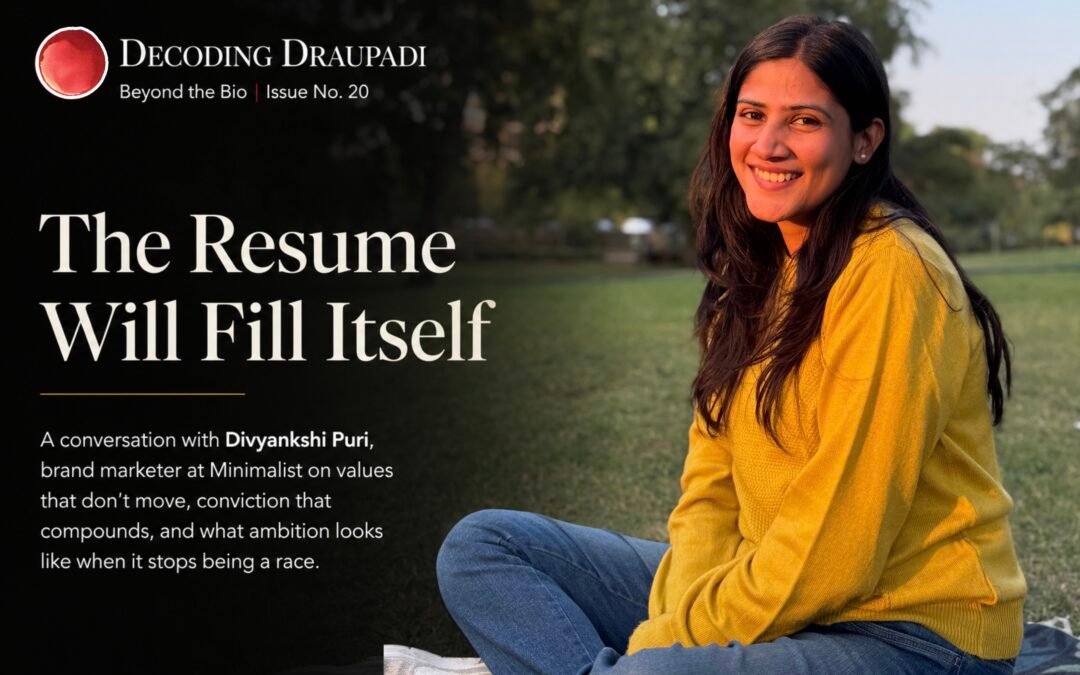
A conversation with Divyankshi Puri, brand marketer at Minimalist on values that don’t move, conviction that compounds, and what ambition looks like when it stops being a race.
Divyankshi Puri joined Minimalist already a fan, and became a bigger one from the inside. That trajectory says something. In an industry where people regularly trade conviction for visibility, she builds from a different starting point: knowing what a brand would never do is just as important as knowing what it will.
Across every answer in this conversation, one thread keeps surfacing. Restraint. Not as limitation, but as clarity. She talks about distinctiveness, ambition, and validation the same way she talks about brand partnerships: not as things you chase, but as things you earn by holding a position long enough for it to mean something.
Curious. Contradictory. Whole.
Who is Divyankshi right now, across the different lives she is living?
Most people who know me would describe me differently. They’re all right!
We are often taught that success requires a singular focus, but I’ve found that my greatest strength lies in my contradictions.
At my very core, I am curious, genuinely, almost restlessly so, always pulling at threads, asking questions that don’t always have clean answers, and moving forward even while I am still figuring things out.
I value the plan, but I value the pivot just as much. Clarity matters to me, and so does the ability to sit with uncertainty when clarity isn’t there yet. Being fiercely independent and being deeply anchored in the people I love, my family and friends, those two things coexist in me. They are essential to who I am. They are who I return to, who keep me whole.
And in between, I also like to travel whenever I can. That kind of pulls me out of routine and back into perspective.
“I value the plan, but I value the pivot just as much.”
There is something quietly radical about describing your contradictions as a strength rather than a confession. Most of us spend years trying to make our identities tidy. Divyankshi seems to have arrived at a different conclusion: wholeness doesn’t require resolution.
Right Doesn’t Move. The Temptations Do.
What does it actually take to ensure a brand’s values are not just communicated, but consistently lived?
Building a brand on values sounds good in theory. Living those values, consistently, especially when it’s inconvenient, is where the real work begins.
I’ve come to believe that it starts with alignment. You can’t build or sustain a values-led brand unless you genuinely believe in the same value system. Otherwise, it becomes easy to compromise when faced with pressure, trends, or short-term gains.
When I was joining Minimalist, I knew one thing clearly: I wanted to work somewhere I would be genuinely proud to build. Not just proud of the output, but proud of the how. Minimalist was an easy choice, not because it was perfect, but because what it stood for felt real. I was a huge fan as an outsider. Somehow, I became an even bigger one from the inside, and that doesn’t always happen.
But beyond any one brand, I think what it actually takes is simpler and harder than most frameworks suggest. You just have to keep choosing what is right, even when the world around you is shifting. Right doesn’t move. The temptations, the shortcuts, the pressure to compromise, those move. A brand stays true not through a values document but through a thousand small decisions made by real people who are actually living those values, not just communicating them.
“Right doesn’t move. The temptations, the shortcuts, the pressure to compromise, those move.”
That last line is the kind of thing that sounds simple until you sit with it. Values documents are easy. The thousand small decisions are not. This is also why culture can’t be copy-pasted, and why Divyankshi makes the distinction between being proud of the output and proud of the how. One you can fake. The other you can’t.

The Ones Who Know What They Won’t Do
What does it really take to move away from formula-based marketing and build something genuinely distinct?
The reason so much marketing feels repetitive today is because we’ve become obsessed with best practices. But best practices are, by definition, what everyone else is already doing. They might keep you safe, but they will never make you distinct.
So the real question isn’t how to stand out. It’s how to stop looking sideways, just for the sake of mirroring others.
In my opinion, it starts with knowing your own brand deeply, not just what it sells, but what it believes, how it sees the world, and what it would never do, no matter what. That clarity is rarer than it sounds. Most brands can tell you their product. Far fewer can tell you their point of view. And without a point of view, you are always going to be borrowing someone else’s.
I also think genuine distinctiveness requires restraint. A lot of brands try to stand out by doing more, more content, more formats, more presence everywhere. The ones I find most compelling, including ours, usually do less, but with more conviction. They know what they won’t do as clearly as what they will. And that knowing is visible in the work.
In the end, distinctiveness isn’t built through one big campaign. It’s built through repeated, intentional choices that compound over time.
“Most brands can tell you their product. Far fewer can tell you their point of view.”
This is the argument against content calendars as strategy. Showing up consistently is not the same as having something to say. Divyankshi is drawing a distinction between volume and conviction, and she’s right that the difference is visible in the work, even if audiences can’t always name what they’re responding to.
The Fit Was Almost Too Obvious
When you’re part of a large brand moment or collaboration, how do you ensure it still feels true to the brand and not just like a reach play?
This is, in many ways, an extension of the same idea. Brand alignment, and when and what to say no to.
In a landscape where everyone is fighting for their share of voice, brands have to be incredibly mindful of relevance.
When I think about what makes a partnership feel true rather than transactional, it comes back to the same question: does this make sense for who we are, or do we want to do this just because everyone else is doing it.
Two examples stay with me. When
Minimalist became the official sunscreen partner for the Dua Lipa concert in India, it wasn’t just a visibility play. We set up sunscreen dispensers inside the venue, the first brand in India to do something like that, and used the moment to genuinely talk about sun damage and why protection matters. Thousands of people, outdoors, under the sun, at a concert. The fit was almost too obvious. That’s how you know it’s right.
IPL was similar. Players train in the sun, practice in the sun, play in the sun. Viewers sit in stadiums through afternoon heat. Everyone in that ecosystem needs sunscreen, it’s sampling in the most natural setting possible.
One more thing worth saying honestly is that the results from these moments are rarely immediate. You don’t always see a spike the next day or the week after. But what you do build, gradually and eventually, is something longer lived than a campaign metric. Brand associations, when chosen well, settle into people’s minds slowly. They shape how a brand is remembered, not just noticed.
“Brand associations, when chosen well, settle into people’s minds slowly. They shape how a brand is remembered, not just noticed.”
The Dua Lipa example is doing a lot of work here. It’s not just a case study, it’s a proof of concept. When the context and the product are in genuine alignment, the brand doesn’t have to explain itself. It just shows up and makes sense. That ease is the whole point.
The Inner Scorecard
When there is no external validation, no praise, no visible win, how do you know you’re doing good work?
I think our relationship with validation and appreciation changes as we grow. When you are just starting out, external validation is necessary, but somewhere along the way this shifts. You start to recognize the wins yourself. You develop an inner sense of when something was done well and when it wasn’t, and that sense becomes much more important than any applause.
As I have also grown in my career, I have started setting up goals for myself. When I meet them I know, when I don’t, I know that too. That inner scorecard is quieter than applause but considerably more honest.
That said, doing meaningful work in isolation is hard to sustain, and the people around you matter enormously as well, not to validate every decision, but to notice the effort behind them. What I have observed in the last few years is that the right team and the right manager don’t always celebrate loudly, but they do notice the effort behind the work, and they create a culture where good work doesn’t go unseen.
“That inner scorecard is quieter than applause but considerably more honest.”
She is not arguing against appreciation here. She is describing what it means to stop needing it as proof. That distinction matters. The women I’ve spoken to in this series who seem most settled in their work are usually the ones who have built that inner reference point. They still want to be seen. They just don’t require it to keep moving.
Ambition That Stops Being a Race
How has your relationship with ambition evolved? What does it look like for you now?
Ambition, when I was just starting out, looked exactly like what you would expect from a fresh-out-of-college kid. A big brand name on the resume. A fat pay cheque. A role that sounded impressive when someone asked what you did. Those things mattered, and honestly, I don’t think there is anything wrong with that. It is where most of us begin.
But over time, that definition started to shift. Ambition, now, is more internal than external.
Now it’s about doing work I’m proud of, with people I genuinely respect, in a place that aligns with how I think and what I value, in a way that doesn’t cost me the things that matter most: my relationships, my curiosity, and my sense of self.
I still care about growth. I still care about doing well. But I’m less interested in chasing what looks impressive, and more focused on building something that feels right.
Safe to say, ambition for me no longer feels like a race against anybody.
“Ambition for me no longer feels like a race against anybody.”
She is not saying ambition shrinks. She is saying it matures. There is something worth sitting with in how she frames it: not losing interest in growth, but losing interest in performing growth. That shift doesn’t happen at the same time for everyone, but it does seem to happen, and the women who name it out loud make it easier for the rest of us to recognise it when it arrives.
Loosen the Grip
What would you want someone just beginning their journey to worry less about?
I was someone who worried a lot. About grades, about getting it right, about keeping up. And to an extent, those things do matter, they build discipline, they open doors, they shape opportunities. But that doesn’t mean you start treating life like a checklist.
Anybody reading this who is just starting out, or even if you are already well on your way, loosen the grip a little. Make space for curiosity, for people, for experiences, for joy in between all the ambition. They are not mutually exclusive, let me tell you.
Also, get your ethics right, early. You can figure out your career, your strengths, your direction. Those reveal themselves with time. But your integrity, your definition of right and wrong, your intent, these need to be in place from the beginning. Everything else can be course-corrected. That part is harder to rebuild.
The resume will fill itself, believe me.
And the race? There isn’t one. Believe me on this too.
“Get your ethics right, early. Everything else can be course-corrected. That part is harder to rebuild.”
This is the answer that earns the title. The resume will fill itself is not a platitude when it comes from someone who has lived it. She is making a sequencing argument: the things that are hardest to build back up, your integrity, your curiosity, your relationships, those come before the things that look good on paper. That’s an unusual order to argue for, and she argues for it with conviction.
A Note From Decoding Draupadi
The thing that stayed with us from this conversation is how Divyankshi talks about ethics. Not as a constraint, not as compliance, but as a foundation. In a world where almost everything else is negotiable, she is saying: this part isn’t. Start here. Build the rest on top.
We have spoken to brand managers across industries and roles, and the ones who seem most clear-eyed about what they are building are usually the ones who sorted out the ethics question early. Not because they had it all figured out, but because they decided, early, what they would not move on.
That clarity shows up everywhere else in Divyankshi’s answers: in how she thinks about brand values, about partnerships, about ambition. It is the same principle, applied at every scale.
If this felt like someone you know, share it with her.
— End of Interview —
Divyankshi Puri is a brand marketer at Minimalist. This interview was conducted as part of the Decoding Draupadi Brand Manager Series.
You don’t need the validation. But you do deserve a community of women who get it. Join us at @decodingdraupadi.