
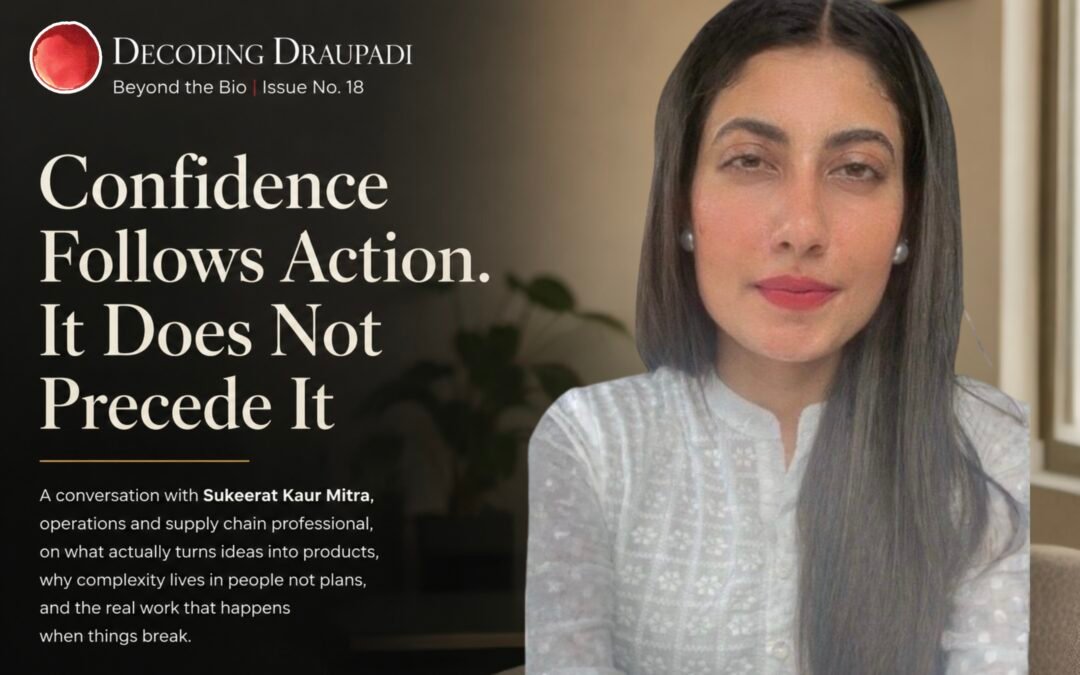
A conversation with Sukeerat Kaur Mitra, operations and supply chain professional, on what actually turns ideas into products, why complexity lives in people not plans, and the real work that happens when things break.
Sukeerat Kaur Mitra works in the part of business that most people never see and that most organisations cannot function without. Operations, supply chain, execution. The work that holds everything else up. She is someone who thinks precisely, moves quickly, and has learned to find the most interesting part of her job in the exact moments everyone else is trying to escape.
This conversation is quieter than most in this series. But the thinking is sharper, and the lines hit harder for it.
Composed on the Outside. More Complicated Than That.
Who is Sukeerat right now, across the different lives she is living?
Someone who is genuinely curious about how things work, systems, people, problems. That curiosity is probably what drew me to a career in operations and supply chain in the first place. There’s something deeply satisfying about understanding how all the pieces connect and finding where the gaps are before they become bigger problems. That’s the version of me at work, which tries to understand why rather than just the what. But honestly, that version applies to most of the areas of my life.
Outside of it, I’m someone who needs people around me to feel like myself. Sports has been a big part of my life and I think it has shaped how I approach a lot of things. I carry the same gaming spirit to board games, online gaming, and also spending time with family. That’s where I decompress and reset. Not because of the activity itself but because of who I’m doing it with.
The part that probably doesn’t come across professionally is that I am a lot harder on myself than I let on. But I’ve come to see that’s less of a flaw and more of a compass. From the outside I probably seem fairly composed. Inside it’s a bit more complicated than that.
“I am a lot harder on myself than I let on. But I’ve come to see that’s less of a flaw and more of a compass.”
That reframe, from flaw to compass, is doing something. It is not minimising the self-criticism. It is repositioning what it is for. The women who seem most clear-eyed in this series are rarely the ones who have quieted the inner critic. They are the ones who have found a way to make it useful.
The Distance Between a Good Idea and a Real Product
What has taking products from early stages to market taught you about turning an idea into something real?
That the distance between a good idea and an actual product is almost entirely made of unglamorous decisions. What I’ve found is that most things don’t fail because the idea was wrong. They fail because somewhere early on, nobody was precise enough about what problem they were actually solving.
Going back to that question, what are we really trying to do here, has probably saved more projects than any tool or framework. The idea is rarely the hard part. Keeping everyone honest about what the idea actually is, all the way through, that’s where the real work is.
“The idea is rarely the hard part. Keeping everyone honest about what the idea actually is, all the way through, that’s where the real work is.”
This is a harder observation than it sounds. In most rooms, the idea gets the applause. Sukeerat is pointing at the quieter, unglamorous discipline of returning to the original question again and again, especially when momentum and sunk cost start pulling people away from it. That act of maintenance is what most people are not trained for and what most projects are eventually undone by.

The Complexity Is Almost Never in the Plan
What have you learned about managing complexity when so many moving parts depend on each other?
That the complexity is almost never in the plan, it’s in the people. Most of the time you’re working with teams who have their own pressures and priorities, and none of them technically owe you anything. What I’ve learned is that if people understand why something matters and trust that you’re being straight with them, things move. If they don’t, no process fixes it.
That took me longer to fully internalise than I’d like to admit.
“If people understand why something matters and trust that you’re being straight with them, things move. If they don’t, no process fixes it.”
Every operations person eventually learns this, but not everyone says it this cleanly. The systems and tools and project trackers are visible and easy to point to. The actual engine is something you cannot put in a slide. Sukeerat has earned this observation the hard way, and the admission that it took time to land says more about her self-awareness than any credential would.
The Cost of Waiting Is Real. It Just Doesn’t Show Up Anywhere Visible.
How do you make decisions when there is no perfect answer and something has to give?
I try to first separate what I actually know from what I’m assuming, because a lot of bad decisions come from treating assumptions like facts. Once I’ve done that I tend to bias toward speed. Not carelessly, but I’ve seen enough good projects stall in the name of getting it perfect that I’ve become more comfortable with moving and correcting.
The cost of waiting is real. It just tends not to show up anywhere visible until it’s too late.
“The cost of waiting is real. It just tends not to show up anywhere visible until it’s too late.”
The distinction between what you know and what you are assuming is one of the most practical thinking tools there is, and most people skip it entirely under pressure. The second part, biasing toward speed over perfection, is something that takes real experience to trust. It is easy to say. It is hard to act on when the stakes feel high. Sukeerat sounds like someone who has learned to act on it.

Confidence Follows Action. It Does Not Precede It.
Has there been a time you felt completely in over your head? What helped you find your footing?
More than once. What I’ve noticed is that the moments I felt most out of my depth were also the moments I ended up finding something in myself I didn’t know was there. Being trusted with something before you feel ready is uncomfortable, but that discomfort tends to be where the actual growth happens.
What helped each time wasn’t a plan or a mentor moment. It was just starting. Not waiting to feel ready, just doing the next thing in front of me. Confidence, I’ve found, follows action more than it precedes it.
“Confidence, I’ve found, follows action more than it precedes it.”
This is the line that earned the title of this piece. It is not a motivational poster statement. It is a sequencing correction. Most of us are waiting to feel ready before we begin, and Sukeerat is saying the readiness arrives after, not before. That is such a specific, hard-won insight, and the fact that she frames it as something she found in practice rather than something she was told makes it land differently.
Switched On Versus Unable to Switch Off
What does stepping back or creating space look like for you?
Honestly it’s still something I’m working on. When something is genuinely weighing on me I tend to go quiet first. I need to process alone before I can do anything useful with it. And then being around people I care about helps in a way that’s hard to explain. Not necessarily talking about the problem. Just being with people who have nothing to do with it.
I think what I’m still figuring out is the difference between being switched on and not being able to switch off. That line is blurrier than I’d like it to be.
“I think what I’m still figuring out is the difference between being switched on and not being able to switch off.”
The honesty in this answer is worth noting. She does not present herself as having solved it. That distinction she is drawing, between being usefully engaged and being unable to disengage, is one that a lot of high-performing people struggle to name even when they are living it. Naming it is usually where the work of actually drawing the line begins.
The Most Interesting Part Is What Happens When Things Break
What is something about the kind of work you do that people don’t fully see or appreciate?
That the most interesting part of this work is what happens when things go wrong. That’s genuinely what keeps me in it. When something breaks, a supply disruption, a launch delay, a bottleneck nobody saw coming, that’s when you find out what you actually know and how well you’ve built the relationships around you. The problem solving in those moments is what I find most alive.
But because the goal is always to make things look seamless from the outside, that part stays largely invisible. Which is fine. But it’s where most of the real thinking happens.
“Because the goal is always to make things look seamless from the outside, that part stays largely invisible. Which is fine. But it’s where most of the real thinking happens.”
This is a portrait of a person who genuinely loves the hard part of her work, not despite the invisibility but almost indifferent to it. She is not asking for the credit. She is just naming that the most interesting thing about what she does is the thing nobody sees. That is a rare combination of self-awareness and actual passion for the work, and it is the kind of thing that is very hard to fake.
A Note From Decoding Draupadi
What stayed with us from this conversation is how Sukeerat talks about invisibility. The work that holds everything up, the thinking that happens in the crisis, the hard-won insight that never makes it into the debrief because the whole point was that nothing looked like it broke. She is not asking for that to change. She just knows it is where the real work lives.
There are a lot of women doing this kind of work right now. Work that is essential and underrecognised, not because it is not valued, but because its entire measure of success is that it goes unnoticed. This series exists, in part, to make that work visible. To say: this is what it looks like to hold something together. This is the thinking behind the seamless.
If this felt like someone you know, share it with her.
— End of Interview —
Sukeerat Kaur Mitra is an operations and supply chain professional. Senior Manager – Ecomm Supply Chain at L’Oréal This interview was conducted as part of the Decoding Draupadi Brand Manager Series.
Know someone doing the work that holds everything else up? The one who finds the gap before it becomes the crisis? She should be in this series. Tag her or send her our way at @decodingdraupadi.