DECODING DRAUPADI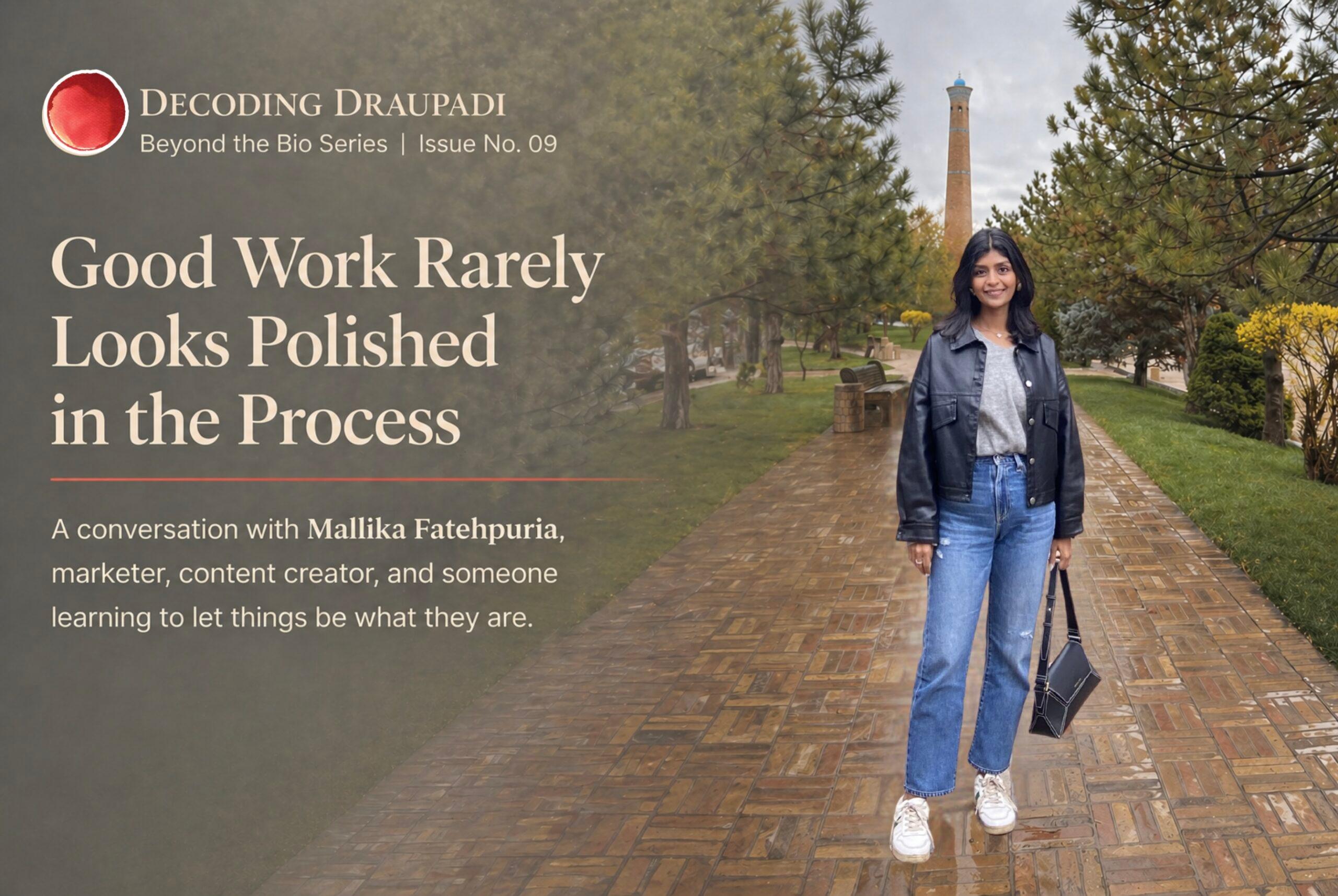
A conversation with Mallika Fatehpuria, marketer, content creator, and someone learning to let things be what they are.
Mallika Fatehpuria doesn’t think of good work as something that reveals itself after it’s out in the world. For her, it’s usually visible much earlier, in the process itself. In the energy in the room, the back-and-forth, the moment something finally clicks and people feel it.
That way of working didn’t come from a framework. It came from being in the middle of it, building, doubting, observing what holds attention and what quietly falls away. Over time, she has learned to trust those signals more than polish, more than speed, more than getting it “right” the first time.
At the same time, her relationship with work has softened. Not everything needs to be understood immediately. Not every phase needs a takeaway. Some things are just what they are, and letting them be has made both work and life feel lighter, and more sustainable.
ON THE MANY VERSIONS OF HERSELF
Who is Mallika right now, across all the different lives you are living?
Honestly, I think I am still figuring that out in real time.
At work, I oscillate between being very clear on what I am doing and feeling imposter syndrome in rooms where I don’t think I belong yet. I care a lot about doing things well, and I am learning the hard way to find that balance between caring too much and just caring enough. Over the last few months, I have also become more comfortable owning my point of view instead of constantly second-guessing it.
Outside of work, I am an organised mess. I overthink, I am impulsive, I crave company and need space more than I used to. I have become more protective of my time and energy, not in a dramatic way, just more intentional about where it goes. I am quite stubborn about giving myself the best life I can.
With friends and family, I am more present now. Less distracted, less consumed by work in my head. I am more vulnerable, my walls come down, and I can just be. Laugh loudly, be a little inappropriate, feel safe.
And then there is a version of me that is just overwhelmed sometimes. Not in a bad way, just in a very human way. Some days my 20 percent is my 100 percent. And that is okay.
“Some days my 20 percent is my 100 percent. And that is okay.”
We hear a version of this in almost every conversation in this series. The woman who holds everything together and still has days where holding it together is genuinely all she can do. What Mallika adds is the lack of drama around it. She is not apologising for it, not reframing it as growth. She is just saying: this is how it is. That kind of honesty takes practice.
ON WHAT TELLS HER SOMETHING IS WORKING
What has shaped the way you understand whether something is truly working or not?
For me, it has come down to something very simple: the feeling.
What is the work making me feel? What is it making the people working on it feel? Are we excited while building it? Are we proud of it right before it goes out?
Because I have realised that if the people in the room don’t feel anything while making it, it is very hard for the audience to feel anything when they see it.
Beyond that, I do look at behaviour. Do people stop? Do they watch? Do they share? Do they come back? But that usually comes after. The first filter for me is always: does this make us feel something?
A lot of this shift has come from creating content myself. Once you start looking at retention, skip rates, watch time, it becomes very obvious what is actually landing. And the patterns are clear: the things that make people feel something are the ones that hold attention.
“If the people in the room don’t feel anything while making it, the audience won’t feel anything when they see it.”
This is one of the clearest articulations of creative instinct we have heard in this series. Mallika is not dismissing data. She is describing the correct order of operations: feel first, measure after. Most briefs get this backwards. They start with the metric and then try to engineer the emotion. Mallika has worked out that it does not work that way, and she has the watch time to prove it.
ON WHAT GOOD WORK ACTUALLY LOOKS LIKE
How has your experience changed the way you think about what good work actually looks like behind the scenes?
Good work, at least in my experience, rarely looks polished in the process.
It is a lot of back and forth, a lot of doubt, a lot of this isn’t working before it finally clicks. But when it does click, you can feel it.
There is a certain energy in the room. People are more invested, conversations are sharper, and there is a shared excitement right before something goes out. That moment, when everyone knows we might have something, is what I have started trusting a lot more.
Earlier, I thought good work meant getting it right quickly. Now I think it is about staying with something long enough to make it feel right.
The thing nobody tells you about creative work is that the mess in the middle is not a sign that something is going wrong. It is usually a sign that something real is being made. Mallika has stopped mistaking the mess for failure. That is a significant shift, and it changes how you show up in every room where work is being made.
ON LETTING THINGS JUST BE WHAT THEY ARE
Has your relationship with work changed in a way where you allow things to just be what they are instead of constantly trying to extract meaning from them?
Yes, this has changed a lot for me.
I used to feel like I had to make sense of everything. Every tough phase needed to have a takeaway. Every bad day had to lead to growth. Almost like if I didn’t extract meaning from it, it was wasted.
And honestly, that is exhausting.
Now I don’t rush to label things. Some phases are just hard. Some days are just off. Some situations don’t resolve neatly. And I have stopped trying to force clarity out of them immediately.
What has also changed is that I don’t attach my entire sense of self to work in the same way anymore. Earlier, a bad day at work felt like a bad day overall. Now there is a bit more separation. I still care. A lot. But I don’t let it consume everything.
“Some phases are just hard. Some days are just off. And I have stopped trying to force clarity out of them.”
We talk a lot in this community about reframing difficulty as growth. And sometimes that framing is useful. But Mallika is pointing at something the reframe can cover up: not everything needs to mean something. Sometimes a hard phase is just a hard phase. Allowing that is not giving up on growth. It is actually a more sustainable way to keep going.
ON QUIET CONFIDENCE
What gives you quiet confidence these days?
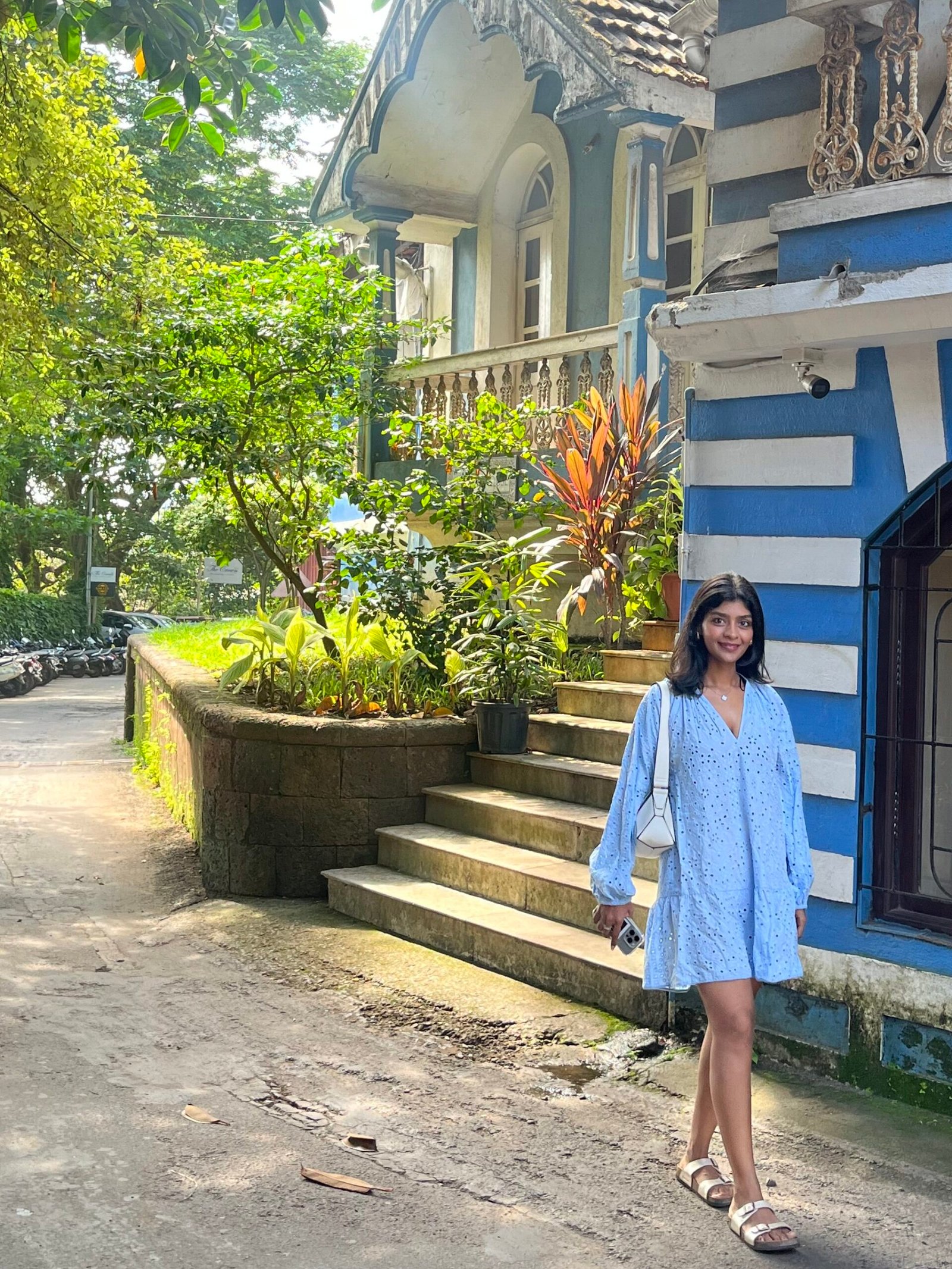
Quiet confidence, for me, has changed shape over time.
I have realised you don’t need to shout to be heard. You don’t have to be the loudest voice in every room or have an opinion on everything.
I am okay being the last person to speak in a meeting and saying just one thing that matters, instead of speaking for the sake of it.
I am also more okay being uncomfortable or even misunderstood at times, as long as I know I am showing up honestly.
And a big part of it is just this: I have gotten through every bad day I have had so far. So I trust that things will work out. They always have. There is really no other option.
“I have gotten through every bad day I have had so far. So I trust that things will work out.”
There is a kind of confidence that comes not from certainty but from track record. Mallika is describing that. She is not telling herself things will be fine because she believes it abstractly. She is telling herself things will be fine because they always have been, and she has the evidence. That is a very different thing, and a much more reliable foundation.
ON REST
What does rest actually look like for you right now?
Rest looks different on different days.
Sometimes it is just logging off on time and not opening my laptop again.
Sometimes it is going out, seeing friends, going to the gym or for a run, or just doing something that has nothing to do with work. Sometimes it is doing absolutely nothing and not feeling guilty about it.
The biggest shift for me has been not trying to optimise rest. Not turning it into something I need to do right. Just taking it as it comes and trusting that I will know what I need.
The optimised rest trap is real. The version where rest becomes another thing to do correctly, to schedule, to extract the most recovery from. Mallika has stepped off that treadmill. Rest is just rest. You know what you need. That is enough.
ON WHAT SHE IS LESS AFRAID OF
What is something you have learned to be less afraid of over time?
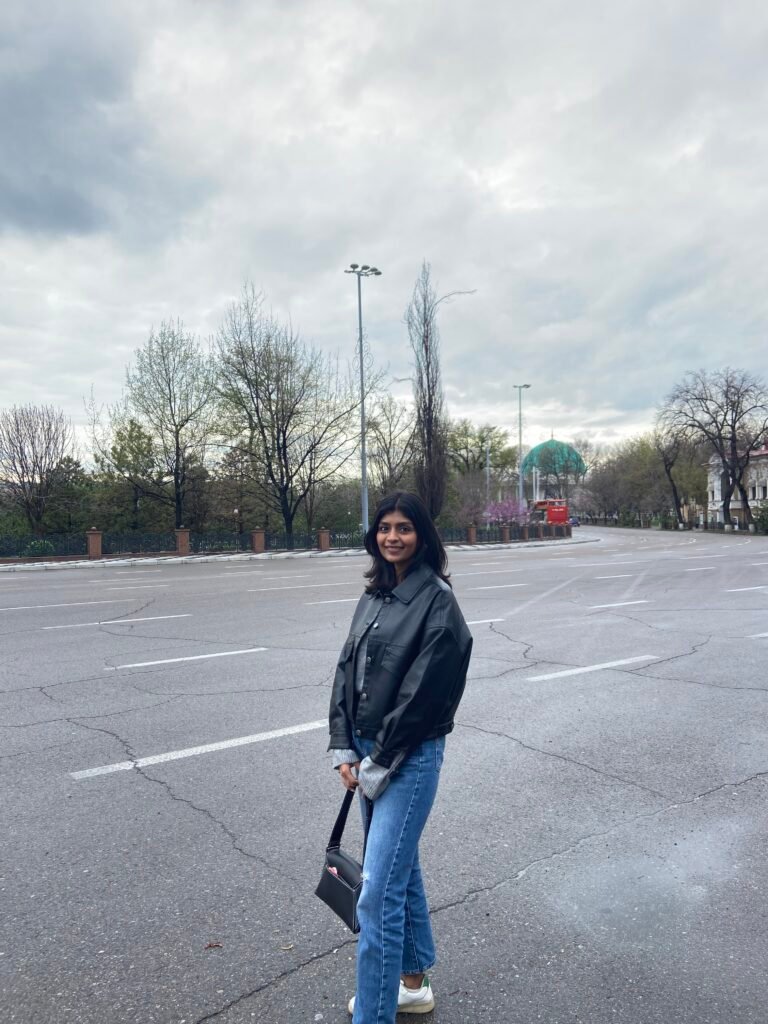
I have become a lot less afraid of not having everything figured out.
Earlier, I felt like I needed a clear plan. What is next, how things will play out, where I am headed.
Now I trust that things will work out when they need to. And more often than not, they work out better than I imagined.
I still have moments where I question things. But I don’t let that fear take over in the same way. If anything, I have started seeing uncertainty as part of the process rather than something to fix.
“More often than not, things work out better than I imagined.”
This is the closer this series needed. Not a neat resolution, not a list of lessons. Just a woman saying: I stopped needing to know how it would go, and it went better anyway. That is not advice. That is just what happened. And sometimes that is the most useful thing you can say.
A Note From Decoding Draupadi
What stayed with us after this conversation is Mallika’s first filter for good work: does this make us feel something?
We think that applies beyond marketing. To the conversations we have, the content we read, the communities we choose to be part of. If it doesn’t make you feel something, it probably isn’t worth your time.
We built this series to make women in brand roles feel something. Seen, understood, a little less alone in the middle of figuring it out.
If this did that for you, share it with someone who needs it.
— End of Interview —
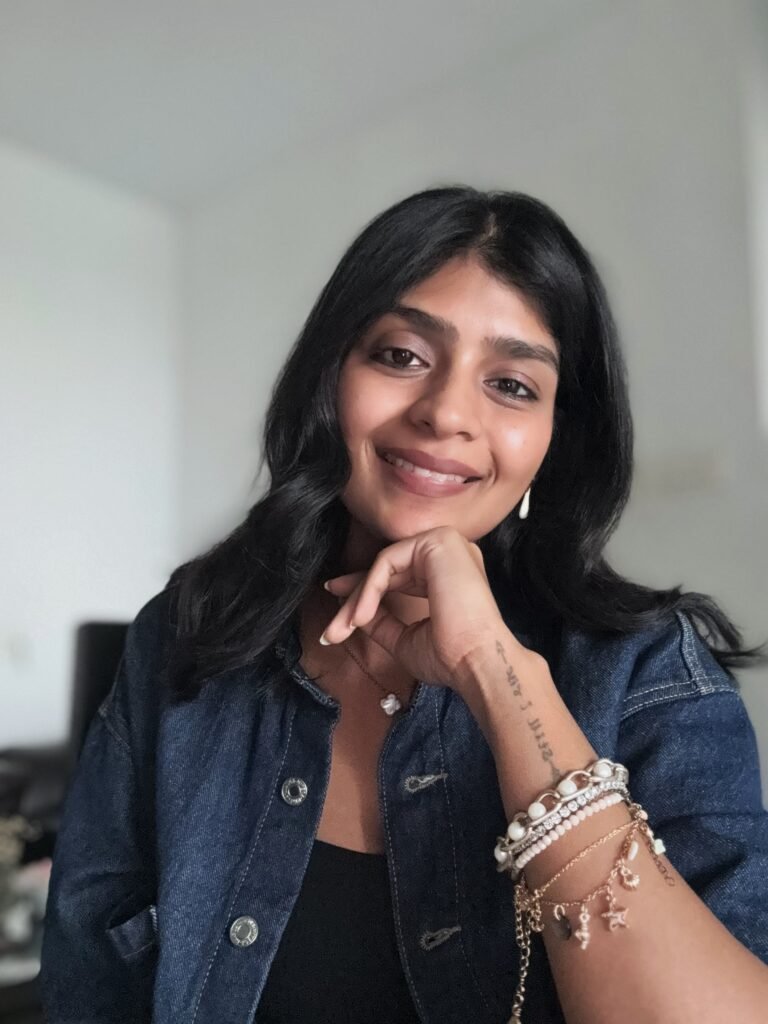
Mallika Fatehpuria is a marketer and content creator. This interview was conducted as part of the Decoding Draupadi Brand Manager Series.
We built this for the woman who is still figuring it out and doing brilliantly anyway. If that is you, you belong here. @decodingdraupadi.