
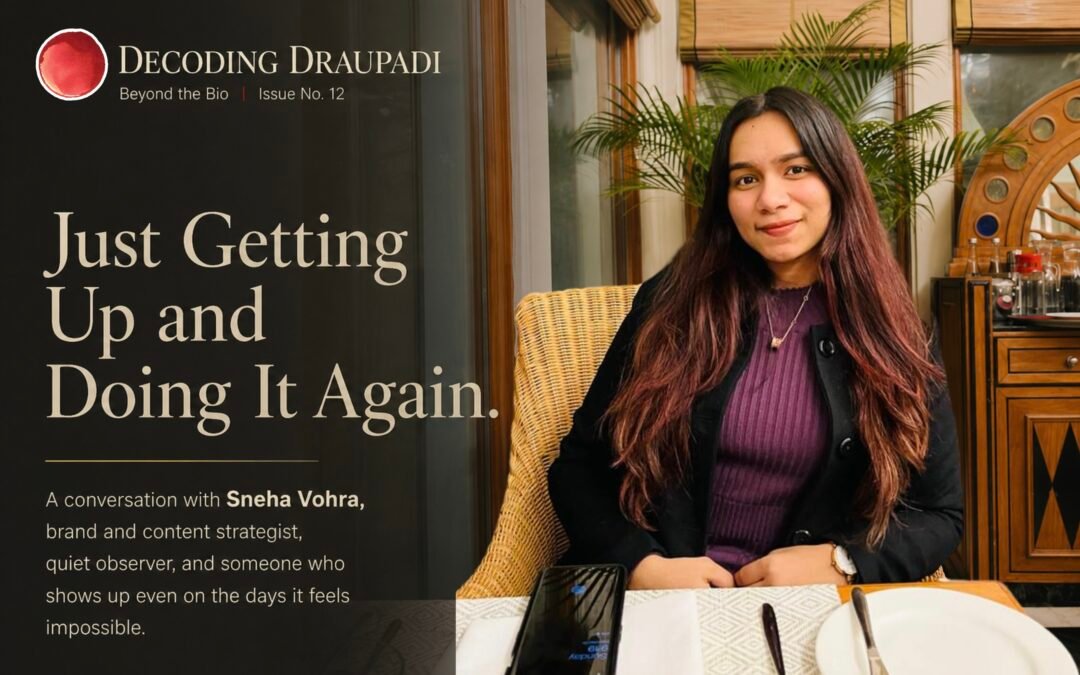
A conversation with Sneha Vohra, brand and content strategist, quiet observer, and someone who shows up even on the days it feels impossible.
Sneha Vohra thinks carefully before she speaks. You can tell from her answers: precise, honest, occasionally uncomfortable in the best possible way. She works at the intersection of brand marketing, content strategy, and influencer ecosystems, and writes publicly about what she observes. That means she has spent a long time watching how things actually work versus how they are supposed to.
She studied architecture before she found her way into marketing, quotes the Bhagavad Gita and Tamasha in the same breath, and describes herself as not fully figured out, not always strong, but quietly resilient.
We asked her the questions most people skip over. She did not.
ON BEING MANY PEOPLE IN ONE DAY
Most of us are never just one person. Not your title, not your bio. Who is Sneha right now, across the different lives you are living?
If you met Sneha on a random Tuesday, you would probably meet different versions of me every few hours.
Morning Sneha wakes up slightly confused about life but still shows up. She makes coffee, opens her laptop, and tells herself, okay, today we will figure work out. Because somewhere along the way, the thing of how I loved being creative has started feeling structured, boxed, a little too corporate. And I think I am in this constant tug-of-war now, trying to not let that part of me die, while also wanting to genuinely enjoy what I do. Some days I win, some days I just pull off my deadlines.
By afternoon, I am in my functioning adult era. Replying to messages, cracking jokes in between, being that friend who listens to everything. Relationship drama, career confusion, random existential spirals. I like being that person. The one who notices things, who remembers details. But also, my friends do not let me get away with too much. I try to be the sorted, low-maintenance one, but they have seen my occasional tantrums. Okay, fine. Fewer tantrums now.
Evening Sneha goes home and switches roles without announcing it. Suddenly I am the tu badi hai, tu samajh le person. The responsible one. The one who does the right thing, says the right thing, absorbs more than she reacts. It is like I have been cast in this role for so long, I do not even question it anymore.
And then there is night. Night Sneha is the most honest version. A little tired, a little overwhelmed. That is when the thoughts get loud. The what am I doing, the am I enough, the how long can I keep going like this kind. I think that is where I feel the weakest. There are days it genuinely feels like I cannot take it anymore.
But the strange part is, I still wake up the next day. No big breakthrough, no dramatic clarity. Just getting up, showing up, doing it again. I think that is who Sneha is right now. Not fully figured out, not always strong, but quietly resilient. The kind of person who does not always have the answers, but does not really have the option to stop either.
“Not fully figured out, not always strong, but quietly resilient. The kind of person who does not always have the answers but does not have the option to stop either.”
We hear versions of this from almost every woman we sit down with. The morning self, the professional self, the responsible one at home, and then the night self that nobody sees. What Sneha does here that most people do not is say it out loud. The nights are hard. The thoughts are loud. And she still shows up. That is not a small thing. That is the whole thing.
ON WHAT ACTUALLY MAKES CONTENT WORK
What has shaped the way you understand what actually makes content or influence work, beyond just reach or numbers?
I think I had to unlearn the idea that numbers have an equal impact. On the surface, this space looks very measurable. Views, likes, shares, followers. Everything has a number attached to it. But the more I have worked on it, the more I have realised that what actually works is usually happening in places you cannot fully quantify.
You do not follow someone because they posted five times a week. You follow them because something about them feels familiar, or aspirational, or just real in a way that is hard to fake.
A lot of my understanding has come from observing how people behave, including myself. The content I save, the creators I keep going back to, the brands I subconsciously trust. It is rarely the most polished or the most strategic piece. It is the one that feels intentional but not forced.
That is where influencer ecosystems get interesting. The creators who actually influence are not the ones shouting the loudest. They are the ones who have built credibility over time. You start feeling like, if they are saying it, it probably matters. That trust is the real currency.
What really makes something work is whether it makes someone feel something enough to remember it later, or act on it without feeling like they were sold to.
“The creators who actually influence are not the ones shouting the loudest. They are the ones who have built credibility over time.”
This is the tension at the heart of every brand conversation happening right now: how do you be strategic without looking strategic? Sneha names it clearly. Trust is the real currency, and trust cannot be manufactured at scale. It is built slowly, through consistency and something that feels real. Every brand manager reading this already knows this. The hard part is convincing the room that reach is not the same thing as resonance.
ON WRITING PUBLICLY AND THINKING BETTER
What has writing and sharing your perspective publicly taught you about how you think, not just how you communicate?
I think writing has exposed how non-linear and sometimes contradictory my thinking actually is. In my head, everything feels clear. But the moment I try to put it into words, I realise a lot of my thoughts are still forming or sitting in a grey area. And over time, I have become okay with that. Writing has made me more comfortable with figuring things out in public instead of waiting to have a perfect, final opinion.
At the same time, it has also made me more responsible about what I put out. If something does not feel clear, I end up going deeper. Reading, researching, looking at existing articles and case studies. So my thinking becomes a mix of instinct and informed perspective, not just surface-level takes.
Along the way, I have also become more aware of how I observe things. I notice patterns in people, behaviour, and what actually connects. And writing helps me translate that in a way that others can relate to. So it is not just about communicating better. It is thinking better, with more clarity, more context, and learning a lot more about myself and the people I am trying to speak to.
There is a version of building a public voice that is purely performative, and then there is Sneha’s version. She is not writing to be seen. She is writing to understand. That distinction matters, and it also explains why her perspective tends to land differently. The content that sticks is almost always made by someone who was genuinely trying to figure something out, not someone trying to appear like they already had.
ON DOING GOOD WORK IN SILENCE
When there is no external validation, no praise, no visible win, how do you know you are doing good work? What tells you that you are on the right track?
I do not think I always know. There are days when it genuinely feels like I am just putting things out there and hoping something clicks. No big wins, no clear signals, just consistency.
But over time, I have started noticing smaller, quieter markers. Like when something I worked on feels right to me before anyone else reacts to it. Or when I can see my own thinking getting sharper compared to a few months ago. That internal shift matters more than I used to admit.
I think a big part of this comes from studying architecture. You get used to putting in hours of work that not everyone sees or fully understands. Sometimes the credit is delayed, sometimes it does not come at all. But you still show up, you still build.
There is a line from the Bhagavad Gita that really stays with me:
Karmanyevadhikaraste ma phaleshu kadachana. The competition now feels less external and more internal. Am I better than who I was a few months ago? Am I still showing up even when it feels pointless? If the answer is mostly yes, that is usually enough.
“Am I better than who I was a few months ago? Am I still showing up even when it feels pointless? If the answer is mostly yes, that is usually enough.”
The architecture background is not a throwaway detail here. There is a particular kind of endurance that gets built when your work takes years before anyone can see it. You learn to trust your own process because you have no choice. Sneha has carried that into marketing. And the internal benchmark she describes, not am I doing well compared to others, but am I sharper than I was, is one of the most sustainable ways to measure yourself in any creative field.

ON AMBITION SHIFTING FROM PROVING TO BECOMING
How has your relationship with ambition evolved? What does ambition look like for you now?
I think earlier, ambition for me was very outcome-driven. It looked like clear milestones. A certain role, a certain salary, a certain kind of life that felt sorted. There was a lot of urgency in it, like I needed to get somewhere quickly to feel like I was doing okay.
But somewhere along the way, that definition started feeling a little empty. Because even when you get close to those things, the feeling does not last as long as you expect it to.
Now, ambition feels a lot more internal. It is less about chasing a fixed end goal and more about the kind of person I am becoming in the process. Am I still curious, still thinking deeply, still doing work that feels meaningful and not just performative?
I still want the external things. The growth, the success, the recognition. But right now, ambition looks like building a life where I do not lose myself in the process of achieving things. Where I can still stay creative and still feel something about the work I do.
I think ambition has shifted from proving something to the world to being a little more honest with myself about what actually matters.
“Ambition has shifted from proving something to the world to being a little more honest with myself about what actually matters.”
The urgency Sneha describes from her earlier years is something we recognise across almost every conversation in this series. The feeling that you need to get somewhere fast, that timelines matter, that being behind is a real thing. What shifts, for most of the women we speak to, is the slow realisation that the finish line keeps moving. And at some point, the question stops being how do I get there and starts being what kind of person do I want to be while I try.
ON STARTING BEFORE YOU ARE READ
Looking back at where you are now and where you started, what would you want someone just beginning their journey to worry less about?
I think I would tell them to worry less about getting it right from the start. In the beginning, there is so much pressure to choose the perfect path, the perfect role, the perfect direction. Like one wrong move and everything falls apart. But in reality, most of us are just figuring things out as we go.
Experiment a lot before you try to find your calling. Travel if you can. Create things. Write. Try different kinds of work. Follow what interests you, even if it does not make perfect sense on paper. That phase is not a distraction. It is actually where you discover what feels right and what does not.
As Tamasha puts it so simply: Wahi karo jo tumhe khushi de. Warna tum kisi aur ki zindagi jee rahe ho.
And maybe most importantly, worry less about having it all figured out early. Clarity usually comes after you start, not before. So just start. Try things, change directions, get it wrong a few times. The certainty you are waiting for is not going to arrive before you move. It arrives because you did.
“Clarity usually comes after you start, not before. The certainty you are waiting for arrives because you moved, not before.”
She quotes the Gita and a Bollywood film in the same interview and somehow it all holds together. Because she is not performing wisdom, she is sharing what actually got through to her. And the advice she is giving, start before you are ready, let the path be messy, stop waiting to feel certain, is the same thing every woman in this series has arrived at through her own version of the hard way. Some things you just have to learn by doing.
A Note From Decoding Draupadi
What stayed with us after this conversation was the image of night Sneha. The one who is a little tired, a little overwhelmed, asking herself if she is enough.
We think that version of her is the one most women in brand circles never show anyone. The professional self, the dependable friend, the responsible one at home, those are the versions people see. The night version stays private.
That is exactly why we built this series. Because those private versions of women in this industry deserve to be spoken about out loud. Not to perform vulnerability, but to remind each other that we are all in it.
If this felt like someone you know, or someone you are, share it with her.
— End of Interview —
Sneha Vohra is a brand and content strategist. This interview was conducted as part of the Decoding Draupadi Brand Manager Series.
If this felt like someone you know, or someone you are, share it with her. Come find your people @decodingdraupadi.