
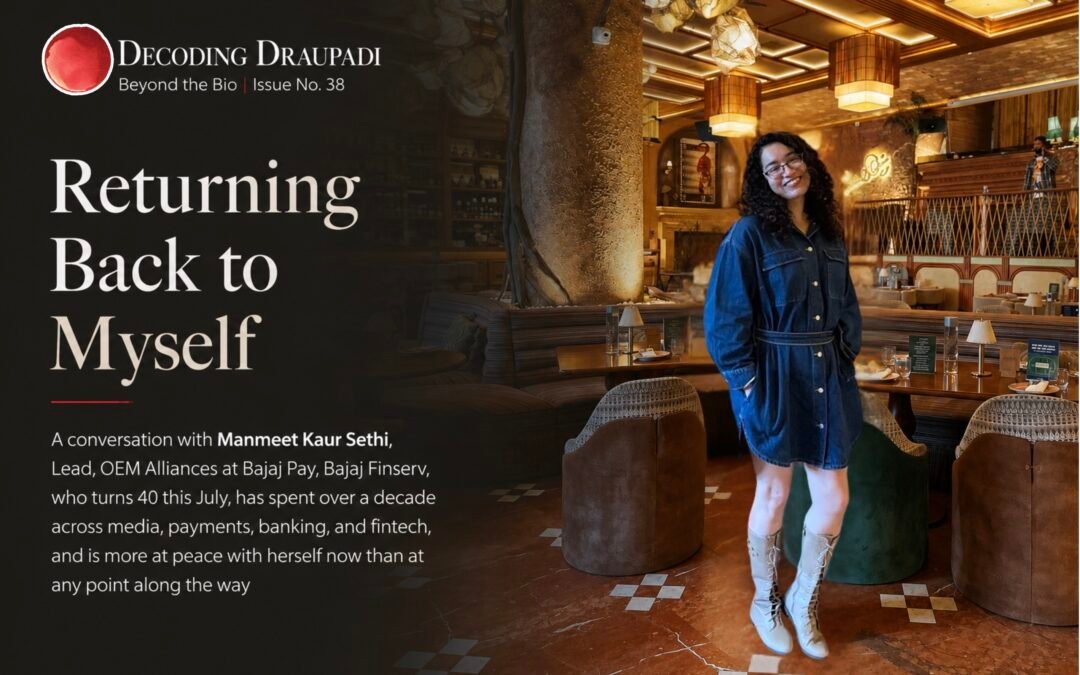
A conversation with Manmeet Kaur Sethi, Lead, OEM Alliances at Bajaj Pay, Bajaj Finserv, who turns 40 this July, has spent over a decade across media, payments, banking, and fintech, and is more at peace with herself now than at any point along the way
Manmeet Kaur Sethi turns 40 in July. She has built her career across media, payments, banking, fintech, and now strategic partnerships at Bajaj Pay. She met fifty matrimonial prospects by the age of 26 because she came from a traditional Sikh family that expected her married by 23.
This conversation is not really about any of those facts individually. It is about what happens to a person across the years between meeting fifty strangers chosen by your family and arriving, at almost 40, in full acceptance of exactly who you are.
Returning Back to Myself
Who is Manmeet right now, across the different lives you are living?
She is turning 40 in July, and she is going through a lot, personally and professionally, at the same time. She describes herself as being in a stage of deep introspection. Not a 20-year-old anymore. Society expects a certain maturity, certain milestones, by 40. In her case, not all of those milestones look the way they were supposed to. But when she looks at herself outside society’s eyes, through her own journey, she is in a very stable space. Happy with what she has built. Genuinely excited about turning 40.
In her 30s, she learned to be more authentic, less of a people-pleaser, particularly difficult in a client-servicing profile where the instinct is always to accommodate. Today she would describe herself, in a single line, as returning back to herself.
She names the pressure plainly: in your 20s, you are told how the world operates, how to behave professionally, when to get married, when to have children. That builds a quiet, accumulating pressure in your mind. What she has arrived at instead is full acceptance: her flaws, her strengths, all of it. She loves who she is.
She also names where some of that pressure actually came from. Coming from a traditional Sikh family, she was expected to be married by 23. She met at least fifty prospective matches by the time she turned 26. Over the years, her own perspective changed, her parents’ perspective on marriage and companionship changed, and she moved from a girl who fantasised about a partner the way films depict it, to a woman who became more independent and put together than any of those films imagined.
Underneath the social pressure, she identifies something more specific and more personal: in a family where her father’s brothers all had sons, and she and her sister did not have that, she built a private resolve, even as a child, to prove she was no less than a boy. Not because anyone explicitly said this to her, but because of the comments that surrounded her growing up. Looking back now, she recognises that pressure as something she built in her own mind more than something the wider world imposed.
“In a line, I would probably say that I am returning back to myself.”
She is careful to locate the pressure precisely: not abstract society, but two or three specific people and their specific comments, repeated enough times in childhood that they became a private vow. Those people and their comments do not exist in her life anymore. The pressure persisted long after they were gone. Naming that gap, between where pressure originates and how long it outlives its source, is one of the more honest things said in this series.

Look at the Person, Not Just the Professional
Your career has moved across media, payments, banking, fintech, and strategic partnerships, but a common thread seems to be building relationships that create long-term value. What have these years taught you about trust? Is it something you build through process, or does it always come down to people?
Early in her career, while handling sales for a brief stretch she never enjoyed, she came to her boss agitated about a client who was not returning her calls. Rude, unprofessional, she called him. Her boss gave her a piece of advice she has held onto since: do not look at this person only from a professional lens. Try a more personal approach. He might be going through something. He might be overburdened. There might be ten other people chasing him the same way you are.
That reframing changed how she approaches every relationship since. Today, ninety percent of the clients and partners she has worked with have become friends. The professional objectivity stays intact when it needs to, but the human understanding sits underneath it. When a partner says no to her now, she does not take it personally, because the trust between them has been built over years of seeing each other as people first.
She extends this principle to her own team. Some bosses expected her to keep delivering even while she was seriously unwell, and she does not extend them much respect in hindsight. Others showed a different instinct entirely: one told her, mid-shift, to stop working and go have dinner with her mother on her birthday, the work could wait until tomorrow. The contrast between those two kinds of bosses, she says, depicts a lot about what actually changes a person’s experience of work.
“Don’t look at this person only from a professional point of view. Try to have a more personal approach. Maybe he’s going through something.”
She names something simple and easily lost in any client-facing or partnership-heavy role: trust is not a process you can fully systematise. It is built by treating the person on the other side of the table as a person, consistently, even when it would be easier and faster not to.
Compassion Going Up. Boundaries Going Down.
What do you think people misunderstand about leadership as they move into more senior roles?
She got a leadership role early, in part because the startup culture of the time was handing out senior titles faster than people were genuinely ready for them. Two things stand out from that experience.
First: at a junior level, you understand certain behaviours because you have lived them. If a team member asks for a Friday off citing illness, your first instinct, once you move into leadership, is suspicion: long weekend, just an excuse, because you yourself have done exactly that in the past. The mistake, she says, is becoming strict about behaviour you once practised yourself, rather than holding onto the perspective you had at the junior level. Being elevated to a certain title does not make you smarter or more deserving of compassion than the people reporting to you.
Second, and more complicated: at a certain level, you also have to maintain a degree of boundary. She has been promoted above people she used to work alongside as peers, and over time, those same people can start taking the relationship for granted, making it harder to get work done. Building a healthy boundary, where people understand what they owe you in terms of reporting and performance, without losing the compassion from the first point, is the real balancing act of moving into leadership.
“Just because I’ve been elevated to a certain profile doesn’t mean I’m above them or smarter than them. You still need that compassion.”
Most leadership advice picks one side of this tension and stops there: be kind, or be firm. She is naming both halves as necessary and describing the actual difficulty of holding them simultaneously, which is closer to how leadership is actually experienced day to day.

The Fear That Never Fully Leaves, and Never Gets Shown
What is one fear you have learned to perform with confidence around, even if it still exists underneath?
The fear of losing her job has been with her since the start of her career, because she became the sole breadwinner for her family early on. It happened once: a startup she worked for shut down, and she had to find a new job within her notice period. She was lucky to land one in a month. The fear never fully left after that, even once she had built a financial safety net that could carry her for a year without work.
What she does not do is show that fear to the people around her. She does not let it dictate how she behaves, how loudly she speaks up, what she is willing to push back on. At one organisation, during a difficult personal period, she became uncharacteristically timid, and within about six months she noticed her boss’s expectations had quietly expanded to fill the space her fear had created. The moment she raised her voice and said this is enough, the dynamic shifted, and the work culture became noticeably better for her.
“The moment somebody realises you’re in dire need of the job, they have more power over you. The day I raised my voice, he stepped back.”
This is a precise account of how fear gets exploited, often without anyone consciously deciding to exploit it. Expectations simply expand into whatever space goes uncontested. The correction she describes, raising her voice once and watching the dynamic reset, is not really advice. It is closer to an observed mechanism, and it is worth taking seriously as one.
More Vocal. Less Personal About Rejection.
Is there a part of your personality that has become stronger with time, and another part you have had to consciously let go of?
Stronger: her willingness to be vocal. She is no longer afraid to tell a room full of senior people, regardless of what they think of her for it, that something will not work. It has always worked in her favour. People tend to respect being challenged on substance more than they resent it.
What she has consciously let go of is taking professional rejection personally. Earlier in her career, if a boss or senior leader did not like an idea she had researched and prepared carefully, she would spiral into questioning whether they disliked her specifically. She has realised, over time, that ninety percent of the time it has nothing to do with her. It is an organisational decision, not a verdict on her worth. If an idea does not land, she moves on to the next one rather than burning energy wondering why.
“If somebody is being really cruel to you or saying something bad, it has a lot more to do with them than with you. The insecurity comes from them.”
She extends this principle past professional feedback into outright hostility. She describes colleagues who treated her badly from day one simply because she had been hired at a higher package, something she only learned the reason for a year later. Her conclusion, that the hostility was never really about her, is a genuinely useful reframe for anyone trying to figure out how much of someone else’s behaviour to carry.

Your Career Is a Part of Your Life. Not the Entire Thing.
What is something you have changed your mind about in the last few years?
That everything happening to her did not need to be taken so personally, a lesson she learned the hard way. Among her close circle of professionally accomplished women, mostly the same age, some entrepreneurs, she noticed a pattern: their conversations used to revolve entirely around work. At some point she realised they had made their professional lives their entire lives, rather than one part of a fuller one.
Her corrective is not to dismiss career as unimportant. It is to build other buckets alongside it. If someone goes through a breakup and throws themselves entirely into career as the only outlet, that instinct is not wrong, but it should not become the whole strategy. There is room for starting something of your own, picking up a hobby, joining a community, doing something with no professional payoff attached to it at all.
“Your professional life is a part of your life. It is not your entire life.”
This echoes a pattern that shows up across several conversations in this series: a generation of accomplished women who built careers as a form of proof, and are now, mid-career, consciously rebuilding the rest of the architecture around that career rather than letting it stand alone.
Hyper-Independent, With Healthy Boundaries
If someone met you five years from now, what do you hope they would notice has changed about you, beyond your job title?
People who have known her for around a decade describe a shift everyone notices: she used to be extremely pampered, and extremely sensitive. She still considers that sensitivity one of her biggest strengths, because it lets her understand people more deeply. But she has built boundaries around it that did not exist before. She no longer gives everyone in her life unrestricted access to her, a deliberate choice made for her own wellbeing and mental health.
She also used to be intensely extroverted, available at any hour, any location, for anyone who asked. Today, her energy goes toward building something more concrete for herself, something that will last and that genuinely belongs to her, rather than spreading evenly across every social invitation. She still enjoys a night out or a date. But the majority of her energy is now directed at things she wants to hold onto over a long period of time.
“I’ve diverted my energy towards things that really matter to me. I want to build something more concrete for myself, something I can hold onto for a longer period of time.”
The shift from hyper-availability to hyper-independence is rarely framed this honestly. She is not describing a loss of warmth. She is describing a redirection of it, toward fewer things, held more deliberately.
A Note From Decoding Draupadi
What stayed with us is the gap she names between where pressure starts and how long it lasts. The specific people whose comments shaped her ambition as a child are no longer in her life. The pressure they planted outlived them by decades. She is only now, at almost 40, fully examining where that pressure actually came from and whether it still holds any value.
That kind of retrospective honesty, looking back at the entire arc rather than just the most recent chapter, is rare. Most career conversations stay in the present tense. This one did not, and it is better for it.
If this felt like someone you know, share it with her.
Your professional life is a part of your life. It is not your entire life. She learned this the hard way, alongside a whole circle of accomplished women her age. Full interview at @decodingdraupadi.
Manmeet Kaur Sethi is Lead, OEM Alliances at Bajaj Pay, Bajaj Finserv. This interview was conducted as part of the Decoding Draupadi Brand Manager Series.