DECODING DRAUPADI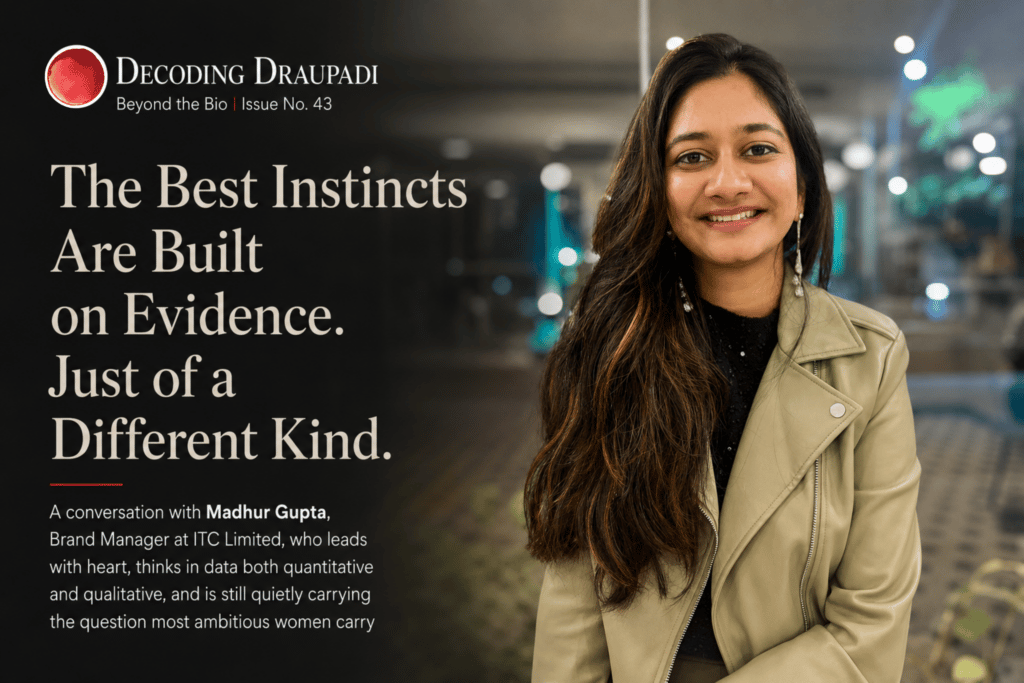
A conversation with Madhur Gupta, Brand Manager at ITC Limited, who leads with heart, thinks in data both quantitative and qualitative, and is still quietly carrying the question most ambitious women carry
Madhur Gupta is Brand Manager at ITC Candyman. She is also, by her own description, someone who leads with heart regardless of the room she is in, who believes the strongest instincts are actually built on evidence rather than in spite of it, and who is carrying a question she names plainly: how do you build an ambitious career without letting structural and societal expectations limit it?
This conversation is sharp, specific, and worth reading slowly.
Someone Who Leads With Heart
Who is Madhur right now, across the different lives you are living?
She leads with heart, regardless of the role she is playing. Whether at work, with friends and family, or reflecting on her own journey, she is deeply people-centric. She values empathy, meaningful relationships, and showing up for the people around her. She cares about doing good work, but equally about how that work impacts others.
She also believes growth is a continuous process. She is aware of her strengths, but just as aware of the areas where she can improve. She tries to approach both with humility, curiosity, and a genuine desire to keep learning.
If there is one thread through all the different versions of herself, it is this: she is always striving to be a better professional, a better friend, and a better person than she was yesterday.
“I’m always striving to become a better professional, a better friend, and a better person than I was yesterday.”
The thread she identifies is not a skill or a personality trait. It is a direction: always slightly ahead of where you were. That is a more honest description of what drives consistent growth than most people manage to articulate.

The Best Instincts Are Built on Evidence
You have worked across brand management and marketing in some of India’s most competitive consumer categories. Do you think great marketing is data-led, instinct-led, or something else entirely?
Great marketing is almost entirely data-led, she says. But we define data too narrowly.
Quantitative data, market share, campaign performance, pricing, distribution, consumer metrics, is the baseline. It tells you what is happening and is indispensable for high-impact business decisions. But qualitative data is equally valuable: conversations during market visits, consumer immersions, observing shopping behaviour, understanding cultural nuances, hearing the language people actually use. These are also data. They tell you why something is happening and regularly uncover opportunities that numbers alone cannot.
The mistake, she says, is labelling quantitative inputs as data while dismissing qualitative inputs as instinct or gut feel. The best instincts are usually built on repeated exposure to consumers and culture. Senior leaders and great marketers often give enormous weight to what comes out of market visits and consumer immersions: the opinions shared, the behaviours observed, the language people use. That is what gets called gut feel. It is actually data. Just of a different kind.
The strongest marketing happens when both forms come together: numbers provide direction, human insights provide meaning.
“The best instincts are usually built on repeated exposure to consumers and culture. They’re informed by evidence, just of a different kind.”
This reframe is genuinely useful. The data versus instinct debate is one of the most persistent in marketing, and it tends to produce bad outcomes on both sides: marketers who will not move without a statistically significant dataset, and marketers who trust their gut over contradictory evidence. She names a third position that is more accurate than either.
Growing, or Just Getting Better at the Same Things?
What is something you are still figuring out privately, even though externally your career may look very sorted?
She is constantly asking herself whether she is still growing, or just getting better at doing the same things. The question matters to her. She wants to look back years from now and feel she used her time well: kept learning, stayed curious, created meaningful impact, and added real value wherever she worked.
The other question she thinks about is one many women quietly carry: how do you build an ambitious career without letting structural and societal expectations limit it? Whether it is balancing family responsibilities, navigating unconscious bias, or simply ensuring your aspirations do not become negotiable, it is something many women are continuously figuring out.
She does not have all the answers yet. But she knows what she wants: a career defined by growth, contribution, and choice, not by the limitations placed on her.
“I want to build a career defined by growth, contribution, and choice, not by the limitations placed on me.”
She names the question most ambitious women carry and rarely say aloud in a professional context: that the ambition itself is subject to forces that have nothing to do with ability. Naming it plainly, without making it the whole story, is the right way to hold it.

From Urgency to Purpose
Do you think ambition becomes healthier or more exhausting as people grow older?
Healthier, she says. As you grow, your frame of reference expands. You meet more people, learn from different leadership and work styles, and become better at managing complexity and balancing multiple priorities.
Challenges do not necessarily become easier. But you become more equipped to handle them. Over time, ambition shifts from being driven by urgency to being guided by purpose. It becomes less about doing more, and more about doing work that creates meaningful impact and keeps you learning.
“Ambition shifts from being driven by urgency to being guided by purpose. Less about doing more, and more about doing work that creates meaningful impact.”
Urgency to purpose is one of the cleaner descriptions of how ambition matures across this series. Urgency is external, comparative, reactive. Purpose is internal, directional, chosen. The energy behind both can look identical from the outside. The experience of each is entirely different.
The Glamour Is in the Idea. The Value Is in the Execution.
What is one thing about the marketing and branding industry that people glamorize too much from the outside?
The advertising and social media side, and she is quick to add: rightly so. It is absolutely exciting. The big ideas, the campaigns, the shoots, that part deserves the attention it gets. The problem is not that it is glamourised. The problem is that credit stops there, and execution rarely gets the same visibility.
The real work is in execution: aligning teams, managing stakeholders, refining details, and ensuring the idea actually delivers business impact. The glamour is in the idea. The value is created in the execution.
“The glamour is in the idea. The value is created in the execution.”
She says this as someone who works in the FMCG category at ITC, where execution is the job. The creative brief is a starting point. What follows it, the weeks of alignment, refinement, and delivery, is where the brand either works or does not. She knows which part most people never see.

When Strategy Becomes Impact
What kind of work gives you the deepest sense of meaning or excitement, the kind that reminds you why you entered this field in the first place?
The moment when strategy translates into impact. Numbers moving: market share, sales, campaign performance. And alongside those numbers, real-time consumer feedback on a product or a piece of communication. That is when marketing stops being a hypothesis and becomes something that has genuinely resonated with people.
“That’s when marketing stops being a hypothesis and becomes something that has genuinely resonated with people.”
She names two things, not one: the numbers and the feedback. Both matter because neither alone is sufficient. Numbers tell you that something happened. Consumer feedback tells you whether what happened was actually good. She wants both, which is a more demanding standard than most people hold themselves to.
Give Yourself the Grace You Extend to Others
If someone younger feels anxious because their career path looks non-linear or unconventional, what would you want to tell them?
Careers rarely make perfect sense while you are living them. They only seem linear in hindsight.
If you are genuinely giving your best, trust that effort has value, even when the path feels unconventional. And give yourself the same grace you so easily extend to others.
More often than not, a non-linear journey becomes your biggest differentiator. It gives you a unique perspective, richer experiences, and a story that is truly your own. In the bigger picture, you are probably doing much better than you think.
“Give yourself the same grace that you so easily extend to others. In the bigger picture, you’re probably doing much better than you think.”
The grace line is the one to hold. Most people who are hard on themselves for a non-linear path are not hard on other people for the same thing. She names that inconsistency directly and asks for the same standard to be applied inward. That is harder than it sounds and more useful than most career advice.
A Note From Decoding Draupadi
What stayed with us is the data question. She reframes what instinct actually is, not the absence of evidence but a different form of it, accumulated through repeated exposure to real people in real contexts. That reframe matters because it stops the debate between data and gut feel from being a debate at all. They are both data. The question is whether you are gathering both kinds.
The Q4 answer stayed with us too. She names the question many ambitious women carry without naming it, because naming it feels like making it too big or too personal or too political. She names it plainly: how do you build an ambitious career without letting structural and societal expectations limit it? That is not a complaint. It is a question she is actively working on. That distinction is worth noting.
If this felt like someone you know, share it with her.
Give yourself the same grace that you so easily extend to others. In the bigger picture, you are probably doing much better than you think. More at @decodingdraupadi.
Madhur Gupta is Brand Manager at ITC Candyman, ITC Limited. This interview was conducted as part of the Decoding Draupadi Brand Manager Series.