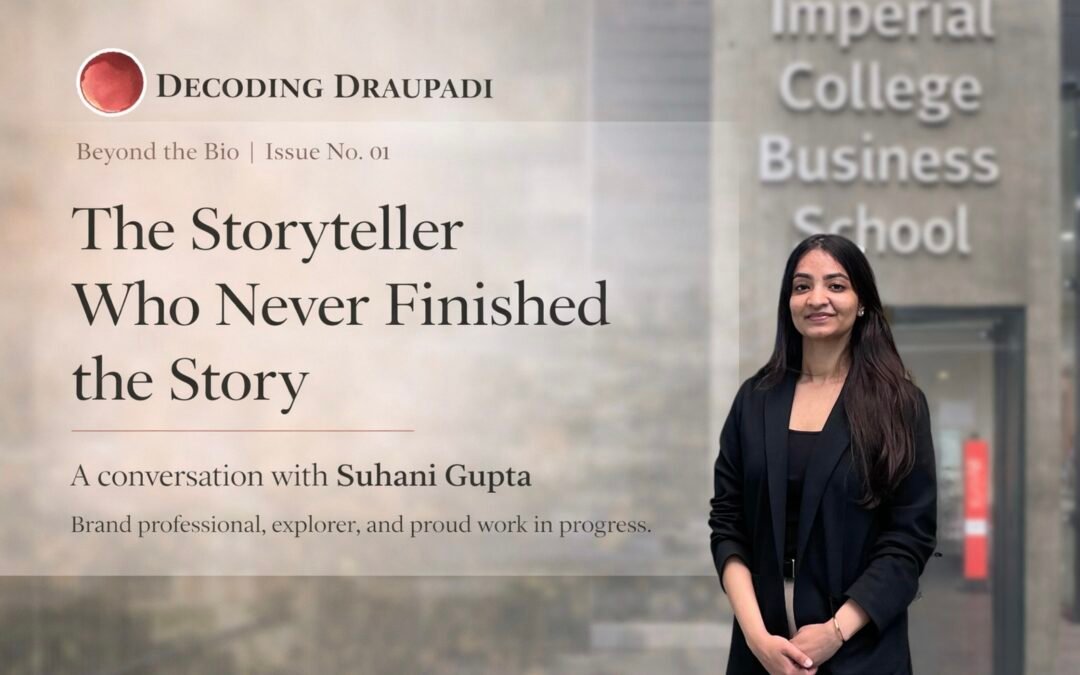
A conversation with Suhani brand professional, explorer, and proud work in progress.
There is a particular kind of woman who refuses to be summarised. She has the degrees, the career pivots, the international chapters and yet none of it quite captures who she actually is. Suhani is one of those women. A strategic marketing professional who started in engineering, circled through software, finance, and consulting, and landed intentionally in brand work. At 27, she manages a team, studies what she loves, and still calls herself a work in progress like it’s a badge of honour. Which, to her, it absolutely is.
We asked the questions that don’t usually make it into a job interview or a LinkedIn bio. The kind of questions that make you pause. She answered them all honestly, warmly, and with the ease of someone who’s long made peace with not having it all figured out.
On Identity Who She Is Right Now
Most of us are never just one person. We’re someone at work, someone at home, someone in our private thoughts. So when I ask this, not your title, not your bio, who is Suhani right now, across the different lives you’re living?
The first word that comes to mind is storyteller. That’s it. Nothing else. No other label. I want people to associate me with storytelling, and I try to be a good one every day. I won’t say I’ve arrived there. Personally, I’m a sucker for experiences. I love stories: the ones that happen to me, the ones around me, the ones I read, the ones I watch. Professionally, working in marketing means I have to sell stories, to connect with people. And I think storytelling is the thing that ties it all together.
Secondly, I’m an explorer. A lot of my friends call me free-spirited, and I own that. I don’t like limitations. I don’t want you to put me in a silo and say this is the path, do this, then that. I need room to evolve, to adapt. My journey has been unconventional by every metric science to engineering to marketing, then a 360 degree professional shift. I try new things constantly, not because I’m restless, but because I believe you have to put yourself in uncomfortable, unfamiliar situations every now and then to grow. It could go well. It could go badly. Either way, I learn.
And third I’m a work in progress. Genuinely. And I want to stay that way till the very end. I remember someone once said in a classroom: the key to staying young is learning and unlearning every day. That stayed with me. If you stop letting yourself experience the hard and the good, you’re going to really miss out on life. So yeah storyteller, explorer, work in progress. That’s me.
“The key to staying young is learning and unlearning every day.”
Notice what she doesn’t say. No job title. No company name. No metric the world could rank her by. Just three things she’s chosen to be. And honestly? I think that’s the edit most of us need to make not on our CVs, but on how we introduce ourselves to ourselves. At Decoding Draupadi, this is the kind of self-definition we’re here for.
On the Gap Between Theory and Real Life
Studying strategic marketing while actively working in brand roles means living in two worlds at once: frameworks on one side, real audiences and real stakes on the other. What surprised you about how different the two can feel?
In a nutshell they are very different. There is no direct correlation in terms of textbook knowledge. You don’t walk out of a case study and into a boardroom applying those frameworks one-to-one. That’s just not how it works. Real life doesn’t give you a safe, structured environment with zero risk. Once something is out in the world, it’s out. A lot of decisions happen in the gut. You make your best call, and then you let go.
My master’s was actually immersive experiential learning, real-life projects, case studies across industries. My professors brought decades of real-world experience : PhDs, entrepreneurs, consulting partners, practitioners across industries. And those lessons live in me subconsciously. They’ve shaped how I think, even if I can’t always point to the exact framework I’m drawing from. So academic knowledge isn’t useless, it just works differently than you expect.
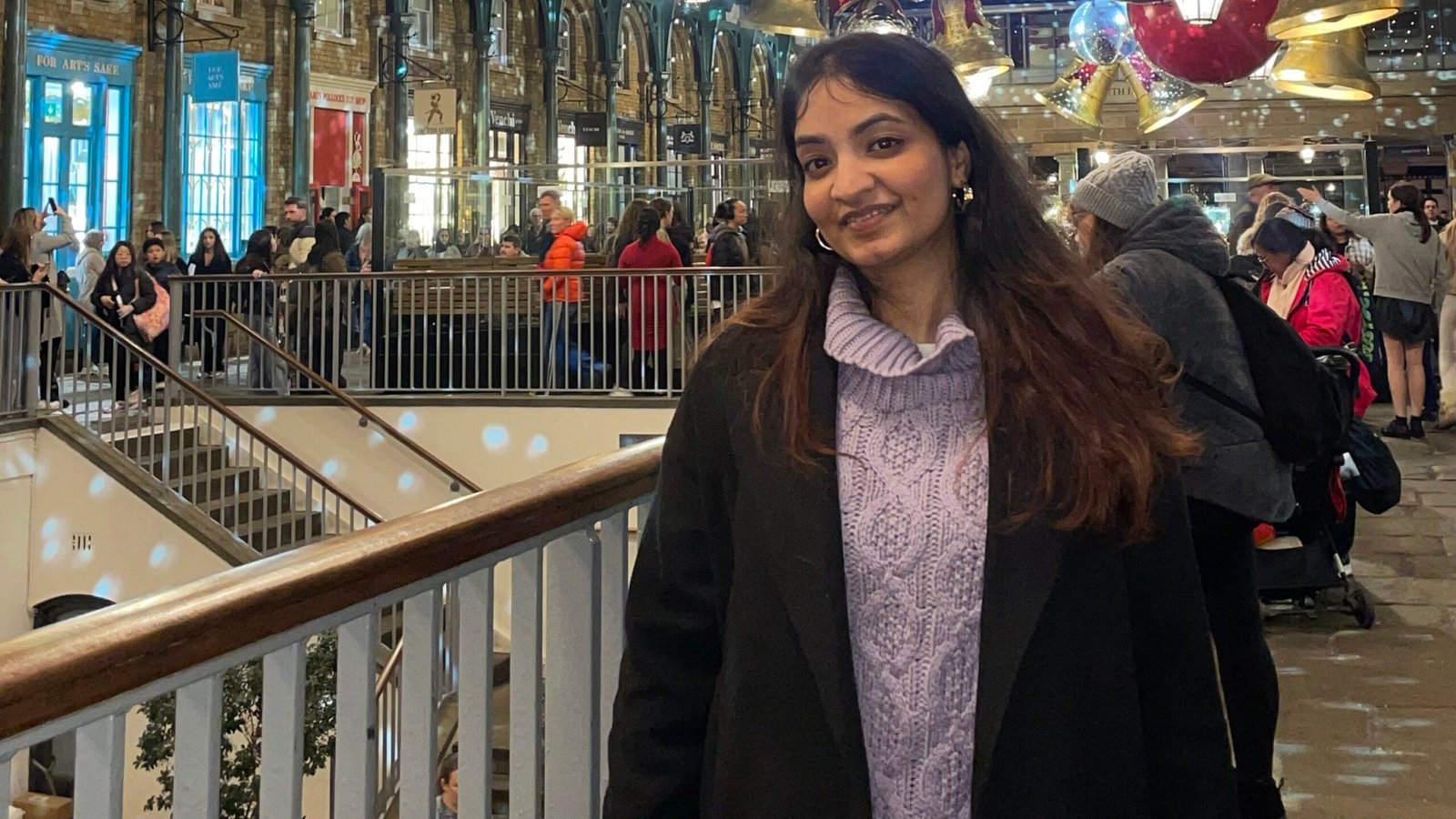
Where the correlation is very real, though, is in soft skills. Studying abroad, in a completely new environment, around people from 50 different nationalities that teaches you how to adapt fast. How to work under pressure. How to solve problems when there is no one looking out for you. And now, managing a team, I realise those experiences built my character more than any syllabus did. I listen better. I make sure everyone in the room feels seen and heard. That didn’t come from a textbook. It came from experience from being humbled, again and again.
The classroom gives you the map. Real work throws away the map and hands you a compass. I think about this a lot, how most of what I’ve learned has come from doing things before I felt ready, from figuring it out in motion. The education that actually sticks isn’t the kind you can cite. It’s the kind that lives in your instincts.
On Comparison and Learning to Stop
Comparison sneaks in easily through social media, career timelines, conversations we don’t even realise are affecting us. How does it show up in your life, and how do you deal with it?
I’m a human being at the end of the day. Comparison has always been part of my life growing up. That’s how our society is built, especially in India. You’re taught early on that you’re in a race, that you need to bag the top position, that your marks decide your future. Nobody tells you what a great life actually looks like. My definition of a great life might be completely different from yours.
I was lucky my parents supported me and encouraged me to pursue what I wanted. But even then, comparisons crept in everywhere. In school. In college, where CGPA became the currency. Then job titles. Then pay packages. When you see peers landing high-paying jobs and you’re still figuring things out, of course it lands on you. Society pushes a lot of it, but honestly, a lot of it comes from within.
Now? I can confidently say my only comparison is with myself. That shift took time and a lot of self-awareness. Everyone has a different timeline. We’re not in a race. There’s no common finish line. Comparing yourself to someone else is not only pointless, you don’t even know what their journey actually looks like.
Even now, there are days when imposter syndrome walks in. I might be the youngest in the room, and for a second I wonder if I belong. But then I remind myself: I’m here for a reason. My opinion matters as much as anyone else’s. Nobody is perfect. Don’t strive for perfection. Just try to do the best you can. Your best is going to look different from mine and that’s not a flaw, that’s just life.
“My only comparison is with myself. That shift took time and a lot of self-awareness.”
The part that got me was: it took time. She doesn’t dress it up as a revelation or a single mindset shift. It was slow, deliberate, and it still has bad days. I think we do each other a disservice when we make unlearning comparisons sound easy. It isn’t. It’s a daily choice. And naming that honestly is more useful than any motivational quote about running your own race.
On Money, Independence, and Space
There’s this idea that when people start earning their own money, the first thing they really buy isn’t an object it’s personal space. Space to choose, to say no, to breathe. What do you think? Has earning changed your relationship with freedom?
I consider myself privileged. I grew up in a household where I was given freedom of choice from a young age so earning didn’t unlock independence for me in the way it might for others. What it did was expand my world. It created another home, metaphorically. It opened up a bigger pool of resources, ideas, and people I wouldn’t have encountered otherwise.
If I had ten choices before, earning gave me fifty more. I still make my own decisions. I still say no. But my decision-making is richer now because my knowledge and awareness have grown. Money supported that lifestyle — but it wasn’t the source of my independence.
I’ve also seen how differently this works for other people how earning has genuinely uplifted lives, created safety, made options possible that simply weren’t before. My relationship with money is still evolving. I think it always will be. But I know that what it’s really buying, for anyone who starts earning, isn’t a thing. It’s permission to take up more space in your own life.
What I really appreciate here is that Suhani doesn’t claim a universal experience. She knows hers was different. And she holds both truths at once, her own story, and the awareness that for a lot of women, that first paycheck is genuinely the first time the word ‘no’ becomes available to them. That kind of self-awareness to hold your privilege without guilt and without erasing others’ reality is something worth paying attention to.
On Unlearning The Growth Nobody Talks About
Growth isn’t only about adding skills or experience it’s about unlearning habits, beliefs, or expectations we picked up early on. What’s something you’ve had to unlearn as you’ve grown?
So much. What I believed even a year ago may not be what I believe today. And I think that’s the most important thing, realizing how little you know. That humbles you in the best way.
We place so much value on pedigree, on background, on the laurels of the past. But you can’t live on past glory. The world changes. Industries shift. What worked brilliantly last year can become outdated overnight. If you hold too tightly to what you know, if you’re not willing to let go of certain beliefs and stay genuinely open it’s going to be tough.
I’ve been lucky to work with seniors who actually let us take risks, who are open to new ideas. That teaches you humility. It shows you how much is still left to learn. And that’s not a demoralising thought, it’s an exciting one. There’s always more. There’s always the next thing to understand, to try, to get wrong, and to eventually get right.
Unlearning is harder than learning, I think. Learning lets you add. Unlearning asks you to put something down, a belief you built, an identity you got comfortable in, a way of working that once made you feel capable. And that’s uncomfortable in a very specific way. What Suhani is describing is staying open, letting go of past glory is something I’m actively working on too. The willingness to be a beginner again, even when you’ve already done the work to not be one. That’s the real thing.
On Rest What It Actually Looks Like
Rest is often talked about but rarely protected. What does rest actually look like for you right now?
Honestly, rest for me is a complete reset of mind and body. I really crave a digital detox. We’ve been conditioned to always be productive. FOMO is real. But if you don’t choose to pause, life will eventually force you to.
Sleep is just one part of it. Every day you’re making decisions, investing energy, showing up in a hundred ways. What I’ve had to learn is that not everything has to happen right now. Parking something for tomorrow isn’t procrastination, it’s recharging.
Some days it’s okay to do nothing. Eat well. Sleep well. Watch a good film. That can be a productive day. Because if you don’t pause, you burn out. The world will keep moving whether you rest or not and that’s actually the whole point. You’re allowed to stop. The story keeps going. You get to decide when your intermission is.
“You’re allowed to stop. The story keeps going. You decide when your intermission is.”
I’ve been thinking about this one since she said it. We’ve made productivity a personality trait and I’m guilty of it too. There’s a version of me that feels uncomfortable doing nothing, that equates a slow day with a wasted one. But Suhani’s framing flipped something: rest isn’t falling behind. It’s part of the work. And honestly, intermission is such a good word for it. The show isn’t over. You’re just catching your breath before the next act.
On Advice What to Worry Less About
Looking back at where you are now and where you started, what would you want someone just beginning their journey to worry less about?
It is fine to not have it all figured out. Stop being so hard on yourself. You don’t need all the answers. It’s actually better to have questions to keep your curiosity alive. And curiosity is what will take you forward, not certainty.
It’s not about wins and losses. Things will keep happening. You’ll get one thing, then there will be something else. Life doesn’t stop and hand you a medal before the next challenge begins. So the only thing that actually makes sense is to focus on the journey, not the outcome we’ve attached to.
Every once in a while give yourself a pat on the back. You get past your rock bottoms. Whatever happens, happens for a reason. What feels like the best decision today may not even be the best thing available to you. The universe is waiting to give you bigger and better things. You will be fine. You will do great. Just live in the present.
“It’s better to have questions to keep your curiosity alive. And curiosity is what will take you forward.”
The thing about advice from someone who’s had to start over is that it lands differently. It doesn’t come from a comfortable place, it comes from the other side of something hard. And Suhani’s version of it isn’t a pep talk. It’s a permission slip. To not know. To not have arrived. To still be mid-story. Which, if you think about it, is all any of us are anyway.
— End of Interview —
Suhani is a brand professional and strategic marketing postgraduate currently based in India. This interview was conducted as part of the Decoding Draupadi Brand Manager Series.
This conversation is just the beginning. Find us on Instagram @decodingdraupadi we’re always talking.