
Beyond the outrage, beyond the obvious. What this moment reveals about what we are quietly teaching an entire generation, and why it is so much harder to undo than a viral clip.
Let us get the obvious part out of the way. Yes, the statement was wrong. Yes, reducing women to saaman, objects, goods, things, is not a cultural observation. It is a failure of basic humanity dressed up as wisdom.
Most people watching already know that. The clip went viral precisely because millions recognised it immediately for what it was.
But the outrage cycle has a shelf life. The clip gets ratio-ed, debated, and then the timeline moves on. What does not move on is what that classroom full of students absorbed. What does not move on is what millions of young people watching at home took away from a man they trust, a man they came to learn from.
That is the conversation worth having. Not just that he was wrong, but what being wrong in that room, with that reach, at that scale, actually costs.
The Logic He Built, And Where It Ends
Let us follow Khan Sir’s argument to its conclusion. Not to steelman it. To show exactly where it goes.
His framework: Indian clothing equals sundarata, beauty, which earns samman, respect. Western clothing equals aakarshan, attraction, which earns something else. Women who dress in the first category are respectable. Women who dress in the second are saaman, objects, and should expect to be treated accordingly.
Follow that logic for thirty seconds.
Most school uniforms for girls in India include a skirt and shirt. That is Western clothing by his definition. Which means, under his own framework, every girl walking into school in her uniform is already forfeiting her right to be treated with dignity. She is not in a saree. She has not earned samman. She is, by his logic, saaman. The National Council of Educational Research and Training prescribes no dress code that would satisfy his framework. The state does not. The schools do not. And yet, apparently, the responsibility sits with the girl.
A four-year-old in a frock. A teenager in her school uniform. A woman in jeans at her workplace. All of them, under this framework, have made a choice that determines how men are permitted to see them.
The question his framework never asks: at what age does a girl become responsible for how men choose to look at her?
He did not answer that. Because there is no answer that makes his logic hold. There is only the realisation that the logic was never really about clothing. It was about assigning responsibility for male behaviour to the nearest woman, regardless of age, context, or anything else.
The Hypocrisy That Was Right There on Screen
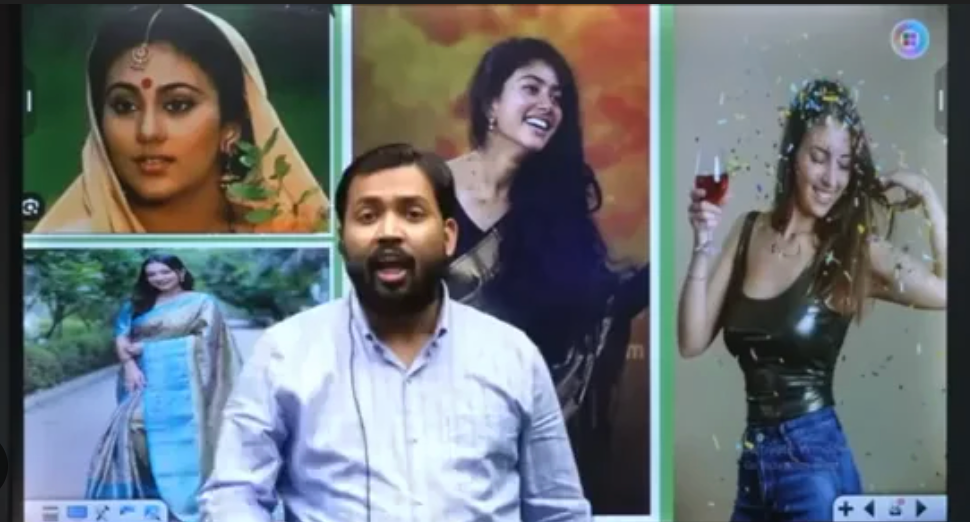
Khan Sir, while explaining why women in Western clothing forfeit respect, was wearing a shirt and trousers.
Not a dhoti. Not a kurta. Not a sherwani. A shirt. And trousers. The very category of clothing he was using to define who deserves to be treated as an object.
By his own logic, he was saaman.
This is not a gotcha. It is the entire argument. Because the rule he articulated, dress Indian to earn respect, dress Western to be treated like a commodity, has never once been applied to men. Not in his classroom. Not anywhere in the culture that produced this thinking.
Men in banyans walk down every street in India. Men go shirtless at the gym. Men wear shorts, jeans, t-shirts, every item of Western clothing that exists, and no one frames it as a question of whether they have forfeited their humanity. No one says they are inviting anything. No one calls them saaman.
The westernisation argument applies to exactly half the population. The half with less power to push back.
That is not a cultural observation. That is a control mechanism with a cultural costume on.
If the standard genuinely came from a place of cultural pride, it would be consistent.
It is not. It has never been. The men who preach Indian values for women practice no such values for themselves. And the moment you point that out, as many did in the comments, you can see the argument for what it actually is. Not about culture. About who gets to set the rules, and for whom.
What Young Men Are Walking Away With
A young man watches this video. He respects Khan Sir. He has watched hundreds of hours of his content. Khan Sir explains things clearly, makes difficult topics accessible, and has never given him reason to doubt him. So when Khan Sir says that women in Western clothing are saaman, and that how you treat someone depends on what they are wearing, that young man does not file it away as one opinion among many.
He files it away as something a trusted, educated authority confirmed.
The message he has received is not subtle. It is this: objectifying a woman is sometimes justified. It depends on what she chose to wear. If she chose wrong, the way men see her is, at least partly, her own doing.
Because of this one teaching, a boy could feel okay molesting a girl because she was wearing Western clothes. What will you do then? Will you take responsibility for what you planted in young minds?
That is not an abstract risk. It is the specific, traceable line between a lesson taught in a classroom and a decision made on a street. The boy does not think he is doing something his teacher endorsed. He thinks he is doing something the world confirmed was understandable. That is how permission travels. Not as an instruction. As a normalisation.
And once normalised, it is extraordinarily difficult to undo. Because it no longer feels like a belief. It feels like common sense.
The Saree Was Never Protection Gear
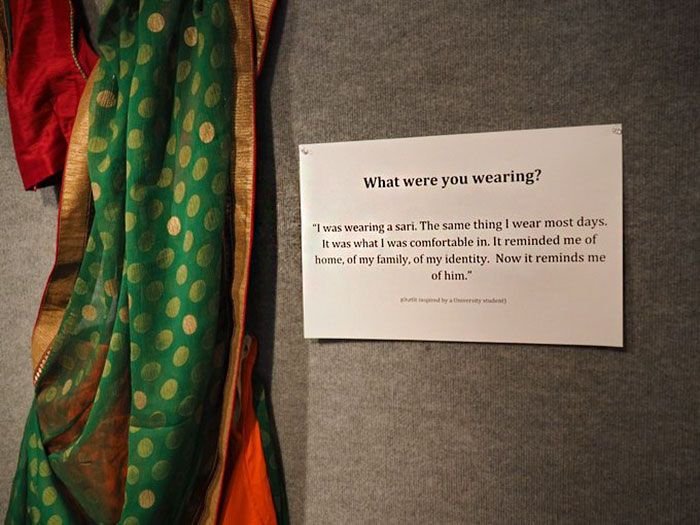
Even Sita was wearing a saree when Ravaan kidnapped her.
That line stopped a lot of people. Because it names something that should have ended this conversation decades ago.
Women in sarees are assaulted in India every day. Women in burkhas are assaulted. Women in school uniforms, in salwar kameezes, in every category of modest, traditional, covered clothing that has ever been proposed as the solution. The data on this is not ambiguous. It is not a matter of interpretation.
Rural India, where the vast majority of women wear sarees and suits as their daily clothing, does not have lower rates of gender-based violence than urban India. The clothing did not protect them. It has never protected anyone. Because protection was never what this was about.
A man with a criminal mindset does not look at a woman and think about the cultural signalling of her outfit. He does not evaluate whether she is dressed in a way that qualifies her for humanity. The framework only exists in the minds of people who want a justification after the fact.
The saree is not protection. It is just the next thing she will be asked about when she tries to report what happened.
Teaching young people that clothing determines safety does not make women safer. It makes them more willing to accept what happens to them as something they had a hand in causing. That is the only thing this lesson has ever achieved.
Education Is Not the Same as Morality. This Moment Proved It.
One of the most uncomfortable things this incident surfaces is the relationship between education and values.
We are taught, explicitly and implicitly, that education produces better people. That someone who has studied hard, built expertise, earned the respect of millions, must have a corresponding quality of thinking across the board. That intelligence in one domain signals something larger.
Khan Sir has built an enormous platform on making complex subjects accessible. He is genuinely skilled at it. And he chose to use that platform, and that trust, to tell students that women in Western clothing are objects.
There is no version of this where the education cancels out the harm. There is no version where his expertise in one area makes his statement in another area acceptable or even just neutral. What education gave him was reach. What he chose to do with that reach is a separate question entirely.
And that separation matters because we use education as a proxy for character all the time. We assume that a padha-likha person holds better values. We defer to credentialed authority. We give platforms to experts and then accept everything they say as if expertise is transferable across domains.
It is not. And this moment is a clear example of why that assumption is dangerous. The most harmful lessons are not taught by people who seem harmful. They are taught by people everyone already trusts.
What We Should Be Teaching Instead
The answer to this moment is not just anger. It is not just calling out one educator. It is the much harder conversation about what is actually missing.
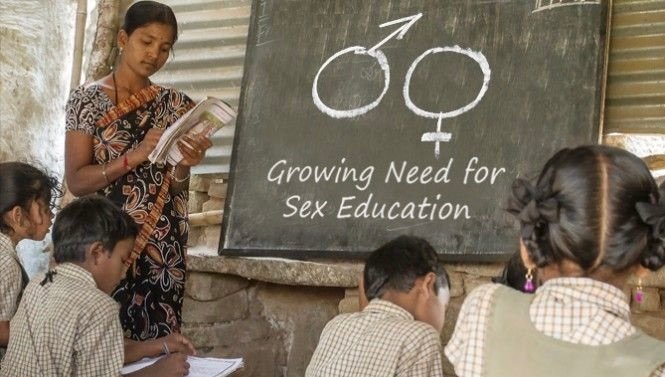
India has no mandatory comprehensive sex education curriculum. What that absence creates is a vacuum, and vacuums get filled by whatever is available. Internet videos. Classroom opinions. The views of whoever has the biggest platform and the least accountability.
Comprehensive sexuality education, as defined by frameworks that have been tested and implemented across multiple countries, is not about sex in the way people fear when they hear those words. It is about consent. About understanding that attraction is normal and that it has no bearing on whether another person deserves respect. About teaching young people that someone else’s behaviour is always their own responsibility, never caused by what another person wore or where they walked or what time it was.
WHAT COMPREHENSIVE SEX EDUCATION ACTUALLY COVERS
UNESCO’s Comprehensive Sexuality Education framework includes, as a core component, the understanding that attraction is natural but that respect and consent are non-negotiable regardless of appearance or clothing. It teaches that a person’s behaviour is always their own responsibility. It addresses shame, self-blame, and the cultural narratives that prevent young people, particularly girls, from recognising when something is wrong and seeking help. India currently has no mandatory national framework for delivering this, leaving classrooms to fill the gap with whatever the teacher in the room happens to believe.
The reason this matters specifically in response to Khan Sir is that his classroom demonstrated exactly the gap. His students were not given the tools to push back. They were not equipped with a framework that said: attraction is not permission. Clothing is not consent. Another person’s behaviour is not your fault.
They were given the opposite. And millions watched it happen.
If we are serious about not repeating this, the conversation cannot stop at calling out the statement. It has to reach the question of what we are giving young people instead. What framework they are being handed to understand respect, consent, and their own worth. The NCPCR and state education boards have the authority to mandate this. The question is whether there is political will to act on it. Because right now, in too many classrooms across this country, the answer is: nothing. Or worse, this.
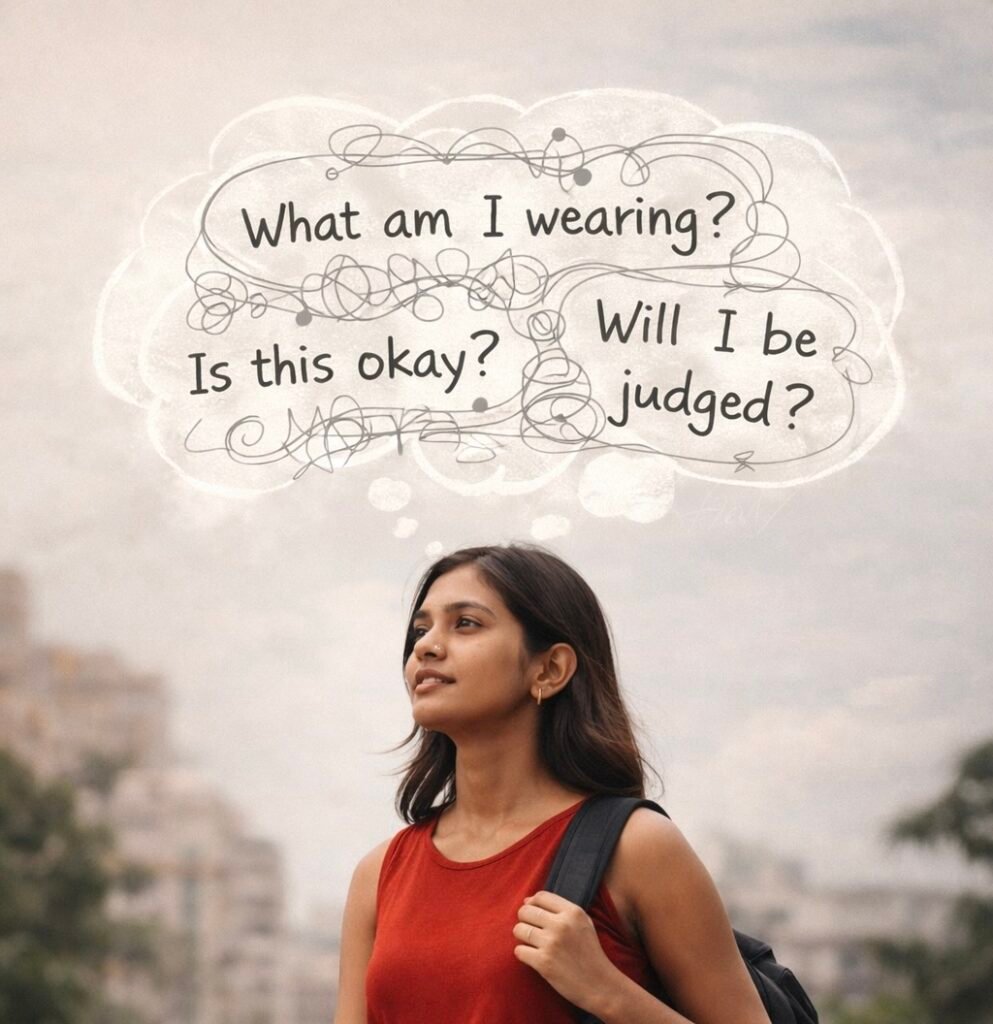
One Lesson. One Apology. One Chance to Fix It.
There is a girl somewhere who watched that clip. She is studying for her boards, or in college, or already working. She respects Khan Sir. She does not agree with everything he said, but it lodged somewhere anyway, the way these things do when they come from authority.
And at some point, something will happen to her. It may be minor. It may not be. But in that moment, before anything else, she will think about what she was wearing. And if the answer is jeans, or a sleeveless top, or anything that does not qualify as Indian enough under the framework she was handed, she will wonder, even briefly, whether this is what she was warned about.
That is the real cost of what happened in that classroom. Not the debate. Not the viral cycle. Not the ratio.
The girl who goes quiet because she was taught, by someone she trusted, that she had
some part in it.
Khan Sir still has time to own this. To stand in front of the same students and say: what I taught you was wrong. Behaviour is never caused by clothing. Respect is not conditional on what anyone wears. Your safety is never your fault.
That lesson would reach further than the clip did. And it would actually be worth teaching.
Decoding Draupadi is a media platform and community for urban Indian working women. Read more at www.decodingdraupadi.com. Follow us on Instagram or subscribe on Substack.