
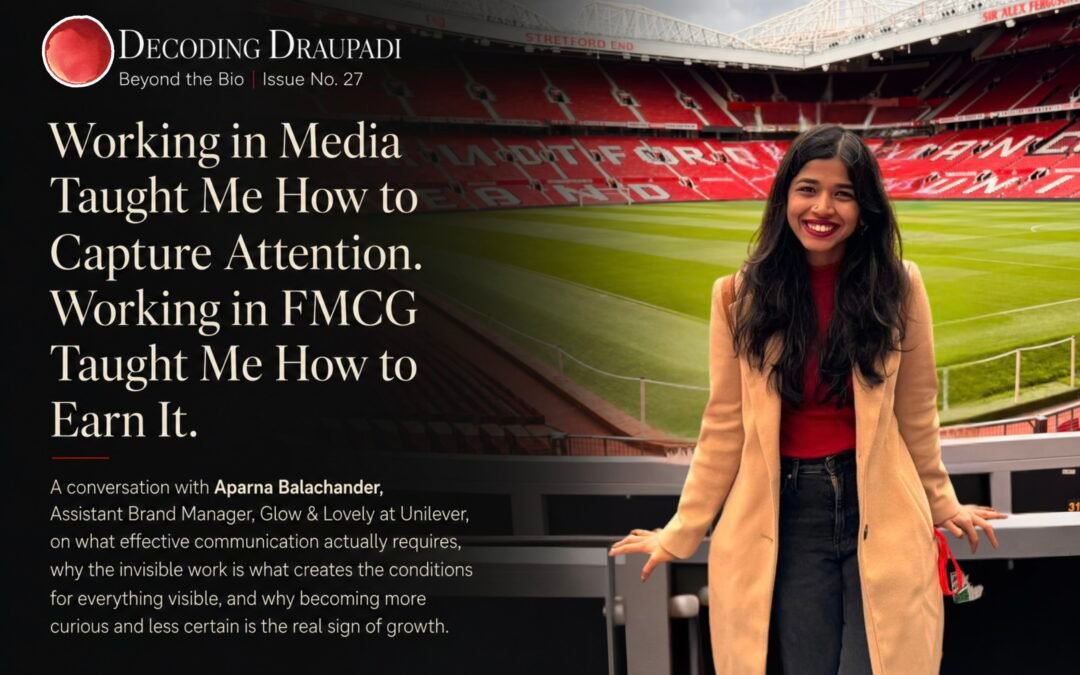
A conversation with Aparna Balachander, Assistant Brand Manager, Glow & Lovely at Unilever, on what effective communication actually requires, why the invisible work is what creates the conditions for everything visible, and why becoming more curious and less certain is the real sign of growth.
Aparna Balachander has moved from Star Sports to Unilever, from media to FMCG, and in doing so has developed a very specific understanding of what communication is actually for. She writes with the precision of someone who has spent a lot of time thinking carefully about language, and the warmth of someone who genuinely cares about the people on the other side of it.
This is a quiet conversation. No dramatic pivots, no single defining moment. Just a person who has been paying close attention to everything around her, and it shows in every answer.
More Curious. Less Certain. Which I Think Is a Good Thing.
Who is Aparna right now, across the different lives she is living?
The older I get, the less I believe that we’re one fixed person. Right now, Aparna is a collection of many versions that coexist.
At work, I’m someone who enjoys solving problems, building brands, and bringing order to complexity. I care deeply about the craft of communication, but I’m equally interested in the people behind the work. Over the years, I’ve become less focused on proving myself and more focused on creating meaningful impact.
Outside work, I’m rediscovering joy through simpler things. Books have become a huge part of my life, not just as a hobby, but as a way of understanding myself and the world. Through reading, writing and conversations, I’ve become more curious and less certain, which I think is a good thing.
As a wife, daughter, sister and friend, I’m learning that presence matters more than perfection. Earlier, I thought love was demonstrated through grand gestures or constant availability. Now I think it’s often found in consistency: showing up, checking in, making space for people.
Privately, I’m navigating growth in real time. There are ambitions I still want to pursue, things I’m trying to build, and versions of myself I’m still getting to know. Some days all those identities fit together neatly. Other days they don’t. But I’ve become more comfortable with that tension.
If there’s one thing that ties all these versions together, it’s curiosity. Whether it’s a brand problem, a book, a relationship, or a new chapter in life, I want to understand things deeply and engage with them fully.
“Through reading, writing and conversations, I’ve become more curious and less certain. Which I think is a good thing.”
Most people treat certainty as the goal, the thing you build toward as you grow. Aparna has arrived at the opposite conclusion: that becoming less certain is the sign that something real is happening. That takes a particular kind of confidence to say, and a particular kind of intellectual honesty to actually live. The books thing is not incidental either. It is the practice behind the philosophy.

Capturing Attention Versus Earning It
What has moving between media and FMCG taught you about how communication actually works?
Working in media taught me how to capture attention. Working in FMCG taught me how to earn it.
At Star Sports, communication was often tied to moments: live events, fan passion, cultural conversations. The challenge was creating relevance and excitement in real time.
At Unilever, I learned that communication has to do much more than generate engagement. It has to drive behaviour. It has to be understood by people across geographies, income groups, cultures and life stages. Most importantly, it has to be rooted in a genuine consumer insight.
The biggest lesson has been that effective communication isn’t about saying something clever. It’s about making someone feel understood. When people see themselves reflected in a message, communication starts working. The channels, formats and platforms continue to evolve. That principle remains constant.
“Effective communication isn’t about saying something clever. It’s about making someone feel understood.”
The capture versus earn distinction is one of the sharpest things said in this series. Capturing attention is a moment. Earning it is a relationship. They require completely different skills, different timelines, and a different understanding of what the person on the other side actually needs. Aparna has worked in both and can tell the difference from the inside. That is not a common vantage point.
The Question Is What Role a Brand Can Responsibly Play
When a brand reaches millions of people, what does responsibility actually look like in practice?
The responsibility starts with acknowledging that brands don’t exist in a vacuum. They participate in culture, and culture shapes how people see themselves and others.
When you’re working on a brand that reaches millions, every choice matters: from the stories you tell to the voices you amplify. That doesn’t mean brands need to have an opinion on everything, but it does mean they need to be thoughtful about the impact they create.
Personally, I try to approach that responsibility with humility. No brand has all the answers, and consumer expectations are constantly evolving. The goal isn’t to be perfect. It’s to listen, learn, and make decisions rooted in empathy and genuine understanding.
For me, the question is often less about what a brand wants to say and more about what role it can responsibly play in people’s lives.
“The question is often less about what a brand wants to say and more about what role it can responsibly play in people’s lives.”
She is working on Glow & Lovely, which carries a specific cultural weight in India. She does not mention it by name here, but the gravity of what she is saying is impossible to separate from that context. The humility she describes is not generic. It is earned and applied. And the reframe from what does the brand want to say to what role can it responsibly play is a shift in direction that changes every downstream decision.

Consumers Resist Inconsistency, Not Change
What have you learned about what it actually takes to evolve a brand without losing what makes it trusted?
A brand’s strength often lies in what people already trust about it. Evolution becomes difficult when we mistake change for reinvention.
The most successful transformations usually start with identifying what should never change. Once that foundation is clear, you can rethink how the brand expresses itself, who it speaks to, and how it stays relevant in a changing world.
Consumers are often more comfortable with evolution than we assume. What they resist is inconsistency. If the core purpose remains intact, people are willing to come along for the journey.
The challenge isn’t choosing between heritage and progress. It’s finding ways for them to reinforce each other.
“Consumers are often more comfortable with evolution than we assume. What they resist is inconsistency.”
This reframe is practically useful for anyone managing a legacy brand. The fear is usually that consumers will not follow if you change too much. Aparna is saying the fear is misplaced: the thing that loses people is not change, it is the feeling that the brand no longer knows what it stands for. Clarity of purpose is what makes evolution feel safe rather than disorienting. She has clearly sat with this question for a while.
Consistency Compounds
When there is no external validation, no visible win, how do you know you are doing good work?
The older I’ve become, the more respect I’ve developed for invisible work.
A lot of meaningful work isn’t glamorous. It’s the planning before the presentation, the alignment conversations, the follow-ups, the problem-solving, and the countless small decisions that prevent bigger problems later.
Earlier in my career, I probably measured progress through visible milestones. Today, I understand that consistency compounds. The things nobody notices often create the conditions for everything that eventually gets noticed.
Everyone likes recognition. But I’ve learned to derive satisfaction from knowing that something moved forward because I contributed to it, even if my contribution isn’t obvious to everyone else. There’s a quiet confidence that comes from that.
“Consistency compounds. The things nobody notices often create the conditions for everything that eventually gets noticed.”
Consistency compounds is a short line that contains a complete philosophy of work. It is also the hardest kind of work to sustain because it does not feel like progress while you are doing it. Aparna has not just named the principle. She has described the internal experience of it: a quiet confidence, not external validation, not applause, just the knowledge that something moved. That is a very specific and mature relationship with work.

A Student Even When You’re Expected to Be the Expert
As you grow, what is something you hope never changes about you?
I hope I never lose my curiosity.
Curiosity has opened almost every meaningful door in my life. It’s helped me switch industries, understand consumers better, build relationships, discover new books, and challenge my own assumptions.
Curiosity keeps judgment in check. It allows you to remain a student even when you’re expected to be an expert.
Life tends to reward certainty, but I think curiosity is what keeps us growing. If I can hold onto that, I’ll be happy with whatever else changes.
“Curiosity keeps judgment in check. It allows you to remain a student even when you’re expected to be an expert.”
She opened this conversation saying she has become more curious and less certain. She closes this question with the same word. That is not repetition. It is a through-line. Curiosity is not a trait Aparna happens to have. It is the thing she has consciously decided to protect. The student-when-expected-to-be-expert framing is the practical version of that: not humility as a performance, but as a daily practice of staying open.
The Detours Often Become the Most Valuable Parts
What would you want someone just beginning their journey to worry less about?
I would tell them to worry less about timelines.
We’re constantly comparing our beginnings to someone else’s middle. We think we should have everything figured out by a certain age, title, or salary bracket. Looking back, many of the opportunities that shaped my career weren’t things I could have planned for. They came from being open, doing good work consistently, and allowing myself to change my mind when new possibilities appeared.
Careers are much less linear than they appear from the outside. The detours often become the most valuable parts of the journey.
So worry less about whether you’re moving fast enough and focus more on whether you’re learning. Learning has a way of creating opportunities long before you can see them.
“The detours often become the most valuable parts of the journey.”
She switched from media to FMCG, which from the outside might have looked like a detour. She is describing it from the inside: it was where she learned the more important lesson. The careers-are-less-linear-than-they-appear observation is one of the most consistently true things said in this series, and it lands differently from someone who has actually crossed an industry boundary and come out the other side with something the straight path would not have given her.

A Note From Decoding Draupadi
What stayed with us from this conversation is the consistency compounds line. Not because it is surprising, but because of how rarely people actually live it.
Aparna is describing a way of working that does not perform for an audience. The planning before the presentation, the alignment conversations, the small decisions that prevent bigger problems: none of that gets applause. It just makes everything else possible.
We think there are a lot of women doing exactly that kind of work right now. Quietly, consistently, creating the conditions for things nobody will trace back to them. This series exists, in part, to say: we see it.
If this felt like someone you know, share it with her.
Aparna Balachander is Assistant Brand Manager, Glow & Lovely at Unilever. This interview was conducted as part of the Decoding Draupadi Brand Manager Series.
Consistency compounds. The things nobody notices often create the conditions for everything that eventually gets noticed. For everyone doing the invisible work, at @decodingdraupadi.