
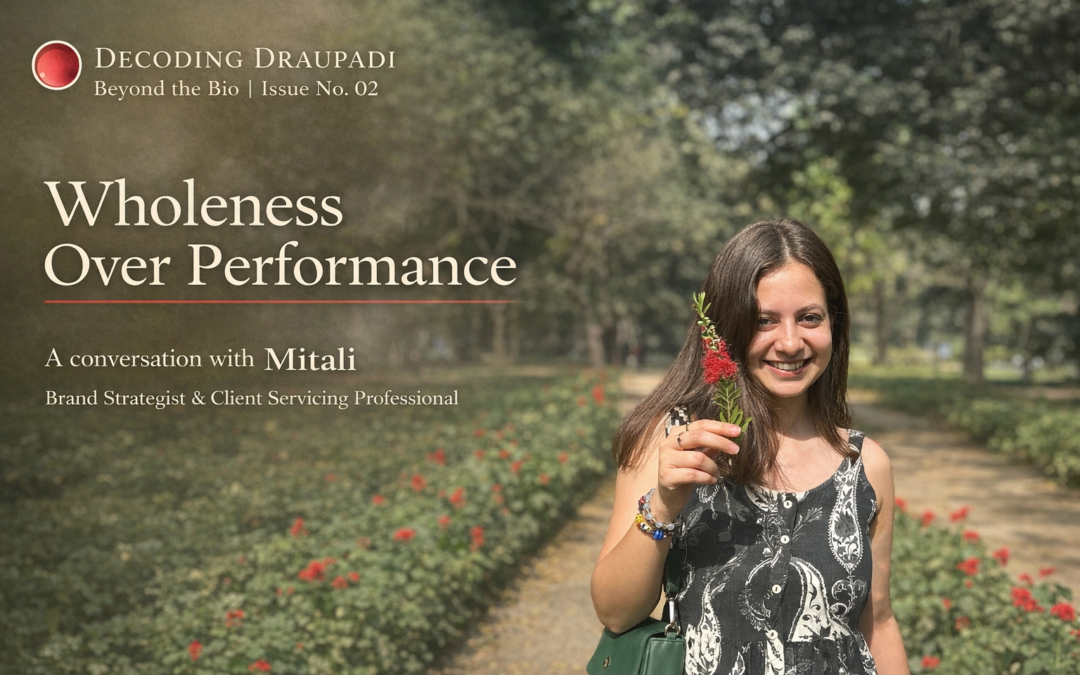
A conversation with Mitali brand strategist, eldest daughter, and someone learning, deliberately, to live in the present.
Some people think out loud. Mitali thinks in clarity. Working at the intersection of brand strategy, client servicing, and creative direction at a creative agency, she has built a career on turning ambiguity into structure, on asking the uncomfortable questions before a brief goes sideways, on knowing when to push back and when to listen. But what makes Mitali interesting isn’t just what she does professionally. It’s how she’s chosen to live.
She has lived across multiple states, crossed academic streams, picked up languages, and built circles across very different worlds and somewhere in all of that movement, she found a quiet guiding principle: minimise regret, act with intention, and believe in yourself just slightly more than logic allows. This is her, in her own words.
On Identity Zooming In and Out
Most of us are never just one person. We’re someone at work, someone at home, someone in our friendships, someone in our private thoughts. So who is Mitali right now, across the different lives you’re living?
Right now, Mitali is someone who is on the right path to learning the art of switching off. I’m learning how to leave work at work and show up fully at home to actually be present instead of mentally time-travelling into the future.
As the eldest daughter, I’ve always been wired to think ahead. To anticipate problems before they happen, to plan three steps forward. That instinct has helped me grow, but I realised it was quietly stealing from my present. I was experiencing today through the lens of tomorrow. That wasn’t working for me.
Now I’m consciously practising balance. I zoom out to see the bigger picture, but I also zoom in to live in the moment. I’m deeply passionate about whatever I take on. I believe in doing things wholeheartedly, so I don’t look back with regret. But I’m also learning that life isn’t just about performance. It is about joy.
I’m intentionally returning to my hobbies, especially dancing and scheduling them with the same seriousness as meetings and deadlines. For me, that feels like reclaiming space as a woman. Not just succeeding professionally, but choosing wholeness personally.
“Life isn’t just about performance. It is about joy.”
There’s something striking about Mitali’s self-description; she doesn’t begin with her job or her achievements. She begins with what she’s learning to let go of. The eldest daughter’s identity is one that many women carry silently: the constant forward-planning, the quiet vigilance, the sense that someone always has to be thinking ahead. Naming it and actively choosing to be present anyway is not a small thing.

On Unlearning What Briefs Don’t Tell You
Reflecting on your journey in brand management and client servicing, what’s one belief about how brands should communicate that you’ve had to unlearn? And what have you learned instead?
One of the biggest things I’ve learned is that briefs are rarely complete. They often come in as a board missing a piece of the puzzle and it becomes our job to help find it.
Earlier, I believed brands came in knowing exactly what they wanted, and our role was simply to execute that vision strategically. What I’ve unlearned is this: not all brands fully know what they want. And that is okay. In fact, that ambiguity can be an opportunity. The key is identifying it early. If you assume clarity where there isn’t any, you end up spiralling later.
I’ve learned that setting expectations from the beginning, and embracing collaboration to define the problem, is just as important as solving it.
On a more personal note as a woman in client-facing roles, I’ve had to unlearn the need to overprove my competence. I’ve learned that clarity does not need aggression, and authority does not need volume. Wins and losses are collective. Sincerity is important, but over-sincerity is exhausting. Healthy detachment has helped me grow without burning out mostly.
“Clarity does not need aggression. Authority does not need volume.”
This is the unlearning that nobody puts in a job description. The invisible labour of proving yourself especially as a woman in a client-facing role is real, and it compounds. What Mitali has arrived at is something that takes most people years to understand: that credibility built on composure lasts longer than credibility built on performance. You don’t have to be louder to be taken seriously.
On Creative Instincts The Power of No
Has there been a moment in your brand work where a client’s brief, or a strategic direction you were pursuing, taught you something unexpected about your own creative instincts or priorities?
Learning to say no has been transformative.
No to fake urgencies. No to ideas that sound exciting but don’t make practical sense. No to overloading myself beyond what’s realistic for the day.
Earlier, I equated saying yes with being efficient or dependable. I’ve realised that boundaries don’t weaken your credibility, they strengthen it. When you back your perspective with logic and clarity, clients respect it. Some of the most productive agency-client relationships I’ve experienced have come from honest, reasoned pushback.
That taught me that my instinct to pause, question, and structure chaos isn’t resistance. It is valuable.
There is a version of ‘being good at your job’ that is actually just people-pleasing with extra steps. Mitali has identified it and named it clearly: saying yes to everything isn’t dependability, it’s a slow erosion of your own standards. The pivot she’s describing from yes as default to no as a considered professional position is one of the most underrated career moves a woman in a client-facing role can make.
On Being Overwhelmed Courage Over Self-Doubt
Has there been a time you felt completely in over your head? What helped you find your footing again?
In the early days of my advertising journey, I often felt completely out of depth. Everything moved fast, everyone seemed confident, and I constantly wondered if I was keeping up.
‘Fake it till you make it’ can sound superficial, but for me it meant choosing courage over self-doubt. Sometimes audacity has to be louder than insecurity.
What helped was reminding myself that we live in an age of abundant resources. You can learn almost anything quickly if you are willing to put in the effort. More importantly, colleagues are usually kinder than your fears assume as long as you are genuinely asking to grow.
I also anchor myself in ethics. When your intent is right and your effort is honest, confidence eventually follows. That belief has helped me regain my footing more than once.
“When your intent is right and your effort is honest, confidence eventually follows.”
What Mitali offers here isn’t toxic positivity or a shortcut, it’s something more grounded than that. The idea that ethics can be an anchor in moments of professional overwhelm is quietly profound. When you’re not sure if you’re good enough yet, knowing that you’re trying honestly is something to stand on. It’s not the same as being the most skilled person in the room. But it’s a foundation.

On Money and Space Agency as a Way of Living
There’s this idea that when people start earning their own money, the first thing they really buy isn’t an object, it’s personal space. Has earning changed your relationship with space, independence, or choice?
I truly believe personal space is one of the greatest luxuries. Being able to afford my own space was a turning point for my mental health. There is something powerful about having a place where your decisions, your silence, and your routine are entirely your own.
For a woman especially, financial independence shifts something deeply internal. It is not just about money. It is about agency. It is about having the option to choose your environment, your pace, and your boundaries.
Earning your own money doesn’t just buy comfort, it buys choice. The choice to build a life aligned with your values. That freedom also comes with responsibility. Independence is not just about enjoyment; it is about discipline.
I have always thrived in my own company and embraced living by myself. As adulthood becomes more complex, having control over even one part of your life your space becomes grounding.
The word Mitali keeps returning to is agency. Not freedom as a feeling, but freedom as a structural condition: the ability to say no to an environment, a routine, a pace of life that isn’t yours. For many women, that first paycheck isn’t just money. It’s the first time their choices have actual weight behind them. Mitali names that, and she also names what comes with it: not just the right to choose, but the discipline to make those choices count.
On Comparison Different Terrains, Different Timelines
Comparison sneaks in easily through social media, career timelines, or conversations we don’t even realise affect us. How does it show up in your life, and how do you deal with it?
I’ve lived across multiple states in India, learned different languages, moved across academic streams, explored sports, and now work in advertising. That has given me very diverse circles of friends all thriving in completely different worlds. So comparison, change, and movement have almost become familiar to me.
Most of the time, comparison motivates me rather than diminishes me. I once heard the analogy of comparing a fish to a bird both extraordinary, but in entirely different terrains. That stayed with me. We don’t even have five identical fingers on one hand, yet each one is essential.
I try to redirect comparison into aspiration. If someone else is soaring, it doesn’t mean I’m failing. It simply means we are operating in different timelines and different strengths. That shift in perspective keeps me grounded.
“If someone else is soaring, it doesn’t mean I am failing. We are simply operating in different timelines.”
There’s a particular kind of peace that comes from having moved enough cities, circles, disciplines to know that the metrics keep changing depending on where you’re standing. Mitali’s experience of living across very different contexts has given her a genuinely useful lens: comparison only makes sense if you’re playing the same game. Most of the time, you’re not. Most of the time, nobody is.
On Advice Trusting the Move
Looking back at where you are now and where you started what would you want someone just beginning their journey to worry less about?
Trust your instincts. Try different paths until something genuinely excites you. Don’t be afraid of change. It is often the fastest teacher.
Most importantly, don’t let fear dictate your choices. Minimising regret has been a quiet guiding principle for me. When you act with intention and courage, even mistakes feel like movement.
And also listen to your parents. They are not always wrong. Coming from someone who was quite the rebellious kid herself, I’ve realised that experience often speaks from a place we only understand later. You don’t have to agree with everything, but don’t dismiss it too quickly either.
Believe in yourself a little more than logic allows. That belief builds resilience, and resilience builds everything else.
“Believe in yourself a little more than logic allows. That belief builds resilience and resilience builds everything else.”
Mitali ends where she began: with intention. The through-line of everything she’s shared the choice to be present, to say no, to anchor herself in ethics, to redirect comparison is a woman who has decided to act with purpose, even when the path isn’t clear. That last line is one to hold onto. Logic will always give you reasons to doubt. Belief has to be a choice you make anyway.
— End of Interview —
Mitali is a brand strategist and client servicing professional at a creative agency. This interview was conducted as part of the Decoding Draupadi Brand Manager Series.
If this made you pause for a second, we’re doing something right. We’re having more conversations like this with women figuring things out in real time. You’ll find us on Instagram @decodingdraupadi.