DECODING DRAUPADI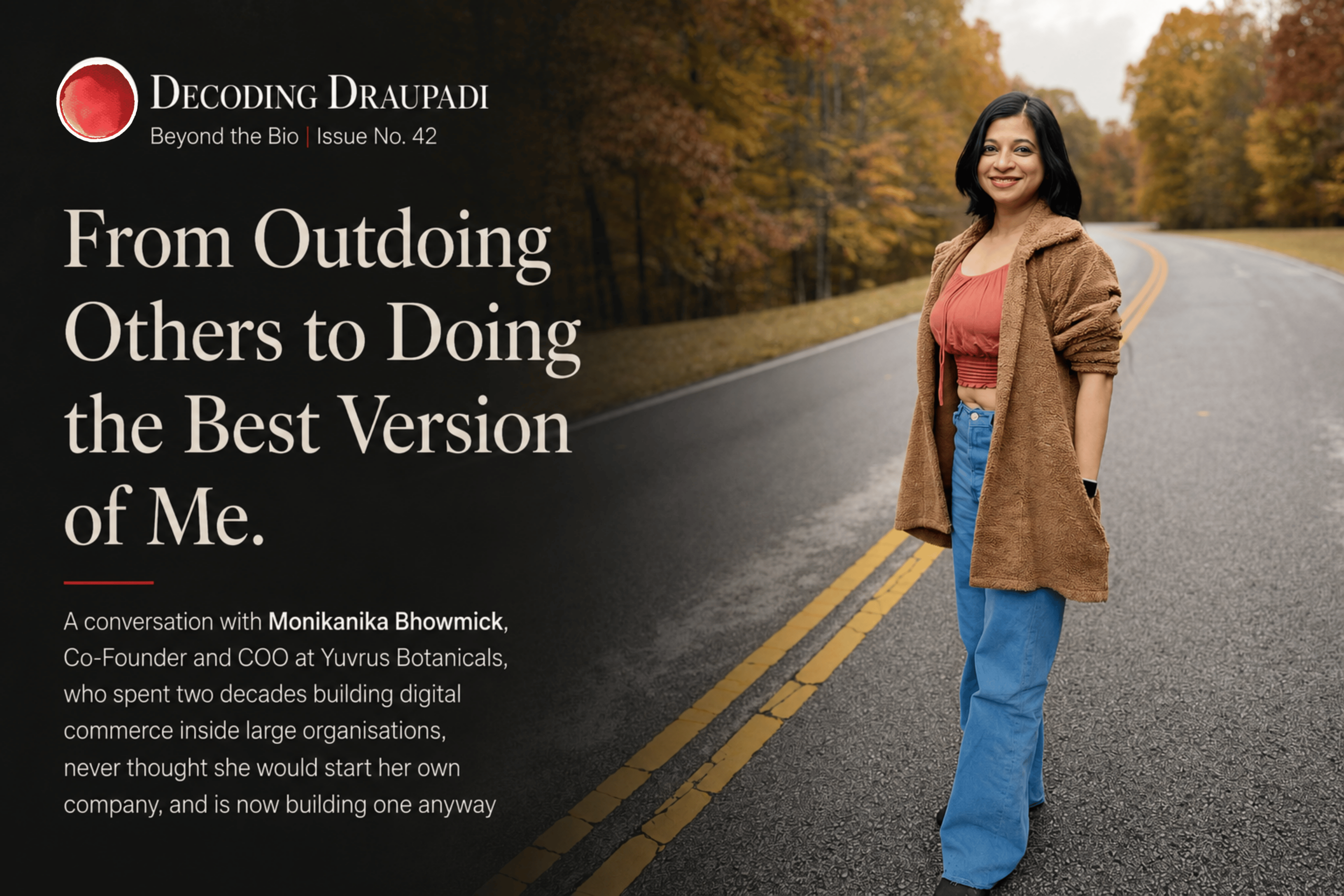
A conversation with Monikanika Bhowmick, Co-Founder and COO at Yuvrus Botanicals, who spent two decades building digital commerce inside large organisations, never thought she would start her own company, and is now building one anyway
Monikanika Bhowmick has spent twenty years building digital businesses inside large organisations: Castrol, 3M, Polycab, Bajaj Electricals. She has an XLRI degree and a certification as an Independent Director. She also comes from a family of teachers and professors, a detail she mentions almost in passing, but which turns out to explain more about her than most of her job titles do.
She recently left corporate life to co-found Yuvrus Botanicals, a clean baby food brand. She says she never thought she would start something of her own. That, too, turns out to explain more about her than it first appears.
At Peace With Yourself
Who is Monikanika right now, across the different lives you are living?
At the core of every role, she says, the person remains the same. What you bring to different rooms is the same fundamental self, the basic you, your ethical standards, your introversion or extroversion, your flexibility or its absence. You play the role accordingly, but the core does not change.
What does change is how you feel about that core, and when that shifts. In your teenage years, you are more insecure, more anxious about the future, more caught up in proving something. As you earn financial independence, things settle. And then, eventually, you arrive at a phase where you are beyond the basic struggles of life, where you are at peace with yourself.
That is where she is now. Happy with what she has. No longer performing for a wide audience. Fewer friends, but ones she does not have to perform for. People around whom she can be completely herself without putting on a version of herself that is not authentic.
“At peace with yourself. At some point, you realize you’d like fewer people around you, but the ones with whom you are less performative and absolutely yourself.”
Most people describe who they are in terms of what they do. She describes it in terms of how much she no longer has to perform. That is a different kind of self-knowledge, and it tends to come only after you have spent enough time performing to know what it costs.

Help Was Out There. I Just Had Not Asked.
You have spent years building businesses from scratch inside large organisations, and now you are building one of your own. What surprised you most about the difference?
The surprise was not as large as she expected, because she had anticipated much of it. Inside a large organisation, you are building something, but you are supported by everything already in place: the brand name, the existing processes, the support systems, the people. On your own, it is block by block, everything from the ground up. Including the most basic things, including people, because at the start you cannot afford salaries.
What actually surprised her was the help. She is not, by nature, someone comfortable asking for it. But when you are alone and you know you cannot do everything yourself, you reach out to people you have not spoken to in years, or would not have spoken to at all without the need. And what she found was that people are generally helpful. They may not always respond, but the idea that reaching out is difficult or embarrassing turned out to be less true than she had assumed.
Help was out there. She simply had not been asking for it.
“The answer is always no if you don’t ask. I realised that now. There is nothing wrong with asking for help when you need it.”
She names this as a discovery about herself, not just a practical lesson about entrepreneurship. Someone who spent two decades in corporate structures, surrounded by support systems she did not have to ask for, had to unlearn the assumption that asking is weakness. The unlearning happened at fifty, by necessity. That timing matters.
I Never Thought I Could. Then I Did.
What is something you have changed your mind about in the last few years?
Starting something of her own. It was never something she thought she would be able to do.
She grew up in a generation where the path was structured: engineering degree, MBA, corporate career, the same route most people around her took. Startups were rare. The culture of building your own thing was not the assumed option. You trained yourself to think in corporate terms, to work within corporate structures, and to assume that those structures were where your professional life would always live.
Then the world changed. Large corporations, she noticed, have limitations: they are constrained by scale, by governance, by larger goals that prevent the kind of focused innovation she wanted to do. Realising she could step outside that and build something herself was itself the biggest shift. She still does not know everything about how to do it. But she is doing it.
“I never thought I would be able to start something on my own. Taking that route itself has been the change.”
The change she is describing is not just a career decision. It is a revision of what she believed she was capable of. Those two things feel similar from the outside but are completely different from the inside. One is logistical. The other is a rewriting of identity.

From Outdoing Others to Doing the Best Version of Yourself
Do you think ambition becomes healthier or more exhausting as people grow older?
Eventually, she says, most people find their own pace. And in finding their own pace, they come to understand what balances them out and what burns them out. The balance between a life where the body is nourished and work where the mind is nourished becomes something you actively manage, rather than something that happens by accident.
She does not think ambition has to look the way the world typically defines it, as titles and career progression and corporate achievement. An ambition to give back to society, or simply to take care of family well, is also a valid form of ambition. Everyone is different. Finding your pace eventually is what matters.
What she notices in her own arc is the shift in the nature of ambition: from outdoing others, which is how ambition tends to feel when you are younger, to doing the best version of yourself. From outward competition to inward direction.
“Ambition shifts. From outdoing others to doing the best version of me.”
This is one of the cleaner descriptions of how ambition matures across this series. Not more exhausting. Not less intense. Just differently oriented. The energy does not shrink; the reference point changes from everyone around you to the person you are trying to become.
Leaders Are Human. That Is Not a Weakness.
What do you think people misunderstand about leadership as they move into more senior roles?
That a leader cannot be vulnerable. That you have to be seen as always strong, always certain, always pointing in the right direction. She thinks this is one of the most misleading ideas in professional culture, in both directions.
Nobody can always be right. And the pace at which the world and skill sets are changing means that being senior no longer guarantees knowing more than the people below you. The knowledge that matters most right now often flows from the ground up, not the top down. A junior team member may understand the current landscape far more precisely than someone senior, who brings experience but not necessarily relevance.
Beyond that, she believes projecting invulnerability creates the wrong model for the people watching. Younger professionals learn leadership by observing the people above them. If what they see is an always-right, always-certain, always-in-control persona, that is what they learn to perform, and the cycle continues. Better to show that trying something and failing, reconsidering, thinking together, is also what leadership looks like.
“Leaders should always be human. People can only relate to someone a little human. You cannot be the perfect role model all the time.”
She is not making an argument for softness. She is making an argument for accuracy. Projecting omniscience when you do not have it does not make the organisation stronger. It makes the organisation less likely to surface problems honestly, because the people below have learned that leaders do not acknowledge limits.

Giving Back What Someone Once Gave to You
What kind of work gives you the deepest sense of meaning, the kind that reminds you why you entered this field in the first place?
She entered corporate life almost by default: engineering degree, MBA, and then the natural next step. She comes from a family of teachers and professors, which created some friction when she chose corporate life instead. Over time, though, she has realised that the pull toward teaching may have been in her all along.
The most fulfilling moments of her career have been when she could add value to someone younger, someone on her team, a student she mentors as a visiting lecturer. More recently she has branched out into visiting lecturerships and mentoring at schools, and those roles feel more personally fulfilling than almost anything else. There is something particular about giving back what someone once invested in you: the time, the experience, the teaching. Someone trained her, taught her, gave her their time. Giving that forward is what makes her feel genuinely happy.
“The most fulfilling moments are when I can contribute value to the younger generation. Giving back makes me feel a lot of happy and fulfilled.”
She says it slightly unexpectedly: a lot of happy. Not standard corporate language, and probably a more accurate description than a more polished version would be. The sentence sounds like what it actually is: someone describing a feeling, not a professional achievement.
Calmer. Healthier. Not Rushing.
If someone met you five years from now, what do you hope they would notice has changed about you, beyond your job title?
She hopes they see a calmer, healthier, and happier version of herself. Not rushing all the time.
She is actively working on this already: meditation, yoga, taking the right breaks, building habits that are about the body and the mind as much as about the business. Five years from now, she wants whoever meets her to see someone who has arrived at that, not someone still chasing it.
“Five years later, I hope people see someone who is happy, not rushing all the time. And definitely healthy.”
The answer is short and specific, which is rare for this question. Most people list things they hope to have achieved. She lists a quality of being she hopes to have arrived at. That difference, between having and being, is the whole point of the question, and she answers it directly.
A Note From Decoding Draupadi
What stayed with us is the family detail. She comes from teachers and professors. She chose corporate life and there was friction about it. But the pull toward teaching, toward giving back, toward mentoring the younger generation, has been there the whole time, running quietly underneath the digital commerce career. It just took twenty years to surface as the most fulfilling thing she does.
She also said something that deserves repeating: the answer is always no if you do not ask. She did not learn this early. She learned it at the point when she had no choice but to ask, because she was building something alone and help was the only way forward. That is a hard way to learn a simple thing. But she learned it.
If this felt like someone you know, share it with her.
The answer is always no if you don’t ask. She learned this at fifty, building alone, when asking was the only way forward. More at @decodingdraupadi.
Monikanika Bhowmick is Co-Founder and COO at Yuvrus Botanicals. This interview was conducted as part of the Decoding Draupadi Brand Manager Series.