DECODING DRAUPADI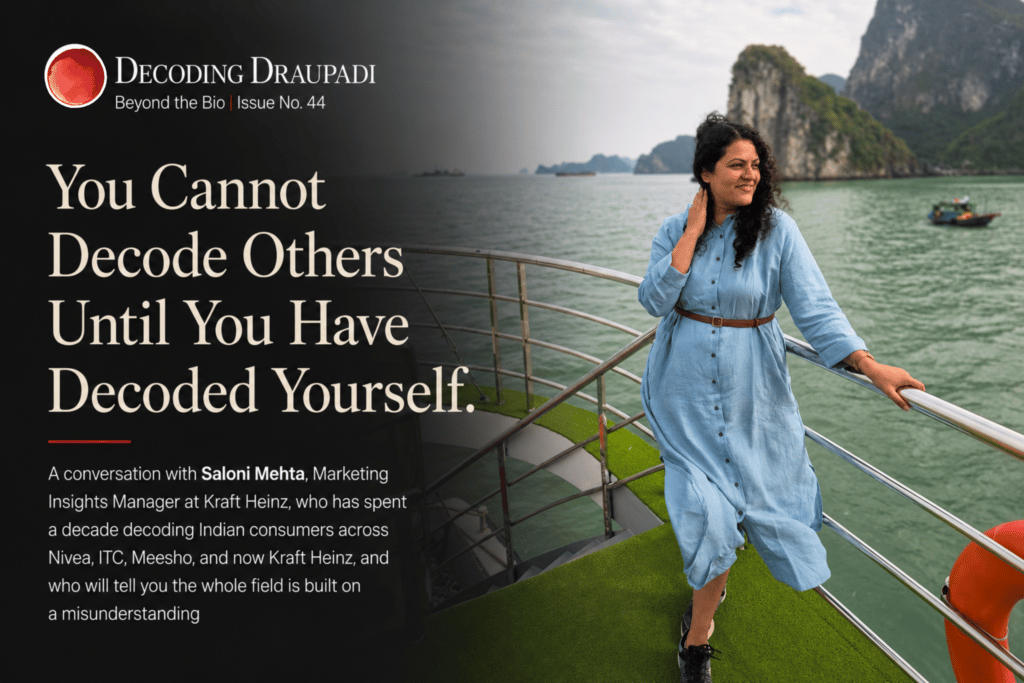
A conversation with Saloni Mehta, Marketing Insights Manager at Kraft Heinz, who has spent a decade decoding Indian consumers across Nivea, ITC, Meesho, and now Kraft Heinz, and who will tell you the whole field is built on a misunderstanding
Saloni Mehta has spent over a decade in consumer insights, moving through Nivea, ITC, Meesho, and now Kraft Heinz. Her job, in every role, has been to understand what people actually want underneath what they say they want. She is unusually precise about what that takes, and unusually honest about what most people in the field get wrong.
She is also, for what it is worth, the person who failed engineering exams and shows up on LinkedIn looking like she got everything right the first time. She finds this funny. Both things are true.
The Balancing Act, and the Person Without a Phone
Who is Saloni right now, across the different lives you are living?
She lists the roles: wife, daughter, employee, team leader, friend, sister, sister-in-law. The list is long. But the more interesting answer is what those roles feel like from the inside.
With all of those responsibilities, she says, she is a balancing act. Without them, she would just be someone carefree, roaming around with no phone.
That second version, the carefree no-phone one, is not a fantasy she is waiting to achieve. It is just the other self that coexists alongside the one navigating all the roles. She knows both are real. She does not have to choose between them.
“With those responsibilities, I’m a balancing act. Without them, I would just be somebody carefree who would roam around with no phone.”
The no-phone version is the detail that lands. Most people describe their ideal self in terms of things they would do or have. She describes it in terms of what she would not be carrying. That is a more precise kind of self-knowledge.
You Decode Yourself First. Then You Can Decode Others.
You have spent your career understanding consumers across research, analytics, FMCG, e-commerce, and now global food brands. Has studying consumer behaviour for so many years changed the way you understand yourself?
She flips the question. You cannot uncover what someone else is not saying unless you know yourself first. In her experience, it works the other way around: to be good at this job, you have to go deep into yourself. And the more you do, the more you realise that you are constantly changing.
She changes often, she says. Continuously trying to be a better version of herself across every role she is playing. Sometimes that pace of change is hard even to keep up with personally, which is where the people around you help anchor things.
She chose this field, in part, because she knew it would require her to go deeper into herself. The consumer work was the vehicle. The self-knowledge was what she was actually after.
“It’s not that by decoding others I’m decoding myself. I’m actually decoding myself, and that is why I can decode others.”
This is the most precise reversal in this series of what the job is usually understood to be. Consumer insights is not typically framed as a practice of self-examination. She is saying it has to be, because without that, you are just running surveys on people you do not actually understand.

Stop Performing. Drop the Judgment. People Open Up.
Are there any assumptions about people you have completely unlearned along the way?
Early in her career, she thought she needed to show up to consumer conversations as a bubbly, approachable, always-smiling person. She performed that persona because she believed it would make people open up to her. Most researchers do some version of this.
It did not work. What actually worked was removing two things simultaneously: self-consciousness about how she was coming across, and judgment about the person sitting across from her. When both of those go, people open up naturally. No performance required. No effort. It is just an organic process.
“Leave judgment and self-consciousness out of your head. People naturally open up. You don’t even have to do anything after that.”
The insight is simple and hard to practise. Most people can drop the performance when they try. Dropping the judgment, the running assessment of what the other person is like and whether they are giving you good data, is harder and rarer. She names both halves as necessary.
Calm and Composed. Actually the Opposite.
What is a compliment people often give you that does not fully capture who you are?
That she is calm and composed. Only her family knows how she really is.
The other version of the same gap: after a decade in corporate, she has started coming across as someone who did everything right, studied hard, always took the correct path. The opposite is true. She failed engineering exams repeatedly because she did not want to do engineering and did not study properly. She was never great at academics. Always a backbencher.
That part of her is a little subdued right now, she says. Not lost. Just waiting for the natural flow of things to bring it back.
“People think I’m very studious, first-bencher, did everything right. It’s the exact opposite.”
The backbencher who failed exams is now a decade into a career in consumer insights at multinational FMCG companies. Not because she eventually became the person people assumed she was. But because she stayed genuinely curious about the things that interested her, and that turned out to be enough.
One Plus One Will Never Be Two
What do you think people misunderstand most about working in consumer insights and research?
That it is more science and psychology than art. Most people, she says, assume the field is primarily about surveys, statistics, predictable patterns. And in countries with high homogeneity, there is some truth to that. You can build reasonably predictive models.
In India, that does not work. The diversity is too real. Every consumer is different enough that the job is never done, and anyone who has spent time in Indian consumer research knows this. She describes it, genuinely, as a gold mine for insights, because you are always finding something you did not expect.
The deeper misunderstanding, she says, is that consumers are rational. They are not. When someone says they switched brands because of a price drop, the price drop is rarely the whole reason. Behind it are dozens of assumptions about brand quality, social signals, personal identity. They will not tell you those things. They will give you the price answer. The job is to uncover what is underneath it, without assuming that the simple explanation is the full one.
“One plus one will never be two with consumers. Without accounting for their irrationality, you can’t really understand why they’re making those decisions.”
The word she reaches for to describe what the field is missing is art. Not empathy, not intuition, not creativity. Art: the capacity to sense something true that the data has not yet named. That is a specific claim about what the job requires, and it is more demanding than the science version of the same field.

Whatever Interests Me, I Will Get to the Bottom Of
Is there a part of your personality that has become stronger with time, and a part you have had to consciously let go of?
Even as a backbencher who avoided most of her engineering coursework, she always paid full attention in science class. That was her subject. Whatever genuinely interested her, she would follow all the way down, leaving nothing unexamined.
That quality has only become more pronounced. Whatever she is curious about, she will not leave any stone unturned. And the art of consumer insights, which she spoke about earlier as something the field undervalues, is something she believes she has developed more deeply over time. Not just the science of it. The part that cannot be systematised.
“Whatever I’m curious about, I will not leave out anything. I will get to the bottom of everything.”
She is describing a specific kind of selective intensity: entirely switched off when something does not interest her, entirely absorbed when it does. That is not a temperament that fits neatly into most institutional structures. Consumer insights, unusually, is one of the few fields where that particular combination is genuinely an asset.
Thought She Would Never Leave Mumbai. Tried Bangalore. Loved It.
What is something you have changed your mind about in the last few years?
She always assumed she would stay in Mumbai. Her entire family was there. She was deeply attached to the city. Leaving was not something she imagined or wanted.
Then an opportunity came up in Bangalore and she took it as an adventure. She discovered she liked Bangalore more than Mumbai, at least for herself, at this stage of her life. The city she was completely closed off to became the one that surprised her most.
“I was completely shut off to something, tried it, and it blew my mind away.”
The lesson she draws is not about Bangalore. It is about the danger of being completely shut off to something before you have tried it. She says this without making it a principle or a piece of advice. She just describes what happened, and what it taught her about the assumptions she had not known she was carrying.
Healthier. Happier.
If someone met you five years from now, what do you hope they would notice has changed about you, beyond your job title?
Healthier and happier. That is the answer. Short, specific, and exactly what was asked.
“I hope they see that I’ve become healthier and happier.”
She does not list achievements or roles or things she hopes to have built. She names a state of being. For someone whose entire professional life is built around understanding what people actually want underneath what they say they want, it is worth taking seriously that this is what she says she actually wants.
A Note From Decoding Draupadi
What stayed with us is the reversal at the centre of this conversation. Most people in consumer insights would describe their work as learning about others. Saloni describes it as learning about herself, with others as the mirror. That is a fundamentally different relationship to the job, and it explains why she is so good at it.
The backbencher detail stayed with us too. Not because failure is a redemption arc, but because she does not frame it that way. She failed the things that did not interest her, paid close attention to the things that did, and it all turned out to make sense. No dramatic pivot, no reinvention. Just someone who followed her actual curiosity rather than the expected path, and ended up somewhere useful.
If this felt like someone you know, share it with her.
Leave judgment and self-consciousness out of your head. People naturally open up. You don’t even have to do anything after that. Full conversation at @decodingdraupadi.
Saloni Mehta is Marketing Insights Manager at Kraft Heinz. This interview was conducted as part of the Decoding Draupadi Brand Manager Series.