DECODING DRAUPADI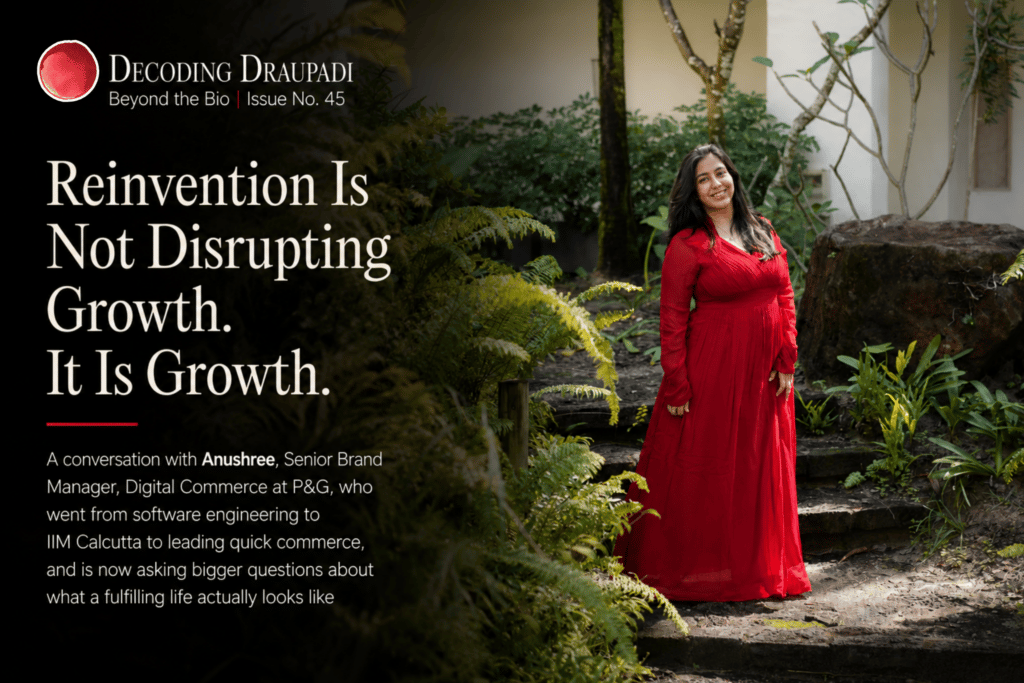
A conversation with Anushree, Senior Brand Manager, Digital Commerce at P&G, who went from software engineering to IIM Calcutta to leading quick commerce, and is now asking bigger questions about what a fulfilling life actually looks like
Anushree has spent seven years at P&G, but her story does not begin there. It begins in telecom systems and IVR software, moves through an MBA at IIM Calcutta that she had no business pursuing on paper, and arrives at a role managing digital commerce and quick commerce for one of the oldest consumer goods companies in the world.
What makes this conversation different is what sits underneath all of that. She became a mother. And that, more than any pivot or promotion, is what cracked open her understanding of ambition, identity, and what she actually wants her life to be.
Evolving Leader
Who is Anushree right now, across the different lives you are living?
Right now, Anushree feels to be at an inflection point, personally and professionally. Rather, a work in progress or an evolving leader.
Professionally, she is a marketer who loves solving complex business problems. Building brands, driving growth, and creating impact still energise her deeply. At the same time, after becoming a mother, success has started to mean something broader than career progression alone. Success to her now means doing what you are passionate about and truly knowing your passion.
At home, she is learning a completely new version of herself. Motherhood has stretched her in ways no job ever has. It has made her more patient, more vulnerable, and more aware of how little control we actually have over life despite all our plans.
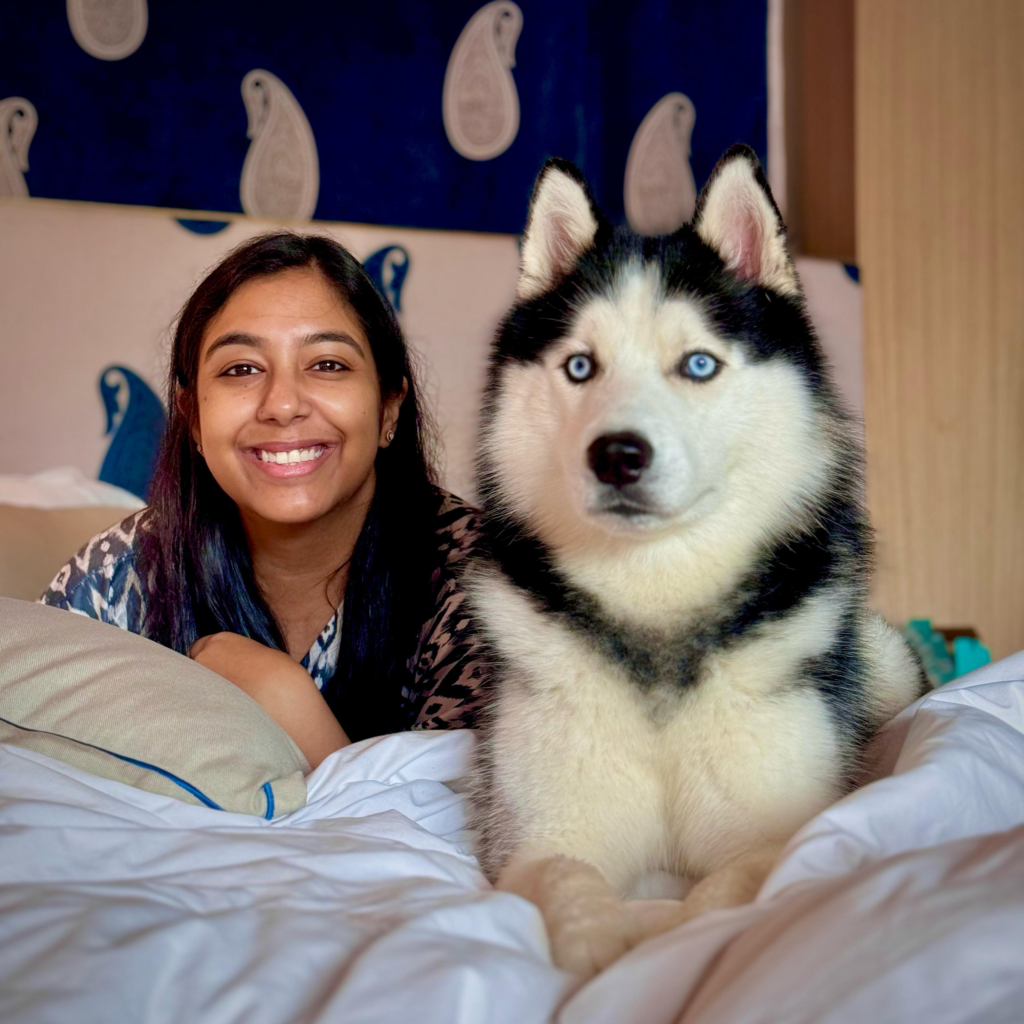
In her relationships, she values depth. Whether it is her husband, family, close friends, or her dog Phoenix, she has come to appreciate that the people who truly know us often see versions of us that we do not always recognise ourselves.
And in her private thoughts, she is in a season of reflection. Asking bigger questions about ambition, identity, and what a fulfilling life looks like. Not because she has lost direction, but because she is becoming more intentional about where she wants to go next.
“She is someone learning to hold multiple truths at once: ambitious but present, confident yet questioning, responsible for many people yet still discovering herself.”
That phrase, work in progress, gets used casually. Anushree means it structurally. She is not describing a rough patch. She is describing a deliberate recalibration, one where the old metrics no longer fully apply and the new ones are still being written.

Data Tells You Everything. Understanding People Takes More.
What has moving from software engineering into consumer brands taught you about the difference between building systems that function well and building things people emotionally connect with?
Fundamentally, both functional and connection-oriented professions have one common theme: solving real consumer problems.
As a software engineer, the role was about driving technical solutions measured on performance, efficiency, and stability. The intent was to build a service, IVR-oriented, telecom support and religious services, irrespective of who was consuming it, but with precision.
As she entered FMCG, the core of serving the consumer became stronger. Building brands that solve for both emotional and functional triggers. The what and the how kept changing, but the why always revolved around the consumer. In her current role managing quick commerce, the how is centred around short-circuiting the consumer path to purchase. But she is still solving for consumer need on the platform.
What all these transitions taught her is that while data empirically tells you everything, understanding people takes curiosity and intent. The most impactful work has been centred on data but with a huge role for deeply understanding consumer intent. Analytical rigour with human empathy, held together.
“Data empirically tells you everything. Understanding people takes curiosity and intent.”
This is the thing most people in data-heavy roles take years to articulate clearly. The numbers describe behaviour. They do not explain motivation. The gap between those two things is where the real work happens, and Anushree learned that by crossing industries, not just functions.
Loyalty Is a Byproduct, Not a Destination
There is a widely held belief in your industry about what drives consumer loyalty that you quietly disagree with.
The one she quietly disagrees with: that loyalty can be built easily.
Having worked with some of the oldest brands in the world, she has seen it play out clearly. It is not loyalty programs, cards, credits, or clubs that build loyalty. It is the 360-degree consumer experience that makes a brand memorable. It is the unique imagery a brand creates in a consumer’s mind that stays with them.
Loyalty is less a destination and more a byproduct. Brands earn it repeatedly through relevance rather than claiming it through messaging. The brands that endure are often the ones that keep solving evolving consumer needs instead of assuming past affection guarantees future preference.
To enable this, every brand should keep asking one question: am I solving the consumer need, or am I just trying to build brand loyalty?
“Brands earn loyalty repeatedly through relevance rather than claiming it through messaging.”
There is a whole industry of loyalty mechanics built on the assumption that if you make switching inconvenient enough, you have earned loyalty. Anushree is pointing at something more uncomfortable: real loyalty cannot be engineered. It has to be deserved, every time.
The Work That Has No Name on a Job Description
What is the most important thing you do at work that most people around you probably don’t notice?
Aligning people around the same business objective. It is the most important task and the least valued most of the time, she says with a laugh, because it comes with the job.
Every function, every role, every person has their own professional and personal agenda when it comes to any activity system or task. Running alignment, especially in cross-functional teams with a high sense of ownership across, takes the most time. While execution is twenty percent of it, aligning is eighty percent of it.
It is both good and bad. Good, because it can lead you to build different, stronger perspectives and arrive at a better solution. Bad, because it is time-consuming, complex, and carries a real risk of conflict.
As you go up the ladder in any organisation, your core job as a leader is to reduce this complexity by having a shared lens built in already. It is something you build over time and experience. Rarely is a person simply gifted with it.
“Core Job of a leader is to reduce complexity by having a shared lens built in already”
Most job descriptions measure outputs. They do not measure the invisible work of getting twenty people with twenty different agendas to move in the same direction before any output is possible. Anushree is describing the actual job of leadership, the one that does not show up in any KPI.
Rank Two, Then a Pivot Nobody Understood
There is usually one decision in your career that looked wrong from the outside and turned out to be exactly right.
She had a strong trajectory in her undergraduate years, finishing rank two across four years. It was a given she would excel in technical fields. She did spend two years as a software engineer.
But her move to marketing looked, on paper, like the opposite of smart. It meant leaving behind six years of hard work and pivoting to something completely different, with no experience and no guarantee of fit. And when she cracked IIM Calcutta, she arrived there with a very different pedigree from her IIT and NIT peers.
What the decision taught her she can summarise in three things. Resilience with bounce-back ability: the first year of her MBA was one of the toughest phases of her life, as was the first six months at P&G. Confidence: everything can be built from scratch, and self-faith matters more than a clear path. And the understanding that there is no self-worth without hard work, no shortcut to growth.
In hindsight, reinvention is not disrupting growth. It is necessary for growth.
“Reinvention is not disrupting growth. It is necessary for growth.”
There is a particular kind of courage in pivoting when you are already good at something. It would have been easier, and safer, to stay in the lane where she was already winning. The fact that she left it anyway, and rebuilt from scratch twice over, is the thing worth sitting with.

Refining what ambition means
What is one thing you have had to actively unlearn about how ambitious women are supposed to behave?
She had to actively unlearn the definition of what an ambitious and successful woman looks like.
The conditioning ran deep: being successful meant being focused on corporate excellence, less family time, always being flexible for work, being the torchbearer, and most importantly, being self-capable for everything. Not asking for help, not expecting any, was the true sign of thought leadership.
Motherhood changed that. It made her realise: it is okay to ask for help. Okay to prioritise family over work. Okay to set boundaries. Okay to trust others.
None of that means being less capable. It means having the maturity to know what truly matters and being more intentional in everything you do. It also means building the right support system so you can excel in the areas where it counts.
Today, she admires a different kind of strength. Not the ability to do everything yourself, but the ability to pursue purpose driven ambition without feeling compelled to prove your worth through constant self-sacrifice.
“Not the ability to do everything yourself, but the ability to pursue purpose-driven ambition without feeling compelled to prove your worth through constant self-sacrifice.”
The version of ambition she was handed is one most high-achieving women recognise without being told. Invisible, exhausting, and quietly punishing. What Anushree describes is not a lowering of ambition. It is a more honest accounting of what ambition actually costs, and what it can actually be.
Not a Trade-Off. Both.
Five years from now, you are having a real conversation with someone you respect. What do you hope you are able to say about this period of your life?
She would want to say that the five years were not a trade-off between being a good mother and being a good professional. That she approached the entire period with courage and maturity, not fear.
She would talk about motherhood, its highs and lows, how it re-moulded her again as a person, personally and professionally. And she would want to say she is a more balanced person, one who is no longer chasing the goal of title and designation but OUTCOMES. What motivates me most now is solving meaningful problems and creating lasting impact but solving for something she truly cares about, feels something for, values.
She would want to say she is building or working on something she is genuinely passionate about, and that she is more fulfilled, more content, and happier than she has ever been.
“I am no longer chasing the goal of a particular title or designation, but outcomes associated with them, which I truly care about“
That last image is specific: a real conversation with someone she respects, not a performance review. She is not describing professional success in the conventional sense. She is describing a life that feels true. That is a harder thing to build than a career. And she is doing both.

A Note From Decoding Draupadi
What stayed with us is the dog’s name. Phoenix. We do not think that is accidental, even if Anushree did not mean it as metaphor. Someone who has rebuilt herself twice, who pivoted from engineering to marketing to motherhood to a new definition of success entirely, and named her dog Phoenix. Make of that what you will.
What this conversation really holds is a quietly radical idea: that the women we should be looking up to are not the ones who have figured it all out. They are the ones who are honest enough to say they are still figuring it out, and intentional enough to do that figuring with their eyes open.
If this felt like someone you know, share it with her.
Not chasing titles. Not chasing designations. Solving for outcomes she cares about.
That is the whole interview in one line. Read it at @decodingdraupadi.
Anushree is Senior Brand Manager, Digital Commerce at P&G. This interview was conducted as part of the Decoding Draupadi Brand Manager Series.