 DECODING DRAUPADI

Neha Phale, a marketing, branding and corporate communications leader, on two decades of corporate communications in industrial companies, the Ikigai exercise she ran on herself with help from the people around her, and what real estate still won’t show women.
We usually know the names and titles of the women we call trailblazers. We rarely know what their evenings look like, or what they changed their minds about. After about 60 of these conversations, that gap is still what I’m most curious about.
Neha Phale has spent close to 20 years in corporate communications, almost all of it on the client side in chemicals, packaging and industrial companies, at BASF, Dow, Huntsman, Huhtamaki and VVF among others. Two months ago she joined Inspira Global, a fast-growing Indian group with businesses in real estate, food, trade and luxury home products, to lead its marketing, branding and corporate communications.
Outside that job she runs two practices of her own. Right Brain Tonic, which she started with her mother in 2020 as a content writing agency, now runs creative workshops for companies, adults, children and social gatherings. Auraya, launched this year, is for self-awareness and clarity coaching and healing. She is also president of the WICCI Maharashtra Happiness Council, trained as a DJ at DJ Suketu‘s institute, and has a book, In between Passion Purpose and Peace, coming early next year.
This conversation is part of Beyond the Bio, the Decoding Draupadi series in which I talk to women about their work, their lives and the people they build for.
On building a brand for the parent
I asked what the first two months of the new role have looked like, from eight in the morning to eight at night.
Inspira is an Indian conglomerate whose founders are under 40, a change of pace after her years at multinationals. What drew her was the chance to build something at the group level from scratch. The businesses already have their own names and customers. What the group lacks is a story that ties them together.
“The children are there, but they are now finding the parent.”
So the first two months have gone into research and a framework. She has been looking at the group as a consumer would, as an employee would, and as someone deciding whether to invest in it or partner with it. She enjoys that it goes beyond execution. She started her career when there were few tools, and everything was done by hand and by thinking, so she knows how to start from a blank page.
She also admits the adjustment is real. She is used to structured companies, and in her personal life she runs on lists and plans. What steadies her in a fast-growing business is a clear vision from the founders. Experts are often hired with one idea in mind, she said, and the first job is to close the gap between what was imagined and what you actually bring.
Most of the brand managers in this series look after one product. Neha’s job is the layer above, a family of brands that grew up before the family name did. It’s the kind of brief people outside communications rarely see, and the research she described, looking at the group as a customer, an employee and an investor in turn, is a good way into it.
On being taken seriously
I asked what it was like to spend two decades in chemicals, packaging and industrial companies, rooms I’d assume were full of men.
The industries were, she said, but her function wasn’t. Corporate communications has long had more women than men, and for her first ten years her bosses were mostly women. The harder part was how the function was seen. People assumed communications women were all about events, spending and looking well-dressed. Some went further and wondered how a woman boss had got there, especially one who was single, divorced or without children, as if it couldn’t have been on merit.
Her answer was to let the work speak, and to carry herself seriously even when she was young and only a couple of years in. Much of it, she said, comes down to knowing your professional and personal boundaries, and building work relationships with care. As her career grew, her roles became more global, and she found that perceptions of the function travelled differently across those teams.
“There should be some side of you that tells the other person, this person is serious, professional.”
On the “girlie” label
I asked what she makes of the trend of calling social media, PR, advertising and marketing the “SPAM” jobs, and the cute way women in them now describe their work.
She puts it down to virality. These professions used to be invisible to outsiders, and now everything happens in public, so they look easy and glamorous. A lot of it, she thinks, is personal branding, with mid-level professionals applying for dozens of awards, sometimes paying for them, to be seen. In her experience the awards people remember are the ones earned on the strength of the work, while the bought kind is forgotten within five years.
Tasneem Lokhandwala, earlier in this series, saw another side of the same trend. She happily called herself a “social media girlie” until she noticed the work being renamed growth once more men moved into it. Neha has watched the function from twenty years further along, and the two of them land in the same place. The label gets far more attention than the work behind it, and both of them would rather be known for the work.
On finding the thread
She leads communications, coaches, practises art therapy and runs a happiness council. I asked what connects them, and how it all happened.
Creativity came first. As a child she danced and painted and wanted to be an architect, then studied mass communication instead. She has kept learning all her life, taking courses even as she moved up, and for a while she taught media students. Knowledge, she says, is the one thing nobody can take from you, and it only grows when you give it away.
The turn came about three years ago, when she lost her father suddenly. Life looked very different after that. She didn’t want to keep sulking, or pass that heaviness on to the people around her, so she started working on herself: self-help books, sessions with professionals, courses in meditation and healing, and a lot of reading about Ikigai.
Then she ran an Ikigai exercise on herself. It took six months. She sent questions to friends, family, colleagues, vendors and partners, and between 60 and 80 of them replied. Three answers kept coming back. Creativity was her biggest strength, people found her easy to approach, and she loved travel and hearing what people were going through. She put those together into her two practices, Right Brain Tonic for creative workshops and Auraya for coaching and healing, which she runs alongside her job.
“People think of hobbies as the last thing. I feel hobbies are your first point of healing.”
Her own list is long: art, dance, singing, DJing, travel, adventure, philanthropy, sports, meditation and fashion. Her love of music is why she trained as a DJ.
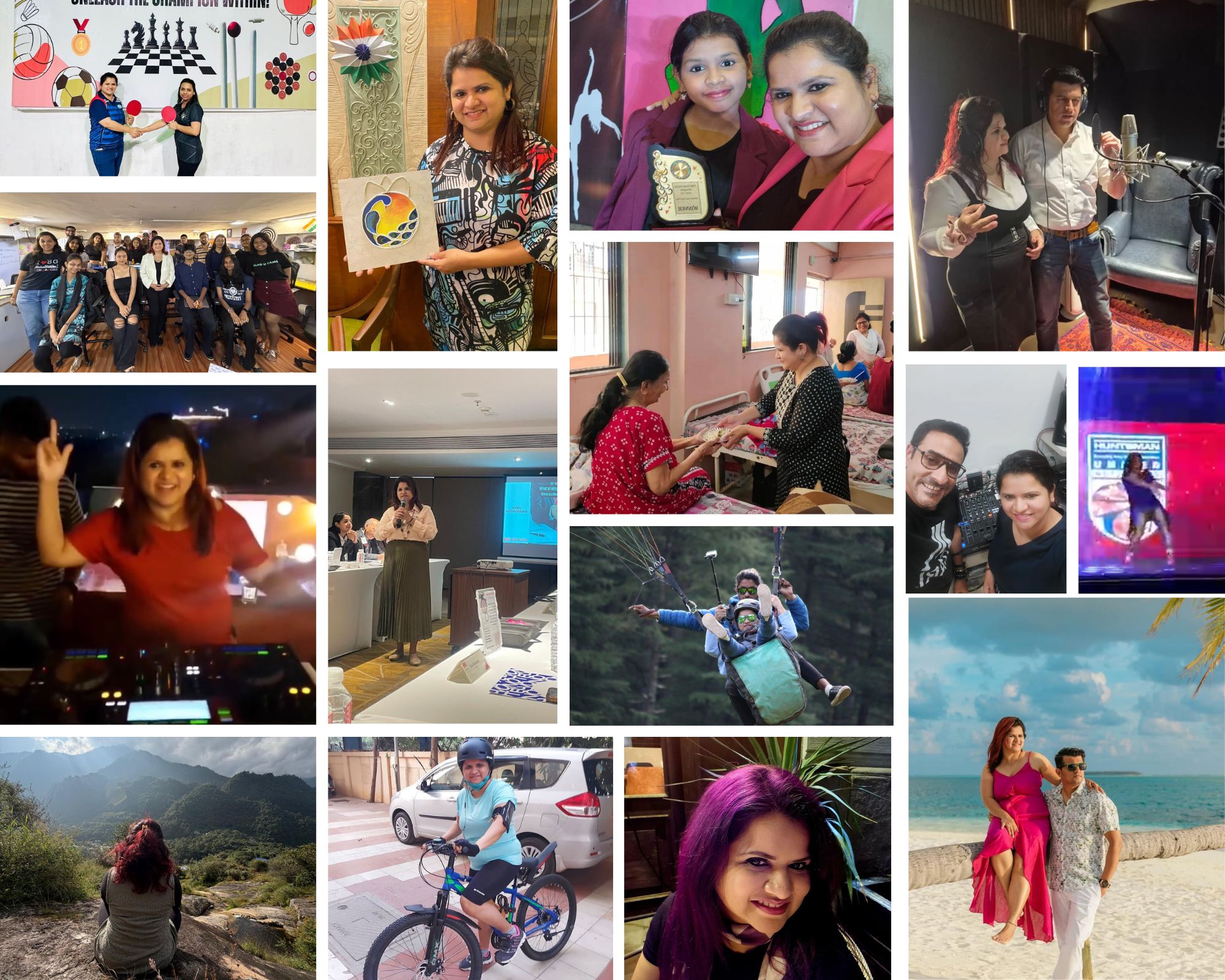
As a brand person, I recognise what she did. She ran a brand audit on herself, with 60 to 80 respondents, and took the findings seriously enough to build a second career on them. Most of us never ask the people around us what we are good at. Neha asked, and then listened.
On two hours a day
A senior corporate job, a practice of her own, a family. I asked whether she ever worried she had taken on too much.
Everyone has the same 24 hours, she said. Corporate jobs no longer expect you to be at your desk late, and she uses the time that frees up. Every day she gives two hours to her own work. Some of it is thinking time on the commute, and the rest is at home, while her daughter plays and before her husband gets back at around eight. After eight it is family only, until about 11.30. Her mother-in-law lives with them, and she moved her own mother into the same building. Saturdays belong to friends.
The structure behind it comes from a 21-day course she did with Dr Aditi Govitrikar, the psychologist and first Indian Mrs World. It splits life into eight areas: health, wealth, social life, personal life, your physical environment, fun and recreation, career and business, and spirituality. Neha sets goals in each one every month and checks them at the end. When she looked at her own wheel, spirituality was the weakest. For her it has nothing to do with religion. It is about awareness and reflection, and it led her to meditation coaching.
She wants to be a full-time entrepreneur in about five years. Until then she is fine with small steps.
“Success is not going to come overnight. I’ve got a few good wins, good work that I’ve done and good people I’ve met, which are like the investment that will return later.”
On building a social life
Many women tell me they want the kind of social life Neha has, with friends over every weekend. I asked how she built hers.
With effort, and over a long time. She still has her school and college friends, and she has stayed close to their families too, from their parents to their siblings. She and her husband were college sweethearts and dated for eleven years before marrying, so they share most of their friends, and they are both social. Each weekend belongs to one group, so every group gets one evening a month. They are passing it on to their 11-year-old daughter, who is just as social.
Then there are the rituals. Every year there is a monsoon trip with one set of friends, and New Year’s Eve with another; they have never missed one. Friends who live abroad get a day or two whenever they’re home for Diwali or December. In between there are 90s nights, Bollywood nights, card evenings and paddle afternoons followed by a long meal, with doctors, engineers and businesspeople around the same table, and ages from 20 to 60.
“Many of our friends have few friends. But we are those few for them.”
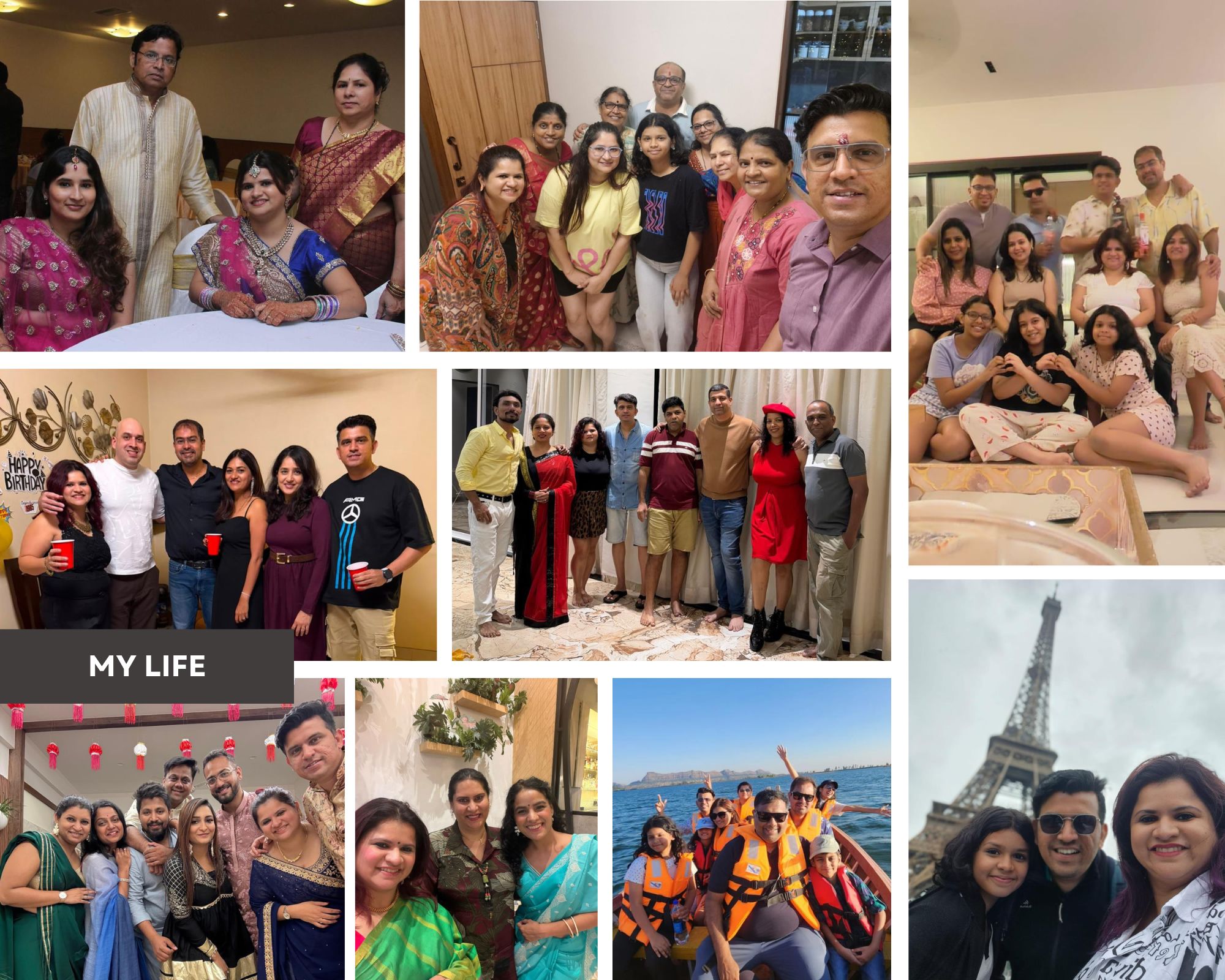
I hear the same wish in our community all the time: women in their late twenties and thirties who want friendships that go beyond cafés and clubs. Neha’s answer is rituals. Once a friendship has a fixed date on the calendar, people turn up, because missing it would feel like missing something.
On women and property
I asked what real estate still doesn’t understand about women buying homes and land.
Neha grew up with one sister and no brother, and she started with how marriages are arranged. Families look at community, income and lifestyle, and almost always at one more thing: the boy must have his own house. For generations, a woman’s security was the man’s house. So women spent on themselves and left property to husbands.
Her generation moved to co-owning. The house in both names, the EMI split down the middle, so the burden and the pride were shared. Now she sees another shift. More women are choosing to stay single, or to delay marriage to look after a parent. Many are only children who know their parents’ home will come to them. Some rent and move for work, and others buy land to farm, to rent out or simply to have. For them property is about owning something for themselves.
The ads haven’t caught up. They still show families. She has never seen one with a single professional woman buying her own space, or a retired woman buying a home for herself with money she saved.
“It’s been a transition: from depending, to co-owning, to being self-sufficient.”
A friend once told me, when we were 18, that her biggest goal in life was to buy land. I had never heard a woman my age say that, and I still rarely do. Women seldom talk about buying property, in conversation or even to themselves, so it felt refreshing, and I wish it were commonplace. It may be more common than the ads suggest. In our Decoding Her 2026 report, about one in five home registrations across nine Indian cities was by a woman buying alone. Neha’s point is that real estate marketing still hasn’t shown her that buyer.
On what women don’t say
She has done internal communications, mentored women employees and sat on a POSH committee. I asked what women hold back.
Three things, she said. The first is confidence, at one of two extremes: so low that a woman doesn’t speak up, or so high that she won’t admit anything is wrong, though her behaviour shows it. The second is trust, which has to be built from both sides. The third is exposure. Someone who grew up in a small, close circle can find a workplace full of different communities and cultures hard to read, and may not realise that is what’s troubling her.
Most of the time, she said, these things don’t even register with the person. Mentoring starts by giving her somewhere comfortable enough to say them out loud.
“It’s a process to get it out of people, and the first step is to give them that comfort.”
On a year she’d save
I asked what she knows now that would have saved her a year.
Deciding with her head as well as her heart. The two have to agree, she said. When she decided with her heart alone, she sometimes walked away from one problem straight into another she hadn’t seen coming.
“You just wanted to escape from something, and you got into something.”
What stays with me
Neha’s book, In between Passion Purpose and Peace, is about how each of the three arrives at a different age. Listening to her, I could see all three in how she lives. Passion is the art, travel and music, and the friends she makes time for. Peace is the eight areas she checks every month. Purpose came from a hard year, and from asking the people around her what she was good at.
The other thing I keep is her two hours. A senior job, a family under one roof and a practice of her own fit because she decided where each hour goes, and then kept to it.
If this felt like someone you know, share it with her.
More from Beyond the Bio: Tasneem Lokhandwala on writing her audience like a cast of characters, and Labdhi Kothari on checking her growth against what she was doing six months ago.
Neha Phale is a Marketing, Branding & Corporate Communications Leader, currently at Inspira Global. She has worked in corporate communications for close to 20 years, runs Right Brain Tonic and Auraya, and lives in Navi Mumbai.
Anshika Kushwaha is the founder of Decoding Draupadi, a media and community platform for urban working women in India. This interview is part of the Decoding Draupadi series Beyond the Bio.
More conversations like this one at @decodingdraupadi on Instagram.


Comments
Loading comments…